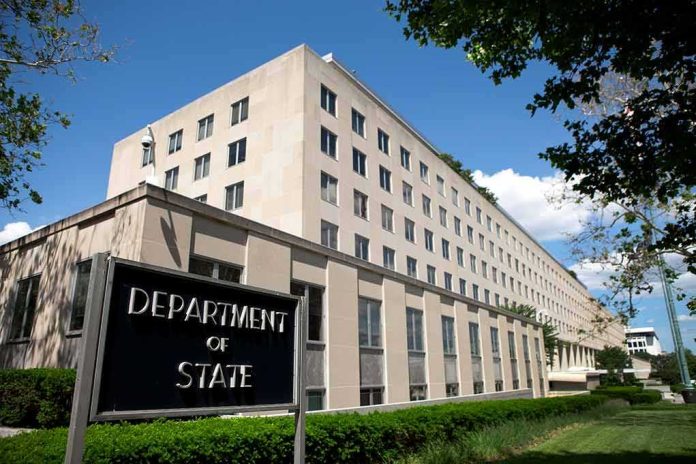
President Trump’s second-term visa crackdown has now reached a scale that raises a basic question about transparency: who got swept up, and why? The State Department says it has revoked more than 175,000 visas since January 2025, but it has released only broad categories, not a case-by-case ledger.
Quick Take
- The State Department says the revocations covered people who broke visa rules, committed crimes, or threatened national security.
- Officials said most cases were tied to law-enforcement encounters and criminal activity, led by assault, driving under the influence, theft, and drug crimes.
- Public reporting shows the total also includes student and speech-adjacent cases, not only classic crime cases.
- The main dispute is not the headline number. It is the lack of public, case-level records showing how each revocation was justified.
What the State Department Says
The State Department says the revocations targeted foreign nationals who “violated the terms of their visas, committed crimes, called for violence against U.S. citizens, defrauded Americans, abused our immigration system, or endangered national security.” Reuters reported that officials said most revocations followed law-enforcement encounters, with assault, driving under the influence, theft, and drug crimes listed as leading causes.
That explanation fits a larger enforcement push that has defined the administration’s immigration agenda since Trump returned to office. The Congressional Research Service has noted that the Trump administration revoked over 100,000 visas in its first year and later paused immigrant visa processing for 75 countries, showing a wider pattern of aggressive screening and revocation authority.
What the Public Record Shows
Available reporting supports the scale of the action, but not a full public accounting of each case. Reuters, TIME, and other outlets describe aggregate totals and broad reasons, yet none publish an individual revocation list or a full legal breakdown for the 175,000-plus figure. That matters because the department’s public language groups together arrests, database hits, and other law-enforcement encounters.
The difference is important. A law-enforcement encounter is broader than a conviction, and some of the reporting does not say whether each revocation followed a charge, a plea, or only an arrest or database alert. That leaves room for a real public debate over process, even when many cases may involve serious misconduct. The strongest evidence supports the department’s claim that criminal activity played a major role.
Why the Debate Is Bigger Than Crime
The story has also expanded beyond ordinary criminal cases. BBC reporting said more than 6,000 student visas were canceled for law-breaking and overstays, while other reports noted broader screening tied to terrorism definitions and social-media conduct. TIME also reported revocations tied to people who celebrated the killing of Charlie Kirk, which shows how the administration has mixed crime, security, and expressive conduct in the same enforcement campaign.
𝐓𝐎𝐌 𝐇𝐎𝐌𝐀𝐍: 𝟏𝟕𝟓,𝟎𝟎𝟎 𝐕𝐈𝐒𝐀 𝐑𝐄𝐕𝐎𝐂𝐀𝐓𝐈𝐎𝐍𝐒 𝐀𝐑𝐄 𝐉𝐔𝐒𝐓 𝐓𝐇𝐄 𝐁𝐄𝐆𝐈𝐍𝐍𝐈𝐍𝐆 𝐎𝐅 𝐀 𝐅𝐔𝐋𝐋 𝐑𝐄𝐕𝐈𝐄𝐖
Secretary of State Marco Rubio's State Department has already revoked a record 𝟏𝟕𝟓,𝟎𝟎𝟎 𝐯𝐢𝐬𝐚𝐬 for criminal activity since President… pic.twitter.com/TlNhmJrlPI
— M.A. Rothman (@MichaelARothman) August 12, 2026
That mix helps explain why critics on both the left and right are pressing for more detail. Supporters see a government finally using visa power to protect Americans. Critics see a system with too little disclosure and too much room for broad discretion. The public facts now show both realities at once: a massive enforcement push, and a thin paper trail for outsiders trying to judge each decision.
Sources:
thegatewaypundit.com, aljazeera.com, nytimes.com, cnn.com, time.com, bbc.com, insidehighered.com, news.bloomberglaw.com