
Federal agents are tracking a nationwide wave of suspicious “white powder” letters that reached Congress and election offices only weeks before midterm voting.
Story Snapshot
- Federal Bureau of Investigation (FBI), U.S. Postal Inspection Service, and U.S. Capitol Police are leading a coordinated probe.
- Packages triggered evacuations at some election offices; congressional mail rooms isolated suspect letters.
- Reports link mailings to senators including Ted Cruz and Susan Collins; one Collins-bound letter was intercepted.
- Law enforcement is reviewing more than 100 letters in the mail stream, according to officials cited by ABC News.
Coordinated Federal Investigation Into Suspicious Mail
Senate security officials told staff that the FBI, the U.S. Postal Inspection Service, and the U.S. Capitol Police are investigating a series of suspicious mailings sent to congressional and election offices nationwide. The FBI said the letters contained an “unknown substance.” The Senate warning called the items potentially hazardous. The scope spans multiple states and targets. That scale moved the response from isolated handling to a coordinated, national investigation with shared information and lab testing.
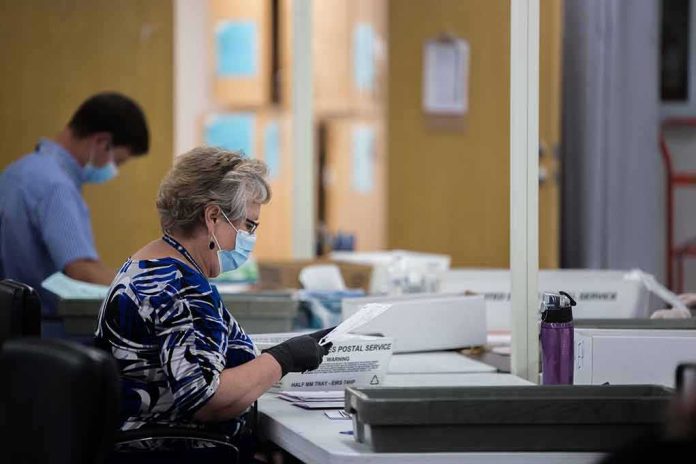
Election sites in Louisiana and Oklahoma evacuated after receiving powder-containing packages, according to the Associated Press. Staff at Senator Richard Blumenthal’s office in Hartford flagged a suspicious letter during screening and isolated it before police arrived. These are standard steps to protect workers and the public. Trained teams secure the scene, collect samples, and send them for testing. That process can take time, which is why alerts and safety rules remain in place.
Targets Include High-Profile Senators And Election Offices
Published reports said letters reached or were aimed at multiple lawmakers across parties, including Republican Senators Ted Cruz and Susan Collins. U.S. Capitol Police intercepted a letter addressed to Collins’s Washington office before delivery, showing that screening can stop an item upstream. News accounts also tied the pattern to secretary of state and election offices in several states, broadening the target set beyond Capitol Hill and raising election security concerns near voting.
Law-enforcement sources cited by ABC News estimated that more than 100 letters with apparent white powder moved through the mail system, underscoring the wide footprint investigators are mapping. Counts in media stories vary because agencies are still sorting what to include. Some offices report “suspicious substances,” while others report visible powder. Officials have not publicly identified a suspect, sender network, or common motive at this stage of the probe.
What Officials Know And What Safety History Teaches
Authorities have described the material as unknown. Some letters tested negative for dangerous substances, according to reporting, but testing continues across many sites. One brief caveat matters here: investigators have not said the powder is toxic. Still, police and federal agents treat these events seriously because missing a real hazard would have severe costs. That stance reflects training shaped by the 2001 anthrax attacks that killed five people and sickened others.
🚨 SUSPICIOUS LETTERS TARGET ELECTION OFFICES NATIONWIDE
The FBI and U.S. Postal Inspection Service are investigating suspicious mailings sent to election offices and other recipients just weeks before the November 3 midterms.
✉️ MORE THAN 100 REPORTED
Votebeat reports that… https://t.co/Oxj2OAMGOe pic.twitter.com/UuMY9FOPhg— Gunnys Adventures (@DerrickSalas9) October 15, 2026
Past patterns also help explain today’s response. After 2001, the FBI logged thousands of white-powder reports in a single year and opened hundreds of full cases. Most later incidents turned out to be hoaxes or nonhazardous substances, but every new letter triggers the same playbook: isolate, test, and notify. That history shows why a large cluster can be real as an investigative pattern without proving the material is dangerous. It also shows why agencies move fast even when lab work is pending.
Why This Matters To Readers Across The Aisle
Mail threats hit a nerve because they target public offices that handle the rules of our democracy. Election workers and congressional staff are not household names. They keep the system running. Disrupting their work weeks before voting can waste time, drain budgets, and sow fear. Voters on the right and left worry that elites in Washington play by different rules. Swift, transparent, and steady updates can help rebuild trust while investigators do the quiet, careful work.
What To Watch Next
Watch for lab results that identify the powder type and any shared traits across letters. Look for whether the FBI or postal inspectors link items to a single sender through handwriting, postage data, paper, or prints. Track whether counts stabilize as agencies reconcile local reports with federal case files. Finally, expect continued screening and possible brief evacuations as a precaution. These steps seek to protect people first while preserving evidence for a potential prosecution.
Sources:
nypost.com, wtnh.com, cnn.com, politico.com, apnews.com, 9news.com, edition.cnn.com, npr.org