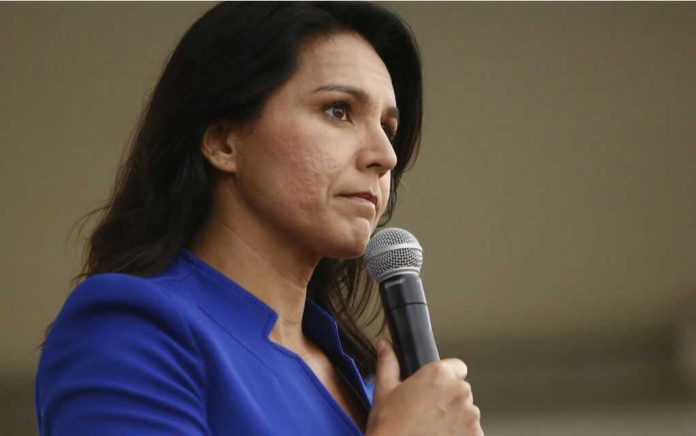
Tulsi Gabbard’s journey from Hawaii lawmaker to President Trump’s Director of National Intelligence shows how a party defector can end up steering America’s spy system.
Story Snapshot
- Gabbard left the Democratic Party in 2022 with a blunt, anti-establishment message.
- She served four terms in Congress and ran for president in 2020.
- In 2025, she took the oath as Director of National Intelligence under Trump.
- Her record mixes military service, national stage visibility, and sharp critiques of party elites.
From Hawaii Politics to the National Stage
Tulsi Gabbard won a United States House seat from Hawaii in 2012 and served four terms through 2021, building a national profile on veterans’ issues and foreign policy. Coverage during and after her tenure often labeled her a former congresswoman and 2020 presidential hopeful, reflecting her broader visibility beyond Hawaii. That mix of military service and committee work positioned her as a recognizable voice on wars, civil liberties, and the limits of intervention abroad. The path set the stage for later breaks with party leadership.
Her 2020 presidential run further increased her name recognition and debate exposure, even as she challenged the party’s direction and media treatment. National reporting at the time presented her as a distinct figure within Democratic circles, combining anti-war themes with criticism of insider politics. That profile helped her connect with voters who distrust Washington staff culture and national security hawks. It also made future realignment possible by keeping her brand focused on independence rather than party hierarchy.
The Break With Democrats and Anti-Elite Rhetoric
In October 2022, Gabbard announced she was leaving the Democratic Party, calling it an “elitist cabal of warmongers” and blasting what she saw as a culture of “cowardly wokeness”. The statement captured anger that crosses party lines: frustration with endless wars, politicized institutions, and leaders who seem more focused on power than people. Her words resonated with many who think the system serves a protected class first. The sharp tone also locked in her identity as an outsider to both party machines.
Major outlets covered the exit as a milestone in her evolution from insider to critic. The moment mattered because it turned a brewing tension into a public split. Some on the right welcomed her warnings about groupthink and bureaucratic drift. Some on the left viewed the move as a final break from core party values. For voters tired of rising costs, foreign entanglements, and culture wars, the move symbolized a wider revolt against a political class that feels unaccountable.
Confirmation as Director of National Intelligence
In 2025, Gabbard took the oath as the eighth Senate-confirmed Director of National Intelligence, becoming the first female combat veteran in the role. The Office of the Director of National Intelligence highlighted her military and congressional experience as key credentials for leading the intelligence community. In remarks, she stressed the need for accurate, unbiased, and timely assessments for the President, Congress, and the military—an appeal to competence over ideology. The appointment marked a pinnacle for a onetime party dissenter.
The rise from defector to intelligence chief fits a broader American realignment, where visibility and cross-coalition appeal can outweigh strict party loyalty. Her path shows how an anti-establishment brand can translate into senior office when governing coalitions shift. It also underscores a shared, uneasy truth: many Americans on the left and right believe federal institutions drift from core duties. Gabbard’s charge now is to deliver trustworthy intelligence in a town where trust is in short supply.
Sources:
youtube.com, odni.gov, archive.dni.gov, goodmorningamerica.com