

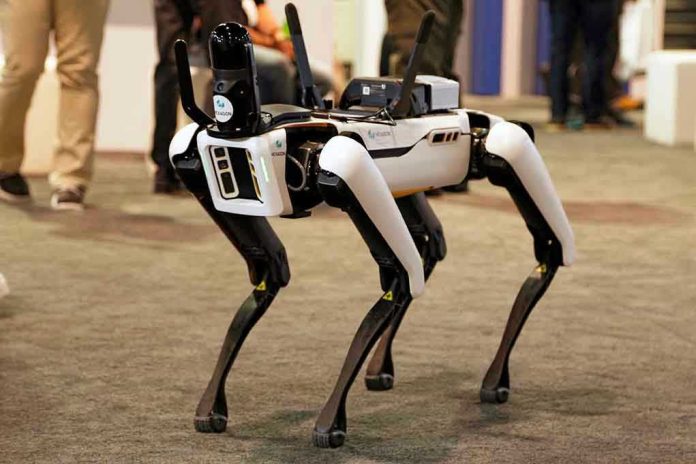
Armed quadruped robots and joint Haitian–Salvadoran forces retook Haiti’s national stadium, where leaders say troops later found human skulls inside.
Story Snapshot
- Haitian and Salvadoran forces seized Port-au-Prince’s Sylvio Cator Stadium on November 12.
- Video showed rifle-mounted robot dogs moving through the stadium complex.
- El Salvador’s president said several human skulls were found during the sweep.
- Reports do not state whether the robots fired shots or how they were controlled.
Joint Operation Reclaims Haiti’s National Stadium
On November 12, Haitian National Police and Haitian Armed Forces moved with Salvadoran Special Forces to retake Sylvio Cator Stadium in downtown Port-au-Prince. The stadium is Haiti’s national soccer venue and had been under gang control, according to multiple reports that credited a bilateral Haitian–Salvadoran arrangement for the action. El Salvador’s leader publicly tied the stadium seizure to that partnership and highlighted the units involved, describing a planned, coordinated push to secure the site.
Published accounts date the operation to November 12 and say the facility was secured that day, marking a visible win in efforts to claw back key urban ground. Outlets that focus on security and defense coverage reported the stadium had been in gang hands for more than two years, making the retaking symbolically important as well as practical for future public use. The operation followed pledges by El Salvador to send more than two thousand troops to support missions in Haiti.
Rifle-Mounted Robot Dogs Featured in Stadium Sweep
Video released during the operation showed four-legged robots moving down corridors and up stairs inside the stadium, each with a rifle mounted to its frame. Reporting described the weapons as bracketed beneath the chassis, with rods appearing to reach the triggers, though specific models were not officially confirmed. Coverage noted the footage did not explain how the robots were controlled, whether the rifles were functional, or whether any shots were fired during the sweep.
Analysts who reviewed the imagery said the platforms resembled a popular commercial quadruped and the rifles looked like a specific assault rifle family, but those identifications relied on appearance rather than procurement records. Reports emphasized that the clip showcased movement and presence more than tactical use. Outlets stated it remained unclear how the robots assisted the operation beyond reconnaissance or intimidation effects at the site.
Claimed Discovery of Human Skulls Inside the Stadium
El Salvador’s president stated that several human skulls were found inside the stadium as forces cleared the complex. One outlet reported that his video included a shot of an object described as a skull lying near a wall among leaves and dirt. Other coverage repeated the skull claim and tied it to the same day’s stadium action, presenting it as part of the broader cleanup after control shifted back to Haitian authorities and their partners.
The reports that relayed the skull account did not cite a forensic examination or official laboratory confirmation of human remains, and they did not name an investigating authority responsible for custody or testing. Outlets framed the skull detail as a leader’s statement supported by a short visual, rather than a completed forensic case file. The stadium find, if confirmed by authorities, would underscore the brutality of gang rule and the stakes of the recovery effort.
Why This Moment Matters Beyond One Stadium
The stadium action fits a wider shift in Haiti’s security strategy toward multinational help and technology-enabled counter-gang operations. International frameworks have supported outside assistance to Haitian forces while requiring respect for human rights law as operations expand to retake territory and protect infrastructure. Earlier missions struggled with capacity, and later pushes added armored vehicles, surveillance tools, and explosive drones, setting the stage for the high-visibility stadium sweep and its unusual use of quadruped robots.
What We Know, What We Do Not
Reports clearly establish that Haitian and Salvadoran units retook Sylvio Cator Stadium on November 12 and that video showed rifle-mounted robot dogs moving inside the venue. Accounts also attribute to El Salvador’s president the claim that several skulls were found and note a single skull-like object in the footage. Media reviews say the role, control method, and any firing by the robots were not disclosed, and weapon and robot models were identified by appearance rather than official records.
Sources:
bbc.com, whmi.com, aljazeera.com, haitilibre.org, en.wikipedia.org, ecoi.net