

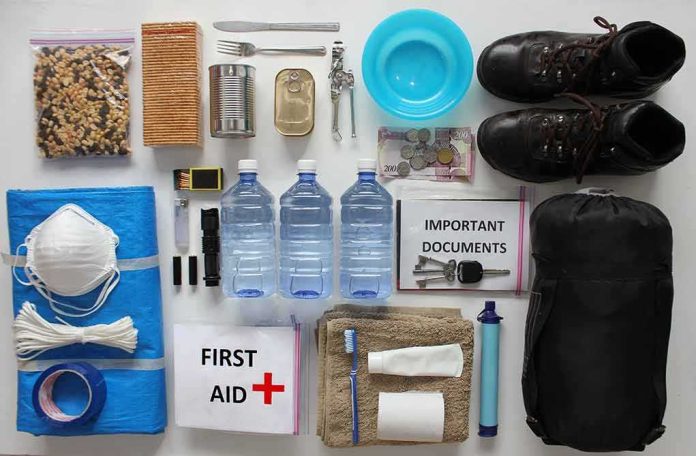
Emergency managers still tell families to keep three days of supplies because help may not reach everyone right away after a major disaster.
Story Snapshot
- Officials recommend at least 72 hours of food, water, and basics for every household.
- One gallon of water per person per day remains the core benchmark.
- A 2015 survey found most people had not assembled a kit and expected help fast.
- Newer federal data suggests more households now store supplies, though gaps remain.
What Agencies Say You Need For Three Days
Local and county emergency offices continue to urge every home to stock a 72-hour kit. Guidance lists simple basics: water, shelf-stable food, a flashlight, batteries, a radio, first aid, medications, and sanitation items. The Unified Fire Authority explains the rule of thumb: one gallon of water per person per day for drinking and hygiene. That means a family of four needs at least 12 gallons set aside for three days. San Mateo’s checklist frames these kits as covering core needs, not fringe scenarios.
Wayne County’s emergency management office states that police, fire, and medical help may be delayed for up to 72 hours after a major event. Roads can be blocked. Demand can overwhelm crews. Power and phones can be out. In that gap, a household’s own supplies become the lifeline. Park City Fire District adds practical kit items like tools, chargers, and copies of key documents, underscoring that communication and identity proofs can matter as much as food and water during those first days.
What Surveys Reveal About Household Preparedness
A Chapman University summary from 2015 reported that 72 percent of respondents had not assembled an emergency kit, even though many believed one would help survival. The same snapshot listed barriers: many people expected emergency services to help them quickly; others cited lack of time, not wanting to think about disasters, or not knowing what to do. These attitudes map to today’s frustrations about government and the sense that systems will rescue us, even when roads are closed and crews are stretched thin.
More recent federal data points to gains. The Federal Emergency Management Agency’s 2024 National Household Survey found that most respondents reported assembling emergency supplies, and a large share of those said their supplies would last beyond three days. That suggests public messaging and lived experience have moved some families toward better readiness. Still, progress is uneven. Action steps like plans, contacts, and practice often trail simple stockpiling, which leaves weak spots when stress hits.
Why Three Days Still Matters In A Polarized Time
Disasters do not check party labels. Floods, wildfires, winter storms, and grid failures hit towns large and small. When crews cannot get through, your kitchen becomes mission control. Preparedness is not about panic. It is about margin. Three days of basics buys time for neighbors to help neighbors and for responders to clear roads and restore power. Agencies set the 72-hour target because it is doable, affordable, and proven in many local after-action lessons.
The One Year Urban Survival Plan for Preppers
Could your household manage a week without power or running water? Tell us the first gap you’d tackle.
Build readiness over the next 12 months through supplies, skills and practice. Address immediate food, water, medical and… pic.twitter.com/xCbKpHBQGC
— The Prepper Almanac (@prepperalmanac) November 15, 2026
Both conservatives and liberals share a core worry: the system feels stretched and slow, while elites seem insulated. A simple kit is one area where families can reduce that risk on their own. Start with water. Add food you already eat. Include vital medications, pet needs, a battery radio, and a way to charge a phone. Print contacts. Store copies of IDs. Rotate items twice a year. Small steps now beat long lines and empty shelves later.
Sources:
unifiedfireut.gov, pcfdut.gov, smccd.edu, blogs.chapman.edu, waynecountymi.gov, fema.gov