

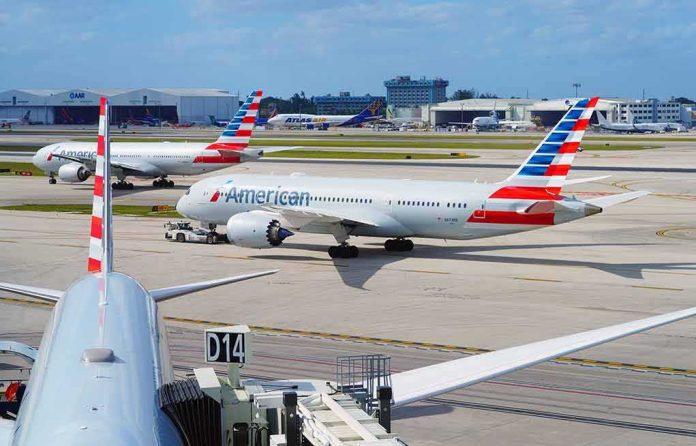
America’s skies briefly went quiet as the Federal Aviation Administration ordered a rare nationwide halt to all departures “for reasons of safety.”
Story Snapshot
- The Federal Aviation Administration halted all departures nationwide citing extraordinary safety concerns.
- Transportation officials linked the pause to unstable radar and communications across air traffic control centers.
- Inbound international flights continued under case-by-case management during the stoppage.
- The halt lasted over four hours before officials lifted it and resumed departures.
What Triggered The Nationwide Ground Stop
On November 13, the Federal Aviation Administration issued a directive stopping all departures nationwide. The advisory cited “extraordinary circumstances” and said the step was taken “for reasons of safety.” It instructed that all airports were ground stopped and that departing air traffic should remain on the ground until further notice. Transportation Secretary Sean Duffy said the issue involved unstable radar and communications across air route traffic control centers, which guide planes between major airports.
Federal officials said the system could not safely handle normal flows while data and voice links were unstable. They described overloaded switches and routers in legacy networks that could not keep up with traffic. When controllers cannot rely on clear data and communication, they must slow or stop departures. That protects passengers and crews but causes large delays on the ground. The agency framed the order as a safety-first step designed to prevent midair confusion or runway conflicts.
How Operations Continued And Then Restarted
While departures paused, the Federal Aviation Administration managed incoming international flights one at a time. This allowed aircraft already in the air to land safely rather than divert all of them at once. The advisory stated that inbound flights would be handled on a case-by-case basis. That strategy reduced congestion and kept safety margins while technicians worked to stabilize the networks.
After several hours, the Federal Aviation Administration lifted the ground stop and began allowing departures to resume. Reports placed the restart in the early evening, with one account citing roughly 8:30 p.m. Eastern after a late afternoon start. Officials said the agency restored enough capability to run traffic again, though some delays and cancellations continued as schedules recovered.
Why This Event Matters Beyond One Bad Day
This was only the second nationwide ground stop since the January 2023 outage in the Notice to Air Missions system. In that 2023 failure, airlines canceled more than a thousand flights and delayed nearly ten thousand more, and the ripple effects lasted for days. The repeat pattern points to pressure on aging systems that support the national airspace, even when those systems do not directly fly planes.
The Government Accountability Office has warned that many air traffic control systems are aging and at risk. In 2024, federal auditors reported that of 138 systems reviewed, 51 were unsustainable or potentially unsustainable. They urged faster modernization with clear plans and costs to reduce outage risk. Those findings match the officials’ descriptions of overloaded legacy equipment during this latest event.
What Leaders Said About Safety, Technology, And Next Steps
Transportation Secretary Sean Duffy said instability in radar and communications forced the pause. He described old network switches and routers that were flooded with data. He also said teams worked to stabilize links so controllers could trust what they were seeing and hearing. Officials emphasized that there was no indication of a nefarious attack at the time, while agencies continued standard checks as systems came back online.
🇺🇸 AIR TRAFFIC CONTROL FAILURE GROUNDS ALL US FLIGHTS FOR OVER 4 HOURS
– The FAA halted all US departures at 3:54 PM ET on Friday after radar and radio links at air traffic control centers became unstable; flights resumed at 8:15 PM ET, the longest nationwide ground stop since… pic.twitter.com/lPK0ejk0JW
— Lord Bebo (@MyLordBebo) November 14, 2026
For travelers, the causes matter less than the outcomes: missed connections, added costs, and plans blown apart. For industry and government, the lesson is clear. When key systems wobble, safety rules leave no room for guesswork. The country expects reliable infrastructure that protects lives and supports commerce. Both parties agree on that goal, even as they argue about budgets and priorities. Fixing core systems is not left or right. It is basic competence in service of the public.
Sources:
youtube.com, people.com, usatoday.com, nbcboston.com, gao.gov, files.gao.gov