
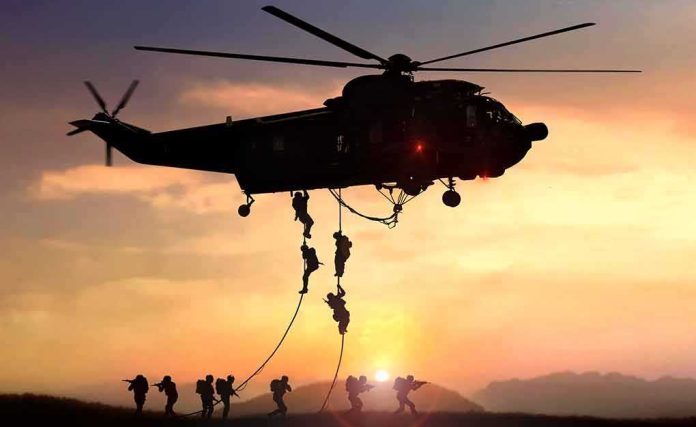
Salvadoran-backed forces struck the 400 Mawozo stronghold near Port-au-Prince, leveling a compound tied to gang leader Wilson “Lanmò San Jou” Joseph as helicopters roared overhead.
Story Snapshot
- President Nayib Bukele said Salvadoran forces destroyed the 400 Mawozo headquarters and the leader’s house, sharing video of the strike.
- Independent reporting says a Haitian police drone team led the assault, with Salvadoran soldiers and helicopters providing air support.
- The raid followed the disappearance of four Salvadoran aviation technicians in an October 18 attack in Haiti, spurring a larger Salvadoran deployment.
- Gang leader Wilson Joseph later sought dialogue with the United Nations, signaling a pivot to talks after the strike.
What Happened In The Strike
President Nayib Bukele announced that Salvadoran forces destroyed the 400 Mawozo gang headquarters and the home of its leader, Wilson “Lanmò San Jou” Joseph. He posted video showing helicopters firing on a large compound in or near Croix-des-Bouquets, a known 400 Mawozo stronghold. Radio France Internationale reported that Haiti’s prime minister praised Bukele after the action, underscoring the political signal of the raid inside Haiti and across the region.
The Miami Herald reported that a Haitian National Police drone task force carried out the main strike on a residence used by Joseph, with Salvadoran soldiers backing the mission. The outlet said four helicopters supported the operation, including two flown by Salvadoran personnel. That account places Haitian police, Salvadoran troops, and air assets in a joint action. It also aligns the location with Croix-des-Bouquets, long linked to 400 Mawozo activity.
Why El Salvador Is In Haiti Now
The action followed the October 18 disappearance of four Salvadoran aviation technicians during an armed attack near Port-au-Prince. The United Nations said the incident occurred as violence surged and confirmed that El Salvador then moved more forces into Haiti. The UN also said most added Salvadoran personnel were outside the formal Gang Suppression Force mandate, which defines what the UN support office tracks and reports.
As the clashes intensified, Associated Press reported that Wilson Joseph confirmed sending a November 1 letter to the United Nations seeking talks between international forces and 400 Mawozo. That move suggested the gang wanted a channel to reduce pressure or shape terms while facing new military action. The timing put the message days before and around the period of stepped-up raids described by regional outlets.
What This Means For Security And Accountability
The raid shows how modern operations blend local police units, foreign troops, and air support. In public messaging, leaders often present one flag and one victory. On the ground, roles can be split. Here, Haitian police drones were reported to lead, while Salvadoran soldiers and helicopters supported. That matters for who chose the target and who must answer for any harm. It also shapes how Haitians view sovereignty and outside force.
Haiti 🇭🇹 and El Salvador 🇸🇻 Hammer 400 Mawozo Gang Stronghold in Joint Airstrike
Security forces in Haiti teamed up with El Salvador's military early Sunday to unleash a helicopter and kamikaze drone assault on a compound outside Port-au-Prince used by notorious 400 Mawozo gang… pic.twitter.com/orkUhbtnUF
— Sagive 𓂆 (@SagivEnduser) November 10, 2026
For Americans watching from home, the lesson is sharper. When government power moves fast, clarity often lags. The United Nations’ note that most Salvadoran personnel fell outside its mandate leaves gaps on rules and oversight. People on the right want hard results against gangs. People on the left want strict limits and protection for civilians. Both want honest lines of command, clean goals, and proof that force serves the public, not the powerful.
Sources:
youtube.com, news.un.org, apnews.com, globalsecurity.org, latinamericadailybriefing.substack.com, bbc.com