
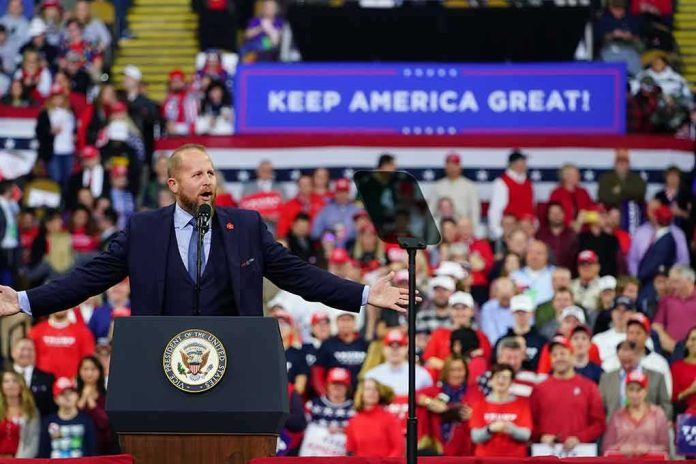
With early voting days away, President Trump drew Tennessee Republicans to Clarksville to charge up midterm turnout.
Story Highlights
- President Trump headlined a midterm rally at F&M Bank Arena in Clarksville.
- Republican leaders, including Marsha Blackburn and Bill Hagerty, joined the event.
- Organizers framed the rally as a push to energize GOP voters before early voting.
- The stop fits a wider red-state tour aimed at base mobilization, not persuasion.
What Happened in Clarksville
President Trump held a campaign rally at the F&M Bank Arena in downtown Clarksville, Tennessee, as the midterms neared. Local reporting described doors opening late morning and Trump taking the stage in the afternoon after an introduction by musician Kid Rock. Coverage identified the event as a midterm push in a state that leans Republican, with a focus on energizing turnout rather than changing minds. Reporters placed the rally on October 10, with voting set for early and Election Day windows soon after.
The rally featured prominent Tennessee Republicans. Outlets reported that Senator Marsha Blackburn addressed the crowd, Senator Bill Hagerty was highlighted, and the state party chair Scott Golden welcomed attendees. The scene matched a classic midterm script: the sitting president boosts down-ballot allies while party officials work the base. The venue and schedule details, including the afternoon speech time, were consistent across accounts from state and local media that covered the event on site.
Why Tennessee, and Why Now
Republican sources described the stop as part of a broader red-state tour meant to lock in reliable voters before the final stretch. The Hill reported that Tennessee was added to a string of states where Trump aimed to keep Republicans engaged as ballots approached. That choice tracks with recent midterm strategy. Parties often go where they can bank votes and drive turnout rather than spend late time chasing undecided voters in places with thin margins.
Political research backs that approach. Studies of presidential visits in midterm seasons find rally effects can be real but short-lived, often strongest for motivating existing supporters rather than converting opponents. One study of presidential rallies found brief bumps in support and intent to vote among partisans, with limited spillover to other candidates. The pattern suggests staging events close to voting can matter at the edges, which is where many midterm races are decided.
What Organizers Said the Rally Was For
Republican National Committee messaging and local reports framed the Clarksville event as a voter activation push for congressional candidates and for Tennessee’s Republican delegation. Coverage tied the rally’s purpose to building energy and attention before early voting and the November election date. Trump’s public notices and party communications pointed to supporting Bill Hagerty and Marsha Blackburn, consistent with the on-stage lineup and speeches reported by multiple outlets at the arena.
Local media also set the rally inside a tension point. Tennessee is deep red, but national midterm forecasts often point to mixed results for the president’s party. That contrast can drive two goals at once: guard the home turf and help set a national story of momentum. The Tennessean’s coverage captured that framing, noting how Republican leaders warned against complacency while trying to keep their voters focused through the finish.
How This Fits the Bigger Picture
Midterm stops by presidents are a staple of American politics. They give supporters a shared moment, the press a focal point, and campaigns a clean way to collect data, raise small dollars, and recruit volunteers. Academic work on television and rally coverage shows that campaigns design these events to control images and messages, while newsrooms select angles that drive audience interest. The result is attention, which is the coin of modern campaigning near Election Day.
US President Donald Trump has floated the idea of renaming either the Atlantic or Pacific Ocean as ‘Trump Ocean’ or ‘Ocean of the Americas,’ extending his push to put an American imprint on geographical names.
Trump made the remarks during a campaign rally in Clarksville,… pic.twitter.com/LPjbllX3nk
— India Today Global (@ITGGlobal) October 11, 2026
For voters who feel Washington is not delivering, Clarksville shows a familiar cycle. Leaders fly in, crowds cheer, and each side says the stakes are huge. Both conservatives and liberals worry about costs, safety, and fairness, yet many believe the system mainly serves the well-connected. This rally does not settle those doubts. It does show how both parties still bet on large, tightly staged events to squeeze every last vote when the clock is running out.
Sources:
cbsnews.com, tennessean.com, academia.edu, sscnet.ucla.edu