

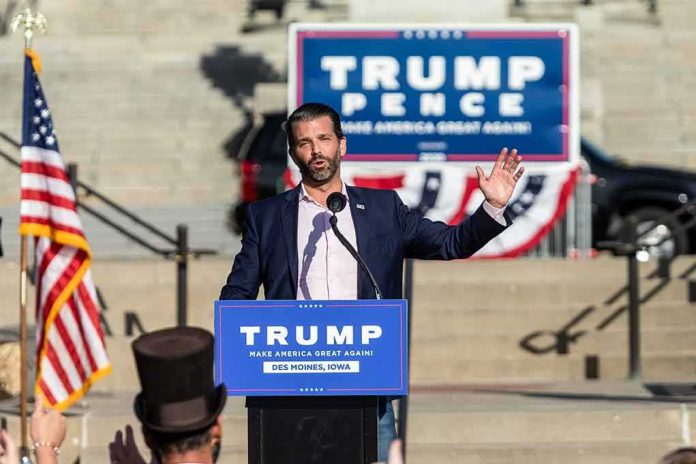
President Trump promised a $5,000 “dividend” to every adult U.S. citizen if Republicans win both chambers of Congress in the midterms, with the money required to be spent inside the United States.
Story Snapshot
- Trump tied $5,000 per-adult payments to GOP wins in the House and Senate.
- The pledge includes a “spend it in America” requirement, not overseas.
- No funding method, legal authority, or payment timeline was detailed.
- Basic math suggests costs that could reach around $1 trillion.
What Trump Said And The Condition He Set
President Trump told a Republican convention crowd in Dallas that every adult U.S. citizen would get $5,000 if Republicans win both the House of Representatives and the United States Senate. He framed the payout as a “dividend” from national success and compared it to a company sharing profits. He also said the money must be spent in the United States, not in other countries. Reporters on site quoted the statement and its election tie-in directly.
The pledge was clear, short, and easy to repeat. Trump named the amount, the recipient group, and the condition for delivery. That design fits a long pattern in politics. Big, simple cash promises travel quickly in headlines and on social media. They also turn the campaign into a referendum on a single number and a feeling. Trump leaned on that approach, telling supporters that strong growth allows a payout to “share” gains more widely, if voters keep Congress red.
How Large The Proposal Is On Basic Math
Reporters noted that the total price tag could be very large. A rough count of about 245 million adults would put the plan near or above $1 trillion. That figure comes from simple arithmetic, not an official score. There is no published analysis yet from the Congressional Budget Office or the Department of the Treasury. Still, the headline scale shows why this would be one of the largest single cash plans in U.S. history if enacted.
Wall Street paid attention as well. Financial coverage said bond traders watched the pledge while a Treasury auction neared. Yields moved in a tight range after the remarks. Markets often react to ideas that could raise borrowing or change growth and inflation paths. Even early talk of giant spending can affect rates and demand for government debt. That is why a one-sentence promise can ripple into trading screens within hours.
What We Know And What We Do Not
Trump did not share how the government would fund the payments. He did not say whether the Internal Revenue Service (IRS) or the Department of the Treasury would run them, how “adult citizen” would be verified, when checks would go out, or how taxes would treat the cash. There is no bill text or White House memo in public view. The promise is tied to an election outcome, not an existing program or enacted law at this stage.
Coverage compared the pledge to “dividends” used elsewhere. Alaska’s Permanent Fund Dividend is a well-known example, but it draws from a dedicated revenue fund and runs at the state level. National plans face bigger hurdles and need new revenue or cuts elsewhere. That is why experts often debate how such ideas affect deficits and inflation once they move from speech to paper. The Dallas remarks have not yet reached that step in the public record.
Why This Lands With Voters Who Feel Squeezed
Many Americans feel the system favors the few. Families see high costs for housing, energy, and food. People on the right blame global deals, heavy rules, and weak borders. People on the left worry about cuts to safety nets, low wages, and wealth gaps. A universal cash promise speaks to both groups because it is simple. It says, “You will get money now.” That direct line can cut through distrust in a federal government seen as slow and captured by elites.
🚨 TRUMP FLOATS $5,000 “DIVIDEND” FOR EVERY U.S. ADULT IF GOP WINS CONGRESS.
DALLAS, UNITED STATES – President Donald Trump used a primetime appearance at a Republican midterm convention to promise a $5,000 payment to every American adult if his party keeps control of both… pic.twitter.com/nM6IwEDj1I
— The Content Factory (@tcf_updates) September 10, 2026
Supporters may view the plan as a fast way to share growth and boost local spending. Critics may warn about new debt or higher prices if cash floods the economy at once. Past debates over universal basic income show those tradeoffs. Think tanks have argued that large cash plans require new taxes, spending cuts, or both. Until a funding path appears, those debates will stay abstract. For now, the fact is the promise, the condition, and the scale voters heard in Dallas.
Sources:
pbs.org, aljazeera.com, wsj.com, wltreport.com, abcnews.com, youtube.com, x.com