
A 29-year-old Pennsylvania volunteer firefighter is now at the center of a rare but deeply unsettling story: the man trusted to run toward the flames is accused of secretly lighting them first.[1][2]
Story Snapshot
- Police say volunteer firefighter Justin Sholly set three fires in roughly 24–30 hours, then showed up with his own department to fight the blazes.[1][2][4]
- Investigators report using license-plate readers to track him and say they found fire starter logs, lighter fluid, and a fire radio in his vehicle.[1][2][6]
- Court documents, as reported by national outlets, say Sholly admitted to setting all three fires, with 18 civilians forced to evacuate and barns and vehicles damaged.[1]
- The case fits a rare pattern of “firefighter arson,” where a tiny minority of responders allegedly create emergencies for the rush of responding.[3][6]
Alleged 30-hour arson spree in small-town Pennsylvania
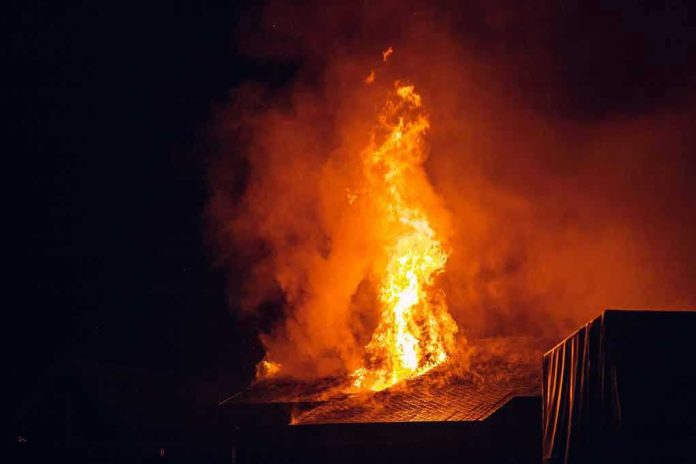
Police in Montgomery County, Pennsylvania say volunteer firefighter Justin Tyler Sholly, 29, set three separate fires in about a 24- to 30-hour window in Souderton and Franconia Township.[1][2][4] Broadcast reports describe barns, vehicles, and property damaged and emphasize that these were not harmless brush piles but active scenes that required evacuations.[1] Prosecutors have reportedly charged him with multiple felonies, including arson, reckless burning, causing catastrophe, and related offenses.[1][6] This is still pretrial; he is accused, not convicted.
Authorities and local coverage describe a tight cluster of incidents: fires close in time, within neighboring communities, and close enough in method that investigators quickly suspected a pattern rather than coincidence.[1][2][4] According to one Philadelphia station, two barns and several vehicles were damaged, and 18 civilians were “put into harm’s way” and had to be evacuated.[1] That detail matters: even without injuries, forcing late-night evacuations for preventable fires crosses from mischief into something every homeowner instinctively understands as a serious threat.
From responder to suspect: how investigators say they found him
Local police say the pivotal break came from license-plate-reader technology, not a dramatic chase or a confession out of the blue.[1][2] Investigators report that automated cameras flagged a vehicle linked to multiple fire locations within the window of the burns, allowing officers to zero in on Sholly as a suspect.[1][2] When they stopped his vehicle, officers say they found fire starter logs, lighter fluid, and a fire radio inside, items that match the kind of basic ignition tools used in small-scale arson.[1][2][6]
National network reporting on the police affidavit goes further, stating that Sholly admitted to igniting wood logs at at least one scene and, in some accounts, to setting all three fires.[2] Those are grave admissions if accurately recorded. However, the actual affidavit wording, the full context of his statements, and any later clarifications or challenges are not yet public in this record.[2] American common sense and conservative respect for due process both point in the same direction here: treat reported admissions as powerful evidence, but do not confuse a press summary with a full trial record.
The twist: a firefighter allegedly racing to his own fires
Coverage of the case focuses on the most disturbing symmetry: authorities say that after setting at least some of the fires, Sholly responded with his volunteer fire company to help put them out.[1][2][4] NBC’s report quotes investigators who say he joined crews at two of the scenes.[2] Local ABC reporting echoes that “in each case” he then responded with his company.[1][4] Dispatch logs, unit rosters, and radio traffic have not yet been released publicly to backfill those assertions, but the basic allegation is straightforward: the arsonist showed up in gear.
For any firefighter, that kind of accusation is reputational napalm. Fire service culture—especially in small-town volunteer outfits—rests on trust and sacrifice. Volunteers leave dinner tables, jobs, and beds at 2:00 a.m. for nothing more than the satisfaction of serving neighbors. When even one member is accused of using that trust as cover for a thrill, it stains a whole department that likely did nothing wrong. Conservative instincts about personal responsibility point squarely at the individual: if the allegations hold, this is one man’s betrayal, not proof of systemic rot.
A rare but real pattern: firefighter arson and the “hero complex”
Firefighter arson is a documented but rare phenomenon: a very small fraction of firefighters are ever suspected, let alone convicted, of setting fires.[3][6] A commonly cited estimate suggests roughly 100 firefighters in the United States are convicted of arson each year, out of more than a million firefighters nationwide.[6] That context matters. Wall-to-wall coverage of a single, shocking case can create the illusion of an epidemic when, statistically, most departments will go decades without a single such incident.
A volunteer firefighter has been arrested for allegedly setting fires and then responding to them with his fire department, according to officials in eastern Pennsylvania.
Justin Sholly, a 29-year-old member of the Perseverance Volunteer Fire Company in Souderton, was arrested…
— Qᴀɢɢ.ɴᴇᴡꜱ (@qaggnews) June 3, 2026
Criminologists and fire-service researchers who study these cases point repeatedly to excitement and attention as key motives.[6] Some offenders are described as chasing the adrenaline rush of sirens and flames, or the desire to be seen as the decisive hero at the scene they secretly created.[6] From a common-sense, right-leaning perspective, that is a brutal example of what happens when a culture that should reward quiet duty instead sometimes over-celebrates spectacle and drama. Systems that honor self-control, not theatrics, are the best safeguard against this kind of ego-driven sabotage.
Due process, media narratives, and what comes next
The public evidence so far is almost entirely filtered through police and prosecutor summaries: no full criminal complaint, no full affidavit of probable cause, and no defense narrative beyond “no comment” from counsel.[2][4] That lopsided early picture is not unusual in high-profile cases, but it does mean citizens are asked to draw conclusions based mostly on law-enforcement characterization. Responsible skepticism does not mean reflexively distrusting police; it means remembering that allegations, however detailed, are not verdicts.
For Sholly, the path ahead runs through courtrooms, not press conferences. For his department and community, the hard job now is to cooperate fully with investigators, release non-sensitive logs that can clarify the timeline, and then rebuild trust without indulging in moral panic about every firefighter who likes a good working fire. The American way at its best holds two ideas at once: take credible threats seriously, and insist that even the most dramatic accusation gets tested, calmly, against evidence and law.
Sources:
[1] Web – Volunteer firefighter arrested for setting blazes and responding to …
[2] Web – Volunteer firefighter in Montgomery County accused of setting fires …
[3] YouTube – Volunteer firefighter accused of arson spree in Pennsylvania
[4] Web – Pa. firefighter charged with 27 felonies in weekend arson spree
[6] Web – Arrested firefighter confesses to arson spree | 6abc.com – ABC30