
Spain’s worst-ever Madrid wildfire is now close to fusing with a second giant blaze next door, creating one massive fire front threatening entire communities.
Story Snapshot
- Two major wildfires west of Madrid have merged into one huge blaze, already called the worst in the region’s history.
- Officials warn this fire wall is now close to joining another large blaze in neighboring Castilla y León, raising the risk to nearby towns.
- Spain has declared a national emergency for the Madrid region and Ávila province, putting the Military Emergency Unit in charge of the response.
- Tens of thousands of people have been evacuated as dry land, high heat, and strong winds help the fires spread across central Spain.
Fires Merge West of Madrid and Push Toward Castilla y León
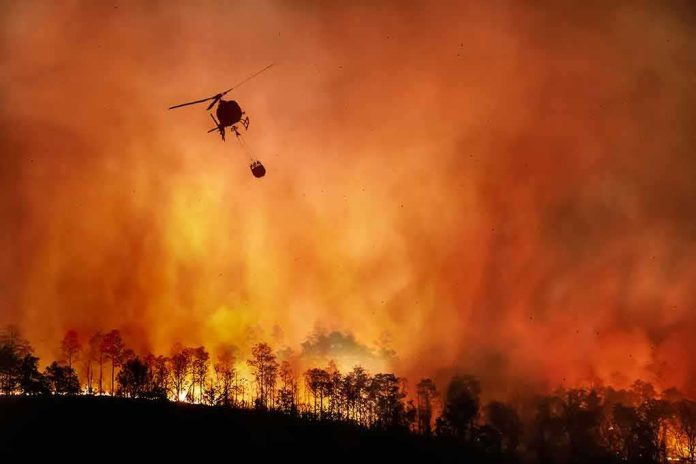
Spanish and regional officials say two separate wind-driven wildfires west of Madrid have now combined into a single massive blaze that has burned about 30 square kilometers of land. This merged fire is centered in rural areas to the west of the capital, where forests, scrub, and dry farmland give flames plenty of fuel. Authorities say the new, larger fire front is now close to another major blaze burning in neighboring Castilla y León, raising fears the perimeters could meet and create a mega-fire that is much harder to control.
Emergency services on the ground describe a fast-moving situation shaped by strong winds and steep terrain. Fire crews are trying to cut firebreaks, drop water from planes, and defend homes and roads as the merged blaze pushes north and west. Officials in the Castilla y León region have warned that weather patterns could drive the Madrid fire toward their own provincial fire line within hours, turning two crises into one and stretching response capacity even further.
National Emergency and Mass Evacuations Across Central Spain
Spain’s central government has declared a national emergency covering the Madrid region and the neighboring province of Ávila, a step that allows faster deployment of national resources and places the Military Emergency Unit in charge of coordination. The declaration came after more than 10,000 people were ordered to evacuate towns such as Villa del Prado, San Martín de Valdeiglesias, Pelayos de la Presa, and Aldea del Fresno, which sit close to the merged fire’s path. Regional officials later said the wider Madrid area has seen around 18,000 residents evacuated, with more under confinement orders as smoke and flames approach.
Evacuation orders and stay-at-home confinement are now common across multiple provinces as the fires continue to burn. In Ávila, a separate wildfire near Burgohondo and other mountain towns has consumed roughly 90 square kilometers and forced about 1,500 people to leave their homes. Across Spain and France together, various reports estimate that tens of thousands have been displaced this week alone as wildfires rage in different regions, showing how one country’s emergency links into a wider pattern of fire risk across southern Europe.
Heat, Drought, and Preparedness Concerns Fuel Public Frustration
These fires are burning into land that has faced years of hotter summers, drier forests, and rapid growth of thick underbrush, all of which make large blazes more likely and harder to stop. Central Spain’s current heatwave, with temperatures above 40 degrees Celsius in some areas, adds another layer of danger by drying out vegetation and making any spark more likely to spread quickly. Strong winds then drive embers ahead of the main fire front, so even villages that seem distant on a map can suddenly face spot fires and urgent evacuation calls within hours.
Local people who have lost homes, farms, or entire town centers in these wildfires are voicing anger and fear toward government institutions at all levels. Some residents and commentators argue that long-standing failures to manage forests, clear fuel loads, and invest in rural fire defenses have left communities exposed to predictable disasters. Others point to slow bureaucratic responses, political fights between regional leaders, and delays in declaring higher emergency levels as signs that systems meant to protect ordinary citizens can be too focused on rules and power struggles instead of results.
Coordination Problems Expose Deeper Trust Gaps in Government
Reports from Spain’s interior ministry and regional governments show that multiple fires broke out almost at once across Madrid, Ávila, and nearby provinces, forcing officials to juggle limited aircraft, ground crews, and police support. The Madrid regional government asked for national help and described the situation as one of “extreme gravity,” while also warning that an Ávila blaze could reach its territory within hours if winds shifted. At the same time, coverage from Castilla y León highlighted tension over when to request the highest emergency level, suggesting regional leaders did not agree on how bad the situation already was or who should take charge.
There is "little time left" before a major wildfire in the Madrid region covering 6,000 hectares merges with a 9,000-hectare blaze in the neighbouring Castilla y Leon region, an official said Friday.
— CGTN Africa (@cgtnafrica) July 24, 2026
For many citizens, these mixed signals feed a wider belief that governments wait too long to act and spend more time arguing than solving problems, whether the crisis is wildfire, border security, or the cost of living. People who already feel ignored by distant elites see each delayed evacuation order or late emergency declaration as further proof that those in charge will protect their own reputations before they protect small towns and working families. As Spain’s fires continue to burn, that trust gap is likely to deepen unless leaders can show clear, fast, and effective action that puts public safety ahead of political point-scoring.
Sources:
dw.com, manchestereveningnews.co.uk, bbc.com, inkl.com, yahoo.com, wmbdradio.com, english.elpais.com, elpais.com