

Ukraine says it can blunt Russia’s missile barrages if the United States backs strikes on the launchers firing them.
Story Snapshot
- Ukraine has used U.S.-made long-range missiles against high-value Russian military targets.
- Kyiv claims strikes hit two Russian Iskander launchers inside Bryansk region; damage is still being assessed.
- U.S. policy on cross-border strikes shifted over time, creating confusion and political risk.
- Experts warn launcher hunting works only with solid intelligence and enough missiles to sustain a campaign.
What Zelenskyy Wants And Why It Matters
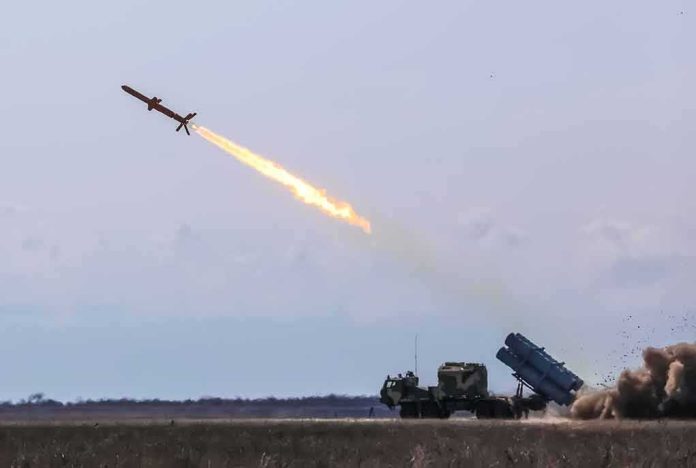
President Volodymyr Zelenskyy argues that taking out Russian missile launchers could reduce deaths in Ukrainian cities. He points to the United States-supplied Army Tactical Missile System, which can hit targets at roughly 190 miles and can launch from High Mobility Artillery Rocket System trucks. Ukraine has already used long-range missiles against airfields, depots, and air-defense sites. Independent analysts verified several of those strikes using geolocated battlefield footage. The goal is simple: fewer launches mean fewer bodies.
Ukraine’s General Staff said forces struck two Russian Iskander operational-tactical missile launchers and a Pantsir-S1 air-defense system in Russia’s Bryansk region. Officials said the extent of damage was still being checked. That caveat matters. Mobile launchers are hard to find and hit before they move. Without clear battle-damage proof, claims face doubt. Still, even forcing Russia to relocate launchers can slow attacks and stretch supply lines, which Ukraine views as a real gain.
How U.S. Policy Shaped The Battlefield
The United States wrestled for years with whether Ukraine could use American weapons to hit targets inside Russia. Earlier policy allowed strikes on Russian forces in occupied Ukraine and Crimea, while cross-border use was restricted over escalation fears. Washington later granted narrow exceptions, such as for the defense of Kharkiv, and then allowed limited use of longer-range systems inside Russia. That shift showed the capability was not only theoretical, but it also sparked Kremlin warnings about added “fuel to the fire”.
Reports said the United States sent a significant number of Army Tactical Missile System rounds. Some outlets cited as many as 500 from stockpiles. Yet officials and analysts questioned whether that quantity could support a sustained launcher-hunting drive across Russia’s vast border regions. NATO officers praised effects on depots and factories, but they also said the strikes had not changed the larger path of the war. They urged more careful target choices and tighter missile use.
What The Military Debate Says About Results
Military researchers at the Royal United Services Institute say hitting Russian tactical-operational missile complexes can reduce casualties if the strikes are part of a broader campaign, guided by steady intelligence and integrated with other weapons. That view warns against expecting miracles from single raids. Range limits also matter. A 190-mile reach gives access to some launcher areas, but not all. Russia can push mobile units deeper, hide them, or move soon after firing, which blunts simple range math.
History adds caution. In past wars, mobile launcher “kills” were often overclaimed, and later reviews found far fewer destroyed units than first reported. The current evidence set does not prove how many Russian launchers Ukraine has actually taken out. The Bryansk case remains under assessment, with no independent battle-damage imagery released so far. That is why supporters focus on broader effects—forcing dispersal, slowing logistics, and making Russia spend more time and fuel to attack—rather than only claiming hard kills.
Politics, Public Trust, And The American Lens
American voters see two hard truths at once. First, Russia’s missile strikes keep killing civilians. Second, every step up the escalation ladder raises risk. The earlier policy zigzags undercut trust. People on the right and left worry that officials say one thing, then do another, while ordinary families pay the price. Clear goals, honest measures of success, and transparent rules for using U.S. weapons can help rebuild confidence and keep decisions grounded in the national interest.
Germany is blatantly using the blood of Ukrainians to advance its military capacities. https://t.co/VJkp1hbDrf
— Josué Michels (@JosueMichels) November 17, 2026
For Ukraine’s launcher-hunting plan to work, three things must align. Intelligence must find mobile launchers fast enough to cue strikes. Missile stocks must be deep enough to keep pressure on targets over time. Target selection must link to a larger plan that limits Russian salvos, not just makes headlines. The facts show pieces of that puzzle are in place, but not all of them. That gap—not rhetoric—will decide how many lives the strategy can actually save.
Sources:
youtube.com, economictimes.indiatimes.com, edition.cnn.com, hamerintel.com