
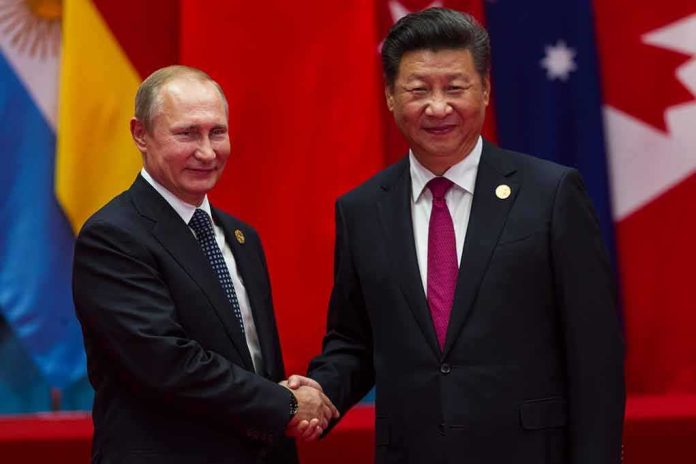
China hosted the 33rd APEC leaders’ gathering in Shenzhen, where President Trump, President Xi, and President Putin appeared together as the summit opened.
Story Highlights
- China staged the APEC leaders’ events in Shenzhen on November 18–19, including a welcome banquet and plenary.
- President Trump, China’s President Xi, and Russia’s President Putin greeted each other before the family photo on November 18.
- Xi hosted a formal welcome at the Shenzhen International Communication Center with leaders and representatives present.
- Images and reports show Trump and Xi at the plenary on November 19, with leaders posing for a group photo that day.
Leaders Converge in Shenzhen for APEC
Chinese officials hosted the 33rd Asia-Pacific Economic Cooperation leaders’ events in Shenzhen on November 18 and 19. President Xi welcomed leaders and representatives to a banquet and group photo, held at the Shenzhen International Communication Center. Officials described a formal program that included leaders, spouses, and delegates from across the Asia-Pacific region. The host economy organized the venues and protocol, as is standard for these forums. The schedule set the stage for public images that drew global attention.
Media outlets reported that President Trump, President Xi, and President Putin greeted each other before the welcome banquet on November 18. Cameras captured leaders mingling ahead of the family photo. The moment showed three major powers in the same frame, which is rare in recent years. The following day, coverage showed Trump and Xi at the plenary meeting, along with a separate leaders’ group photo on November 19 that marked the formal summit session in Shenzhen.
What APEC Shows—and What It Does Not
APEC is a cooperation forum focused on trade, growth, and regional ties. It is not a defense alliance, and it does not make binding treaties. The host sets the agenda style and handles official photos and broadcast access. Hosting rules state the host economy arranges photographers and distributes official materials, shaping what the world sees first. That structure helps explain why images from Shenzhen spread quickly and framed much of the early public narrative.
For readers on both the right and the left, the optics matter. Many people feel global meetings put show over substance while everyday costs rise. Some conservatives see choreographed images as cover for weak trade enforcement or high energy costs. Some liberals see them as sidelining workers and human rights. APEC’s format seeks common ground among 21 economies. It often produces statements about growth and supply chains, not sweeping fixes to people’s daily bills or wages.
Why the Photo Moment Landed So Hard
The sight of Trump, Xi, and Putin greeting each other drew outsize focus because of recent tensions. The world has seen tariff fights, supply chain shocks, and wars grind on. Seeing these leaders in one place signals that channels remain open, at least for protocol and structured talks. Coverage stressed that the handshake moment came before the banquet on November 18, while the plenary and another photo followed on November 19, clarifying the two-day sequence.
The dates matter because people often judge intent from the order of events. A welcome photo shows protocol. A plenary shows policy talk. The Shenzhen timeline placed ceremony first, discussion second. Reports from Chinese officials confirm the banquet and gathering, while independent outlets document the plenary and arrivals. Together, they build a clean record of what happened, without claiming more than the public program establishes.
What To Watch Next
Watch for any official readouts that detail trade, technology, or energy discussions. Look for signals on supply chains, semiconductor rules, or standards that could affect prices and jobs at home. Track whether the United States, China, and Russia show small steps on deconfliction or on easing trade frictions. The formal hosting rules mean images arrive fast, but policy details often come later, in communiqués or follow-up statements that carry more substance than the photos.
#WATCH | Shenzhen, China: Russian President Vladimir Putin, US President Donald Trump and Chinese President Xi Jinping hold trilateral talks on the sidelines of the 33rd APEC Economic Leaders' Summit.
(Source: Russian Pool via Reuters) pic.twitter.com/fz9XDI8GI0
— ANI (@ANI) November 19, 2026
For citizens who feel the system favors insiders, these summits can seem distant. That is fair. But what happens in these rooms can still shape shipping costs, export markets, and energy flows. The Shenzhen meetings placed the world’s largest economies at the same table. That alone does not fix inflation, wages, or fuel prices. It does create chances to cool tensions, reduce risk, and keep commerce moving. The test is whether leaders turn ceremony into concrete steps in the weeks ahead.
Sources:
abcnews.com, news.abs-cbn.com, cnbc.com, asean.china-mission.gov.cn, charlotteobserver.com