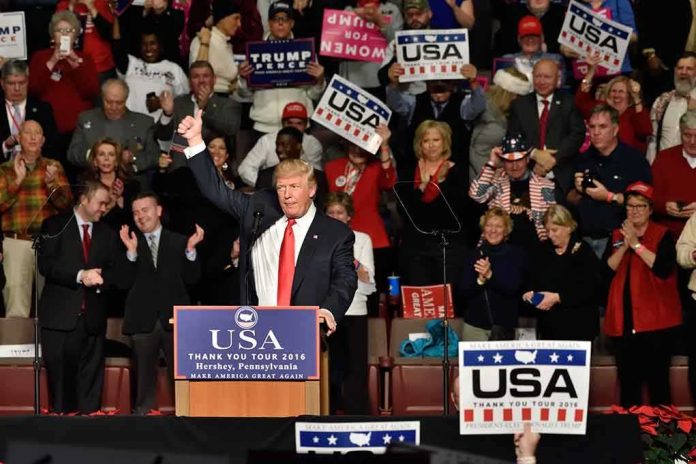
President Trump told South Carolina voters they could “lose everything” on border security and tax cuts if Sen. Darline Graham loses her runoff, casting the race as a stand-in for his presidency.
Story Highlights
- Trump urged voters to “pretend I’m on the ballot,” tying Graham’s race to his agenda.
- Republican leaders, including Sen. Tim Scott and Rep. Russell Fry, rallied behind Graham after Trump’s push.
- Reporters framed the runoff as a test of Trump’s hold on the party in a deep-red state.
- Critics questioned claims that one Senate seat alone would decide federal policy outcomes.
Trump Frames Runoff as a Referendum on His Agenda
President Trump told a South Carolina crowd to “pretend I’m on the ballot,” warning supporters they could “lose everything” if Sen. Darline Graham loses the Republican runoff. He linked the stakes to border security and tax cuts, folding the local race into his national platform. Days earlier, Trump’s team previewed the message and said he would campaign to boost Graham before the vote, underscoring how tightly he has tied her bid to the White House agenda.
Trump’s embrace did not come out of nowhere. He had urged Graham to run and promised his “Complete and Total Endorsement.” He said she would advance “the goals of my administration,” turning her campaign into a loyalty signal for his priorities. Major outlets noted that the contest had turned into a test of Trump’s political pull, a familiar theme in recent cycles when endorsements become shorthand for alignment with his program.
South Carolina GOP Quickly Coalesces Around Graham
Key Republicans in South Carolina followed Trump’s lead. Sen. Tim Scott endorsed Graham and urged others to join him, giving her institutional cover in a divided field. Rep. Russell Fry, who lost earlier in the primary, also backed Graham after Trump pressed allies to unite, saying the Senate needs fighters who deliver results. Bloomberg reported Graham advanced from a crowded field as the Trump-endorsed option, confirming her status as the preferred vehicle for his agenda.
This push came as national Republicans argued that keeping a Trump-aligned seat matters for policy fights in Washington. The Hill said Trump planned to campaign for Graham and that his endorsement gave her an edge heading into the runoff. Reuters described Trump calling Graham’s appointment a “fabulous tribute,” further cementing the narrative that her full-term win would honor and extend a legacy aligned with the current White House.
The Stakes Narrative Meets Questions About Real Policy Impact
Trump’s warning about “losing everything” leans on a clear message: border security and tax cuts are on the line if Graham falls short. That pitch speaks to voters who see Washington as broken and worry elites block change. Yet the record does not show a direct, single-seat mechanism that would by itself preserve or erase those policies. Coverage focuses on Trump’s rhetoric and influence, not Senate whip counts or policy models proving this race alone is decisive.
That is foolishness. South Carolina has rejected his endorsement for the second time. The opposition was so great against his endorsement of PamelaEverette that he ended up endorsing our choice, Alan Wilson, to avoid embarrassment and keep his personal endorsement score of…
— LindaWilcox (@Linda29461) August 21, 2026
Opponents and some voters raised doubts on experience and specificity. Reports highlighted a debate moment where Graham said “national security is not my thing,” which critics used to question readiness for high-stakes issues. Other reporting said some Trump supporters hesitated to follow his endorsement, keeping the race tight and the outcome uncertain. Even so, the campaign remains framed as a proxy for Trump’s power more than as a detailed policy referendum.
Sources:
nypost.com, politico.com, nytimes.com, apnews.com, thehill.com, npr.org, newsmax.com, bloomberg.com