
As Washington hails “great progress” with Iran, both Tehran and the media are already poking holes in the story, raising fresh doubts about who in government is telling Americans the truth.
Story Snapshot
- U.S. officials say Vice President JD Vance secured big steps from Iran on nukes, oil, and regional calm.
- Iran’s government publicly denies key pieces of that story, especially nuclear inspection claims.
- Oil sanctions are temporarily lifted and a 60‑day roadmap is promised, but hard details are thin.
- Competing narratives feed growing fears that “deep state” diplomacy is more theater than transparency.
What the U.S. says Vance achieved in Switzerland
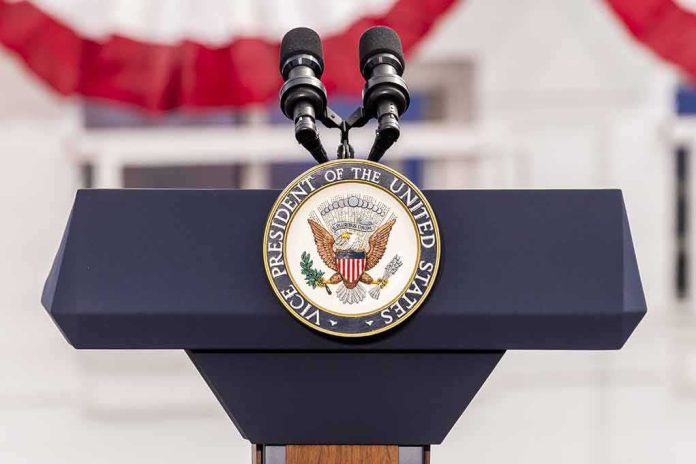
Vice President JD Vance led U.S. talks with Iranian officials at a resort in Switzerland, joined by mediators from Qatar and Pakistan, after months of war and threats between the two countries.[4] Vance told reporters the meetings ran late into the night and produced a “very good foundation” for a final deal, not a full peace agreement.[2] He outlined four main goals: keeping the Strait of Hormuz open, cooling Israel–Hezbollah clashes, restoring nuclear inspections, and launching ongoing technical talks.[2]
According to a U.S. official who was in the room, the delegation “made great progress” and set a framework for more talks that could deliver a final deal within about sixty days.[1][3] Vance said Iran agreed to invite back inspectors from the International Atomic Energy Agency, which he called a “major milestone” toward permanently ending Iran’s nuclear weapons program.[2][4][5] He also backed a plan to use some Iranian assets to buy American farm products, tying foreign policy directly to U.S. exporters.[1][4]
Sanctions relief, Strait of Hormuz, and regional ceasefire claims
The U.S. Treasury, under Secretary Scott Bessent, temporarily lifted sanctions on Iranian oil as the first round of talks wrapped up, allowing Tehran to sell oil at market prices for a limited period.[4][7] Supporters say this gives Iran a reason to stick with the talks while giving global markets a break on energy costs. Vance claimed negotiators agreed to a coordination system to keep the Strait of Hormuz open, manage future incidents, and protect the flow of oil and natural gas through the narrow waterway.[2]
Vance also described a new “deconfliction mechanism” meant to prevent clashes between Israel and the Iranian‑backed group Hezbollah in Lebanon from spiraling into regional war.[2] He argued that fresh communication channels already helped keep recent violence from exploding further, even as Israeli leaders remain wary and keep forces in place near Lebanon.[2][17] For many Americans watching from home, these moving parts—oil, sea lanes, and proxy wars—look like yet another high‑stakes deal made far from public view.
Iran’s flat denial and the clash over nuclear inspections
Within hours of Vance’s upbeat press event, Iran’s Foreign Ministry publicly denied one of his biggest claims: that Tehran had invited nuclear inspectors back in.[7][8] Foreign Ministry spokesperson Esmaeil Baghaei told Iranian media that reports of an invitation to the International Atomic Energy Agency were “baseless,” saying access would depend on how negotiations unfold and citing articles in the memorandum that keep Iran’s nuclear status frozen during the sixty‑day period.[8][11][13]
Baghaei repeated that message on social media, again stressing that no formal invitation had been sent to the agency.[11][13] This directly clashes with Vance’s statement that “the Iranians have agreed to invite” inspectors back into the country.[2][5] For citizens already skeptical of both sides, the picture is familiar: U.S. officials selling progress on television, and foreign governments telling a totally different story at home, with neither side providing the full text of what they signed.[5][8]
Media framing, “foreign propaganda,” and a bigger trust problem
An American official involved in the talks told one outlet that reports claiming Qatar’s prime minister snubbed Vance were “foreign propaganda,” insisting that the meetings were serious and respectful.[1] At the same time, major Western newsrooms describe the Geneva‑area talks as a “beginning,” pointing to vague details and changing timelines.[1][4][7] Social media critics from across the spectrum call Vance’s comments “spin,” arguing that if progress were as historic as claimed, the administration would release the full memorandum of understanding.
Prime Minister and Minister of Foreign Affairs @MBA_AlThani_ Leads Qatar's Delegation at Lake Lucerne Summit
Lucerne | June 21, 2026
HE Prime Minister and Minister of Foreign Affairs Sheikh Mohammed bin Abdulrahman bin Jassim Al-Thani led the State of Qatar's delegation… pic.twitter.com/guqN3yQUEv
— Ministry of Foreign Affairs – Qatar (@MofaQatar_EN) June 21, 2026
Analysts who study U.S.–Iran diplomacy say this back‑and‑forth fits a long pattern where both Washington and Tehran send mixed signals, buy time, and rarely follow through on ambitious talk.[16][17][18] That pattern feeds a broader American fear that foreign policy is run by an elite club—politicians, generals, and well‑connected consultants—who make life‑changing decisions on war, oil prices, and national security while ordinary citizens are left guessing what is real. When even basic facts, like whether inspectors are invited in, are disputed, it deepens the sense that the system is serving itself, not the people.
Sources:
[1] Web – US official says JD Vance made ‘great progress’ in Iran talks, calls …
[2] Web – Vance touts progress in Iran talks as U.S. temporarily lifts …
[3] Web – Vice President JD Vance becomes the face of America’s …
[4] Web – High-level talks between Iran and the U.S. result in “a lot of …
[5] Web – Vice President JD Vance says Iran negotiations set stage …
[7] Web – U.S. Vice President JD Vance said talks with Iranian …
[8] Web – US Vice President JD Vance told reporters in Islamabad …
[11] Web – IAEA / IRAN AGREEMENT | UNifeed – UN Media
[13] Web – Monitoring and Verification in Iran | IAEA
[16] Web – [PDF] Implementation of the NPT Safeguards Agreement and relevant …
[17] Web – Tehran’s mixed signals on US talks underscore diplomatic drift
[18] Web – U.S.- Iran Negotiations: A State of Ambiguity and Uncertainty