

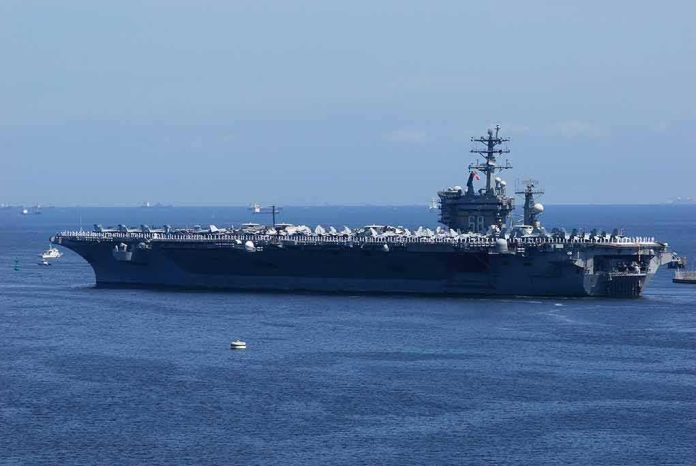
President Trump said nine months at sea for the USS Abraham Lincoln was “not nearly long enough,” even as sailors and families warned the record deployment was wearing people down.
Story Snapshot
- Trump praised the long deployment while families reported worsening morale and living conditions.
- Navy leaders said the crew remains resilient and denied a spike in suicidal ideation.
- The carrier went more than 200 days without a port call, setting a modern mark.
- Relief is planned with USS George Washington heading to the region, Navy says.
What Trump Said And Why It Hit A Nerve
President Trump told reporters the USS Abraham Lincoln’s nine months at sea were “not nearly long enough,” praising a hard line on deployments during rising tensions in the Middle East. His remark landed as families and lawmakers pressed for answers about crew welfare and basic ship conditions. The comment turned a readiness problem into a national debate. It gave fuel to people on both sides who fear leaders value optics over the rank and file carrying the load.
Trump’s stance underscored a larger divide. Families and sailors focused on sleep, food, water, and mental health. Leaders focused on mission and resilience. That gap fed a feeling that people far from the flight deck make the rules, while those on the deck live with the results. It matched a growing view on left and right that Washington defends the system first and the worker last, even when the worker wears the uniform.
How Long The Deployment Ran And What Families Reported
Stars and Stripes and other outlets reported the Lincoln spent more than 200 days without a port call, far beyond the 30 to 45 day rhythm that lets crews rest and reset. Families told reporters they saw morale drop, and said shortages and breakdowns made daily life harder. Complaints included food problems, water and plumbing issues, and missed mail. One sailor fell overboard and was rescued, and lawmakers asked for answers about safety and support.
More than 200 family members met in San Diego with acting Navy Secretary Hung Cao, pressing for a timeline and stronger mental health care. Some said the open-ended nature of the mission deepened stress. Others cited desperate messages from loved ones. These accounts raised fears that the Navy’s carrier force is stretched thin, which increases strain on ships, equipment, and people. The reports suggest the issue is not one crew’s weakness but a force-wide demand problem.
What The Navy Says And What It Is Doing
Navy officials defended conditions and readiness, pushing back on claims of a crisis. Defense Secretary Pete Hegseth said reports about the ship were “completely misrepresented,” and that crews received everything the service could provide. The Navy said it had not seen an increase in suicidal ideation or attempts aboard Lincoln and highlighted onboard support, including chaplains and mental health staff. Leaders still called the deployment “challenging,” while saying the crew remained mission-ready.
The Navy also moved to relieve pressure. Stars and Stripes reported the USS George Washington was headed to the Middle East to take over for Lincoln, pointing to a coming handoff after months at sea. That step suggests leaders recognized the limits of extended surge operations. It also shows how thin margins can become when global demand stays high. A relief ship is a fix for one crew. It is not a fix for a schedule model that leaves little room for recovery.
Why This Matters Beyond One Ship
Long, uncertain deployments have a cost that does not show up on a daily briefing slide. Research and past surveys link lost port visits, sleep debt, and family strain to burnout, lower morale, and retention risk. When planners stretch timelines, they borrow from the future force as people vote with their feet. That cycle can make the next deployment longer for the people who stay, which hurts trust up and down the chain.
USS Abraham Lincoln: Hard Deployment, But Is It a Crisis?
USS Abraham Lincoln has been on a very hard deployment. The crew is tired, families are worried, and the unusually long stretch at sea without normal liberty deserves attention.
But tired does not automatically mean… pic.twitter.com/1MFfr7sN7l
— Ron Skates (@RonJSkates) August 16, 2026
Both conservatives and liberals see a familiar pattern here. Leaders say, “We’ve got this.” Families say, “We’re at the breaking point.” The truth may include parts of both. But credibility comes from data, not slogans. The Navy could release command climate results, counseling trends, and maintenance and habitability reports from this cruise. Clear facts would help the country judge if the burden is fairly shared, or if the system again asks the many to cover for the few.
Sources:
zerohedge.com, stripes.com, forbes.com, cnn.com, migflug.com, drawpie.com, ir-ia.com, 19fortyfive.com, wsws.org, militarytimes.com, independent.co.uk, youtube.com