
As Taylor Swift and Travis Kelce turned Madison Square Garden into a fairy‑tale wedding stage, the sheer scale of security, secrecy, and star power raised fresh questions about how celebrity events now rival — and often eclipse — the priorities of everyday Americans.
Story Snapshot
- Taylor Swift and Travis Kelce held a lavish, celebrity‑packed wedding at Madison Square Garden in New York City, confirmed by Swift’s own publicist.
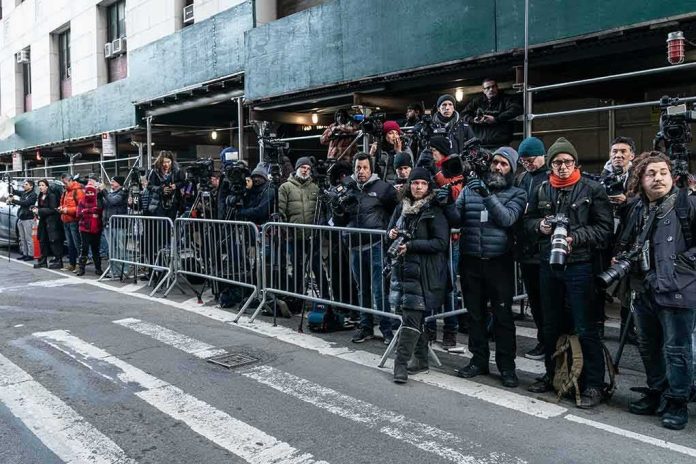
- New York City police, transit, and Amtrak officers shut down streets and flooded midtown with security for the two‑day private event, while regular New Yorkers navigated delays and closures.
- Media outlets and social platforms treated the “wedding of the century” as unquestioned fact and prime content, feeding a nonstop spectacle around a private milestone.
- The event highlights how celebrity power, corporate money, and city government increasingly align, while many Americans across the political spectrum feel their own needs are pushed aside.
A Wedding That Took Over Midtown Manhattan
New York City turned part of midtown Manhattan into a controlled zone for Taylor Swift and Travis Kelce’s wedding at Madison Square Garden. An internal New York Police Department memo described a private, two‑day event centered on the couple’s wedding, with hundreds of officers on patrol and road closures around the arena to manage security and crowds of fans. The memo outlined a rehearsal dinner for about 100 guests inside the Infosys Theater on Thursday evening, followed by a much larger gathering the next day.
According to a statement from Swift’s longtime publicist Tree Paine, the pop star and the Super Bowl–winning tight end “are officially married” after three years of dating. The statement confirmed that comedian Adam Sandler, a friend of the couple, officiated the ceremony and that Swift’s brother Austin and Kelce’s brother Jason played the roles of Man of Honor and Best Man. The city permit obtained by the Associated Press listed a “special event at MSG” starting Friday evening and running overnight, matching the timing described by media outlets on the scene.
Inside the Star‑Studded “Wedding of the Century”
On Friday, Madison Square Garden hosted what some entertainment outlets called a “wedding of the century,” with as many as 1,000 guests expected for the main celebration. Reports described doors opening mid‑afternoon for a cocktail hour, followed by a wedding on the arena floor around 5:30 p.m. and a reception running into the early morning. Celebrities from music, film, and sports arrived in fleets of black SUVs, giving the scene the feel of a Met Gala crossed with a championship parade.
Coverage from entertainment and sports media focused on glamorous details and famous faces. Outlets tracked arrivals of stars such as Jennifer Lopez, Ed Sheeran, and other high‑profile guests, describing the night as a rare gathering even by New York standards. Ahead of the weekend, reports also highlighted a massive charitable push, with Swift and Kelce donating about $26 million to causes they said were close to their hearts, many based in the city hosting their celebration. For millions watching online, the event became less a private wedding and more a made‑for‑screens cultural moment.
City Power, Celebrity Power, and Ordinary People
The Madison Square Garden wedding showed how far city government will go to serve a private event when enough money and fame are involved. The permit obtained by the Associated Press detailed a schedule that could keep the arena active until 4 a.m., with full street closures and drive‑through tents built around the stadium. Police, transit, and Amtrak officers coordinated for days to secure a party that only a tiny group of invited guests could attend, while regular commuters dealt with detours and congestion.
For many Americans, both conservative and liberal, this kind of special treatment feeds a growing belief that there is one set of rules for the famous and another for everyone else. Conservatives who already feel squeezed by high costs, crime, and a political class they see as out of touch may look at this operation and see proof that government can move fast — but mostly when elites ask. Liberals who worry about inequality and the “have‑versus‑have‑not” gap may see a city that can marshal huge resources to protect a celebrity party even as budget fights drag on over social services and basic infrastructure.
Media Spectacle and the Blurring of Reality
Major outlets across the news and entertainment world reported Swift and Kelce’s marriage as fact, leaning heavily on the publicist statement and city documents, with no organized counter‑narrative from credible sources. At the same time, legal and cultural analysts have noted a wider trend in celebrity culture where lavish “weddings” sometimes blur the line between personal commitment, legal status, and pure branding, as events are shaped for cameras, sponsors, and social media reach. That pattern leaves some citizens wary whenever a celebrity story is treated as unquestionable truth.
Taylor Swift-Travis Kelce wedding set for Friday at Madison Square Garden, AP reports https://t.co/074Uu7lqJs
— Boston 25 News (@boston25) July 4, 2026
In this case, there is solid paper evidence for a real ceremony, from the city permit to the publicist’s named statement, and no primary‑source refutation has emerged. Yet the speed and intensity of the coverage — and the clear financial incentive for media and platforms to feed every detail — fit a media system that many Americans see as more interested in clicks than in hard questions. For readers already frustrated with “deep state” elites and political showmanship, the MSG wedding becomes another symbol of a culture where spectacle is rewarded, power circles stay tight, and the daily struggles of ordinary families rarely get this level of careful planning, protection, or attention.
Sources:
facebook.com, nytimes.com, npr.org, cnn.com, yahoo.com, espn.com, townsendfamilylaw.co.uk