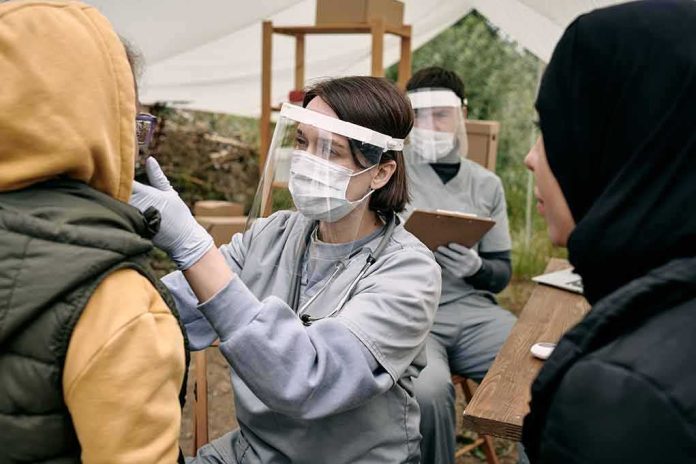
A new Ebola outbreak in Congo has killed dozens and raised cross-border fears, while global health bureaucrats once again expect American taxpayers to quietly pick up the bill.
Story Snapshot
- A new Ebola outbreak in Congo’s Ituri province has left at least 65 people dead and 246 suspected cases, with 13 lab-confirmed infections so far.
- World Health Organization (WHO) officials and Africa’s public health agencies are rushing teams and supplies, warning of possible spread toward Uganda and South Sudan.
- Unstable security, poor roads, and gaps in contact tracing make containment harder and raise questions about how prepared the world really is after years of “never again” pledges.
- American-supported agencies highlight past success in stopping Ebola at the source, but early data gaps and cross-border risk mean this outbreak still bears close watching.
Deadly Outbreak Emerges Again In Congo’s Troubled Ituri Province
Africa’s top public health authorities say a new Ebola outbreak in the Democratic Republic of the Congo’s remote Ituri province has already caused at least 65 deaths and roughly 246 suspected cases, with 13 samples confirmed positive by the country’s National Institute of Biomedical Research laboratory. [2][1] Most suspected infections are clustered in Mongwalu and Rwampara health zones, with additional reports from Bunia, an urban hub whose high population movement and mining-related travel raise obvious concerns about wider spread. [1][2]
World Health Organization Director-General Tedros Ghebreyesus says the agency picked up a signal of suspected Ebola cases on May 5 and sent a team into Ituri to support Congolese health officials and collect samples, which initially tested negative in the field before central laboratories confirmed Ebola in some specimens. [1] That testing discrepancy does not mean the disease was absent, but it underscores how fragile early detection can be in a region plagued by insecurity and thin health infrastructure. [1]
Cross-Border Risk And The Limits Of Global Promises
The Africa Centres for Disease Control and Prevention has formally warned that the outbreak’s location near the borders with Uganda and South Sudan, combined with intense population movement and mining-linked travel, creates real risk of cross-border spread if containment falters. [2] Poor road networks, ongoing violence, and gaps in contact listing and infection control at local clinics make it harder to quickly isolate cases or safely bury victims, challenges that have fueled larger Ebola epidemics in the past. [2][3]
Officials emphasize that this is Congo’s seventeenth recorded Ebola outbreak since 1976, arriving only months after the last one was declared over, and public memory still carries the scars of the 2018–2020 North Kivu–Ituri epidemic, which the World Health Organization says infected 3,481 people and killed 2,299. [3][2] That earlier crisis eventually stayed regional rather than global, but only after massive effort, and it sharpened skepticism toward repeated assurances that “lessons have been learned” and “systems are ready” for the next emergency. [3]
Response Effort Ramps Up, But Hard Questions Remain
World Health Organization leaders say their representative in Congo, along with other experts, is already on the ground in Ituri working “side by side” with Congo’s health ministry to contain the outbreak, after direct coordination calls between Tedros and Health Minister Roger Kamba. [1] The agency reports deploying medical supplies and protective gear to Bunia, the provincial capital, and releasing five hundred thousand dollars from its emergency contingency fund to sustain the response. [1]
Additional World Health Organization staff specializing in risk communication, community engagement, infection prevention, clinical care, logistics, and laboratory testing are promised, with a response plan that stresses contact tracing, active case finding, better surveillance, and safer treatment. [1] That blueprint mirrors what helped end prior Ebola events in Congo, but current public evidence documents mobilization more than results; there is not yet clear data on whether transmission is slowing, how many contacts are under follow-up, or whether any cases have crossed borders. [1][2]
Past Successes, Present Gaps, And What It Means For Americans
The World Health Organization points to its performance during the 2018–2020 North Kivu–Ituri outbreak, when the response included training thousands of health workers, registering about 250,000 contacts, testing 220,000 samples, treating patients with advanced therapeutics, and vaccinating over 303,000 people, while preventing a global spread. [3] That history shows determined work on the ground can contain even large Ebola outbreaks, especially when international partners and local authorities cooperate closely. [3]
The Democratic Republic of Congo is grappling with a new Ebola outbreak in its eastern Ituri province, with the health ministry reporting 80 deaths. The outbreak, which started in late April, underscores the ongoing health challenges in the region.
— Tegu breaking news. (@tegufy_news) May 16, 2026
For Americans watching from thousands of miles away, this new outbreak is a reminder that dangerous pathogens do not respect borders, and that early containment abroad often protects families at home better than panicked reactions later. At the same time, conservative readers are right to insist on transparency: officials have not yet released detailed situation reports, full lab sequencing of the suspected non-Zaire strain, or hard evidence that cross-border risk is under control, so continued scrutiny and demand for honest data remain essential. [2][1]
Sources:
[1] YouTube – WHO confirms new Ebola outbreak in remote Congo province
[2] YouTube – 246 suspected cases of Ebola, 65 deaths in Congo
[3] Web – Ebola outbreak 2018-2020- North Kivu-Ituri