One man in a face-covering and blue gloves at Sacramento International Airport just became a case study in how a “bomb at the checkpoint” headline can outrun the facts, the law, and common sense.
Story Snapshot
- Federal prosecutors say a Sacramento man tried to bring a working improvised explosive device through airport security.[3][4]
- Agents say they also found knives, zip ties, an aerosol can, a torch lighter, and five phones in his bag.[1][2][4]
- An FBI bomb technician says the device could have damaged a plane window at altitude and caused loss of cabin pressure.[1][2][4]
- The public has heard almost nothing from the defense, raising sharp questions about narrative, intent, and due process.[4][5]
Security, suspicion, and a very specific backpack
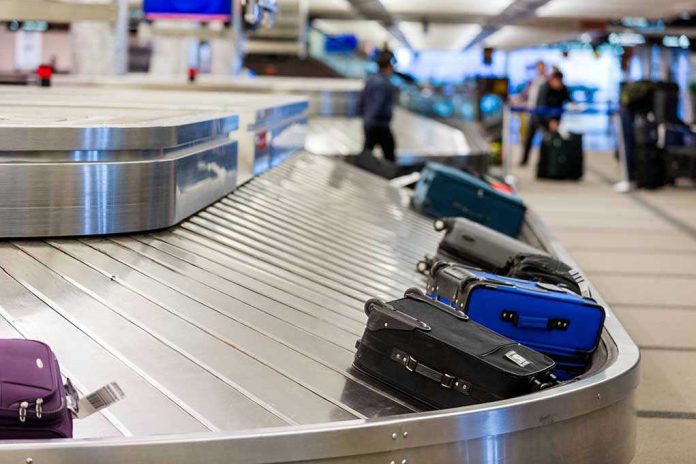
Federal authorities say that around 9 p.m. on a Saturday night, 49‑year‑old Kimani Osayande Jones walked into Sacramento International Airport wearing a scarf over his face and blue latex gloves, and headed for the Transportation Security Administration checkpoint.[1][2][4] Transportation Security Administration screeners scanning his carry‑on reportedly spotted something alarming: what prosecutors describe as an “M‑type” improvised explosive device, a powerful military‑style firework that is banned nationwide.[1][3] At that point, the line between odd traveler and security incident disappeared instantly.
Investigators say the device sat inside a backpack that looked less like ordinary luggage and more like a prop list from a low‑budget thriller: a knife, scissors, scissor blades, plastic zip ties, an aerosol can, and a butane or torch‑style lighter capable of igniting the device’s fuse.[1][2][4][5] Prosecutors also say Jones had five cellphones, with tape reportedly covering some front cameras.[5] One phone allegedly displayed a 15‑minute timer ready to start, and another displayed a message from an unknown number: “we will be awaiting your call.”[2][4][5]
From checkpoint scare to federal explosives case
Bomb technicians from the Federal Bureau of Investigation and the Sacramento County Sheriff’s Office were called to the checkpoint to remove the device.[1][4] According to the federal complaint described by the United States Attorney’s Office for the Eastern District of California, the item was a roughly 2.5‑inch brown cylinder with a one‑inch green fuse, later tested in a laboratory.[3][4] The powder and fuse were found to be “viable and energetic,” language suggesting it was not a toy or an inert replica but something capable of true detonation if properly initiated.[1][2][4]
An Federal Bureau of Investigation bomb technician concluded that if this improvised explosive detonated inside an aircraft flying above ten thousand feet and near a window, it had the potential to damage the aircraft and cause a possible loss of cabin pressure.[1][2][4] That does not automatically mean a catastrophic crash, but it squarely lands in the category of “life‑threatening risk” that airport security is designed to prevent. Federal prosecutors responded by charging Jones with unlawful possession of explosive material in an airport, a crime that carries up to five years in prison and a quarter‑million‑dollar fine if he is convicted.[1][3][4]
Intent, denial, and the silence on the other side
Prosecutors’ narrative paints a picture of intent: a viable explosive, an ignition source, blades, restraint‑style items, multiple phones, and ominous on‑screen text.[1][2][4][5] Yet the public record shows Jones reportedly told officers he did not know those items were in his bag and that he would be fine with simply discarding them.[4] After that, according to reporting, he invoked his Miranda rights and declined further interviews with the Sacramento County Sheriff’s Office or the Federal Bureau of Investigation.[4] Legally, that is his right; politically and culturally, it leaves a vacuum the government’s story quickly fills.
Media accounts rely heavily on the complaint and the United States Attorney’s press release.[1][2][3][4][5] There is, so far, no publicly available defense‑side expert report, no counter‑affidavit challenging whether this cylinder really was a functional weapon, and no alternate explanation for why those phones showed those particular screens at that exact moment. That asymmetry matters. In the federal system, most cases end in a plea deal, and the first wave of coverage often becomes the only frame ordinary citizens ever see. For a conservative reader who values both tough security and due process, that is a tension worth sitting with, not brushing aside.
Airport fear, government framing, and common sense
Airport‑bomb stories are a primal political accelerant; the combination of air travel, explosives, and apparent preparation triggers a near‑instinctive demand for harsh punishment. Prosecutors and agencies know this, which is why early press releases emphasize words like “viable,” “energetic,” and “loss of cabin pressure.”[1][2][3][4] That does not make those statements false, but it does underline that the first narrative out of the gate almost always belongs to the government, not the accused.
Common sense guided by conservative values suggests two simultaneous truths. First, bringing anything even close to a functioning explosive into an airport checkpoint—assuming that allegation holds—is beyond reckless and deserves severe legal consequences. Second, the same government that sometimes overreaches on speech, firearms, and protest also prosecutes explosive cases, and it should not get a free pass simply because the word “bomb” appears in the complaint. The hard work is insisting on full evidence while refusing to minimize genuine threats.
Sources:
[1] Web – Man nabbed with bomb in California airport
[2] Web – Sacramento man facing explosives charge after SMF arrest
[3] Web – Sacramento man found with explosive during airport security check …
[4] Web – Sacramento Man Charged with Bringing Explosive Material into …
[5] YouTube – Sacramento man charged with bringing explosive to …