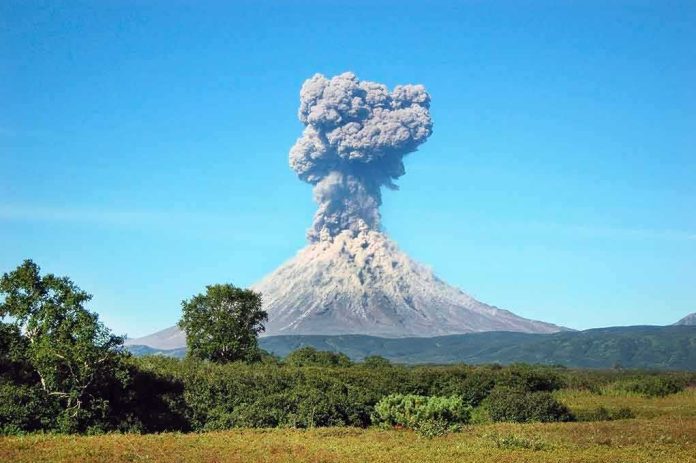
Guatemala has declared a national “danger” alert as Fuego volcano erupts again, forcing evacuations and reminding the world how quickly nature can expose the limits of government preparedness.
Story Snapshot
- Guatemala raised a nationwide orange danger alert after a major Fuego eruption and began evacuating nearby villages.
- The eruption is sending ash, hot gases, and volcanic debris several kilometers from the crater, threatening communities and travel.
- Local schools, roads, and volcano access routes have been closed as authorities try to keep people out of the path of flows.
- Fuego’s deadly 2018 eruption hangs over every decision, showing what happens when warnings come too late.
What Guatemala’s ‘danger’ alert really means
Guatemalan authorities raised the country’s second-highest emergency level, known as an orange danger alert, after a fresh eruption from the Fuego volcano. The National Coordinator for Disaster Reduction, called CONRED, announced the change and started evacuating two villages close to the volcano, which sits about 35 kilometers from Guatemala City. An orange alert signals that officials see active danger zones and that stronger eruptions could follow in hours or days. It is one step below a red alert, which means a major disaster is already underway.
Fuego is one of the most active volcanoes in Central America, so Guatemala has built a formal four-color alert system to manage risk. Green means normal background activity, while yellow marks elevated unrest, stronger explosions, and more ash. Orange, the current level, is uncommon and tells people that a stronger eruption appears likely soon and that some areas are now unsafe. At this stage, authorities can restrict access to the volcano, warn nearby communities, and begin precautionary evacuations before lives are lost.
What the eruption is doing on the ground
Reports from Guatemala and international outlets describe Fuego spewing ash, rocks, hot gases, and pyroclastic flows, which are fast-moving clouds of burning gas and debris. Lava and hot material have traveled several kilometers down ravines on the volcano’s flanks, putting communities 7 to 10 kilometers from the crater at risk if activity increases. The United States Embassy has warned that the eruptions create “elevated danger of injury” and urged people to avoid affected municipalities and follow local orders.
Authorities have already evacuated hundreds of residents from towns in the Chimaltenango, Escuintla, and Sacatepéquez regions, moving them into shelters set up away from the volcano. Past eruptions at Fuego have forced even larger evacuations, with some events in 2025 prompting warnings to as many as 30,000 people and suspension of classes. Access to the popular Acatenango–Fuego hiking routes and the volcano’s crater has been shut down, as tour operators are required to pause trips when alerts reach orange. A key highway, RN-14, has also been closed in earlier episodes because ash and debris can block roads and trap drivers.
Why this matters beyond Guatemala’s borders
Experts note that millions of people live within 100 kilometers of Fuego, and nearly 1.5 million within 30 kilometers, so each eruption tests how well emergency systems can protect ordinary families. Guatemala’s history with this volcano is grim: in 2018, Fuego produced the country’s most violent eruption in a century, killing at least 62 people and forcing about 3,000 residents into shelters. Later counts put the death toll even higher, with dozens more missing, showing how quickly ash and pyroclastic flows can overwhelm villages when warnings come too late.
For Americans watching from afar, this story highlights a familiar worry: can governments that struggle with corruption, budget limits, and political fights truly keep people safe when nature does not care about bureaucracy? Many citizens in the United States already believe that elites focus more on reelection and special interests than on real public safety. Seeing Guatemala rely on color-coded alerts, school closures, and road shutdowns might raise a hard question at home too: would our own systems move fast enough if a sudden disaster hit a major city or critical energy site?
Tourism, risk, and the deep state question
Fuego has become a magnet for volcano tourism, with hikers seeking dramatic views of glowing lava near the Acatenango summit. Experts warn that thrill-seeking tours often push the limits of safety and place more people in harm’s way, forcing emergency agencies to juggle economic pressure with public protection. In Guatemala, tours usually run during green and yellow alerts and pause at orange, but some operators have faced criticism for downplaying risk to keep business flowing. This tension looks familiar to many Americans who feel big money often outweighs common sense.
🇬🇹🌋 Guatemala's Fuego volcano has entered an intense eruptive phase, and authorities (CONRED) declared a national "orange alert" — a "danger" level, the second-highest — with preventive evacuations underway. Residents of two villages (El Porvenir and Las Lajitas) are being moved… pic.twitter.com/t6XsafAYyk
— 🔥🗞The Informant (@theinformant_x) August 4, 2026
In a world where trust in institutions is low, even a necessary danger alert can feed doubts about who is really being protected. On one hand, Guatemala’s use of orange alerts, preventive evacuations, and school closures shows officials trying to learn from Fuego’s deadly past and act before people die. On the other hand, citizens who have watched governments fail on basic tasks—from border control to disaster relief—may see yet another example of leaders reacting to crisis instead of fixing deeper problems, like unsafe housing on volcanic slopes or poor evacuation infrastructure.
Sources:
insiderpaper.com, aljazeera.com, gt.usembassy.gov, pbs.org, youtube.com, reliefweb.int, ktla.com, en.wikipedia.org