

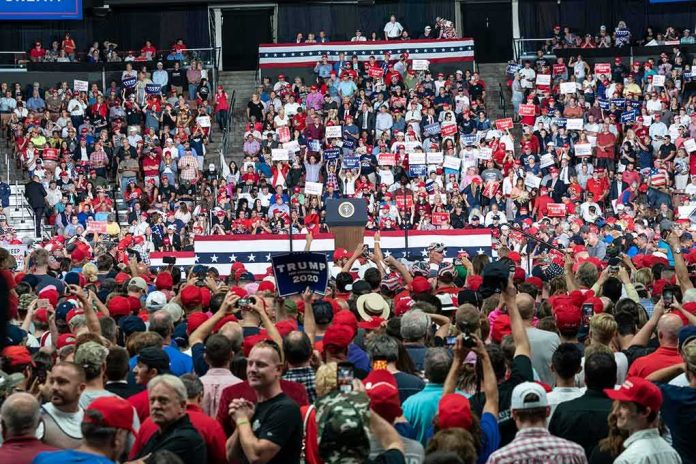
President Trump’s latest Michigan trip puts the state’s struggling auto workers at the center of a big promise: that his trade and manufacturing agenda can still bring their jobs and prosperity back.
Story Snapshot
- Trump is using Michigan factory and auto venues to sell his trade and manufacturing record to voters.
- He argues moves like replacing NAFTA with USMCA and using tariffs have “saved” the U.S. auto industry.
- Independent fact-checkers and some Michigan leaders say his economic story is far rosier than real data.
- Both left and right worry about elites and “the system,” and this fight over trade feeds that distrust.
Trump’s Michigan Stage: Auto Plants, Proving Grounds, and the Economic Story
President Trump is again choosing Michigan as the backdrop for a major speech on trade, manufacturing, and the auto industry, underscoring how central the state is to his economic message. His schedule centers on places that symbolize industrial power: General Motors’ Milford Proving Ground, where new vehicles and technologies are tested, and high-profile events with the Detroit Economic Club and local business leaders. These settings send a visual signal to voters that his “America First” agenda is tied directly to real factory floors, not just Washington talking points.
Trump’s Michigan visits also include tours of a Ford plant that builds F-150 pickup trucks, the best-selling domestic vehicle, and rallies that focus on jobs, trade, and the wider economy. At the Ford facility, he walks the assembly line and praises the trucks as proof that American manufacturing can still lead the world. Then he carries that message into speeches, promising strong growth and a manufacturing rebound even as many families still feel squeezed by high prices and uneven wages. This repeated pattern is designed to assure anxious workers that someone in power is fighting for them.
What Trump Says His Trade and Manufacturing Policies Did
In speeches to Michigan audiences, Trump ties the state’s future to his trade agenda, especially his criticism of the old North American Free Trade Agreement and his praise for its replacement, the United States–Mexico–Canada Agreement (USMCA). He says deals like USMCA “close terrible, unfair loopholes” and require more of each car to be made in North America, with strong rules to ensure American workers get those jobs. He also claims tariffs on foreign vehicles and parts have cut the trade deficit, boosted retirement accounts, and drawn new investment back into U.S. factories, particularly in autos.
Trump often frames this as a sharp break from past “globalist” policies that, in his telling, sent tens of thousands of factories overseas and gutted middle-class jobs. He reminds Michigan crowds that since NAFTA was approved, the country lost a large share of its manufacturing jobs, and since China joined the World Trade Organization, tens of thousands of American plants closed. For many conservatives and even some liberals, that story matches what they have seen in their own towns: shuttered plants, hollowed-out main streets, and fewer paths to the American Dream for people who do not have elite degrees.
Where the Facts and the Spin Start to Diverge
Independent fact-checkers who reviewed Trump’s Detroit Economic Club speech say he painted a much brighter picture of the economy under his leadership than official data supports, and a darker view of his opponents’ record than numbers show. They note he claimed the “strongest and fastest economic turnaround in our country’s history,” with investment booming and inflation “defeated,” even as many Michigan residents still struggle with high living costs, housing problems, and medical bills. His boasts about keeping “all” his promises also clash with stalled efforts to fully address health care, drug prices, and long-term wage growth.
Michigan Governor Gretchen Whitmer has offered a direct challenge to Trump’s tariff storyline, arguing that his tariff strategy hurt manufacturing and helped some foreign competitors instead of protecting local jobs. Her view reflects a wider fear, especially on the left, that trade fights and tariff shocks can disrupt supply chains, raise prices, and push some production to other countries anyway. At the same time, the research available does not yet give a clear, detailed data picture tying USMCA or Trump’s tariffs to specific Michigan job gains or losses, leaving both sides to rely more on stories than on hard proof.
A Deep State of Distrust: Why This Matters Beyond One Speech
Michigan’s trade and manufacturing debate taps into a larger anger shared by many conservatives and liberals: the belief that the federal government and the “elites” who run it are failing ordinary Americans. Trump’s claim that a mix of tariffs, new trade rules, and deregulation has “saved” the auto industry speaks to workers who feel abandoned by past leaders and skeptical that anyone in Washington truly cares about their future. For these voters, seeing a president at a proving ground or factory offers symbolic hope that their struggle is finally being noticed.
Manufacturing cars in America helps create American prosperity.
Since taking office, President Trump has ignited an automotive renaissance, onshoring production, restoring factory jobs, and driving massive investment from automobile companies.
Don't miss his speech at General… pic.twitter.com/okOKbsWy3A
— The White House (@WhiteHouse) July 27, 2026
Yet the gap between campaign-style promises and detailed evidence can deepen distrust on both sides. When news coverage focuses on where Trump speaks and what themes he hits, but rarely walks through the actual data on jobs, wages, and plant investment, many people suspect they are again being managed rather than informed. This fuels the sense that a small group of powerful insiders shape the narrative while everyday workers live with the real consequences. Until leaders of both parties back up their trade and manufacturing claims with transparent numbers and plain-language explanations, Michigan’s auto workers—and millions like them—will keep wondering whether they are hearing truth or just another polished story.
Sources:
facebook.com, cbsnews.com, thehill.com, fox2detroit.com, freep.com, pbs.org, youtube.com, cnn.com