

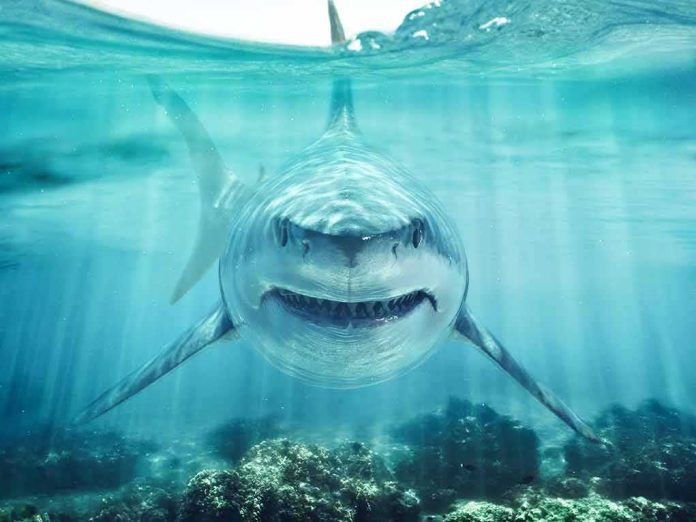
Scientists found that Greenland sharks keep working eyes for more than a century, hinting at natural ways to protect vision far longer than humans typically can.
Story Snapshot
- A Nature Communications study reports adult Greenland sharks have preserved, working retinas adapted to deep, dim waters.
- Researchers link long-term retinal health to DNA repair genes, including ercc1 retention and higher ercc4 expression.
- Exams of 100- to 134-year-old sharks showed no obvious retinal decay and rod cells tuned to blue light.
- Findings may inform future treatments for human eye aging, though the mechanism is not yet proven causal.
Peer-Reviewed Finding: Retinas That Still Work After 100+ Years
Nature Communications published new research showing that adult Greenland sharks keep a preserved and functional visual system. The team reported intact retinal structure and signs of light sensing suited for deep, dark seas. The study says the visual system appears well adapted to extreme low light, which matches the shark’s slow, long life in cold northern waters. These results challenge the old idea that these sharks are nearly blind because of cloudy corneas from parasites and damage.
Researchers examined eyes and retinal tissue from older sharks and found no obvious retinal degeneration. Reporting on the study says the sample included 10 deceased sharks between 100 and 134 years old. That age range matters because human eyes often show wear well before then. Here, the retina still looked healthy, and the molecular signals of vision remained present. The team found rod cells and visual pigments tuned to blue light common in deep water.
How the Sharks See in the Dark: Rods and Blue-Light Tuning
Study coverage notes the retina relies on rods, which help in dim light. The pigment rhodopsin appears tuned near blue wavelengths common in the shark’s habitat. That tuning supports motion and contrast detection needed for slow, deep-water hunting. The evidence includes retinal structure, gene expression tied to visual function, and lab measures that point to light sensitivity in that range. These traits align with the shark’s ecology and help explain how such old animals still find food.
Scientists did not run full behavioral vision tests across centuries, which is not possible. But they did perform genomic, transcriptomic, and histological work on the eyes. That mix can show what cells are present, whether key genes are active, and whether tissues appear healthy. Together, these lines of evidence point toward a working visual system in old sharks. The authors present these as strong findings about structure and function in very low light.
Why the Retinas Last: A DNA Repair Clue
The authors tie the preserved retina to DNA repair pathways. They report the retention of the ercc1 gene in long-lived sharks and higher expression of ercc4, also known as xpf, in Greenland sharks. These two form a repair complex that helps fix damaged DNA. The paper says these data suggest a role for repair in keeping the retina intact for a very long time. That link could matter to human eye aging if future tests confirm cause and effect.
This link fits a growing idea in aging science: cells that fix damage well tend to last longer. The shark results add a rare, natural case in a vertebrate with extreme lifespan. If the same repair activity protects retinal cells in other animals, scientists could learn new ways to slow human retinal decline. The study does not prove the mechanism yet, but it points to a clear target for lab tests that could follow.
Limits, Context, and Why This Matters to People
The sharks examined were more than a century old, not 300 or 400 years old. The core evidence is strongest for preserved vision past 100 years, not for every decade across four centuries. Still, the species is known for very long lives based on earlier eye-lens radiocarbon dating work. That background sets the stage for why this retinal health span looks so unusual compared with most vertebrates, including people.
The study sits inside a familiar science pattern. One careful paper on a rare species delivers strong, narrow results. Headlines can then stretch the claim. Here, the solid finding is preserved, working retinas in old Greenland sharks and a likely role for DNA repair. That is enough to matter for human health research. If repair pathways like ercc1 and ercc4 keep retinas young in nature, drug makers could target similar systems to protect sight as we age.
Sources:
sciencedaily.com, nature.com, pmc.ncbi.nlm.nih.gov