

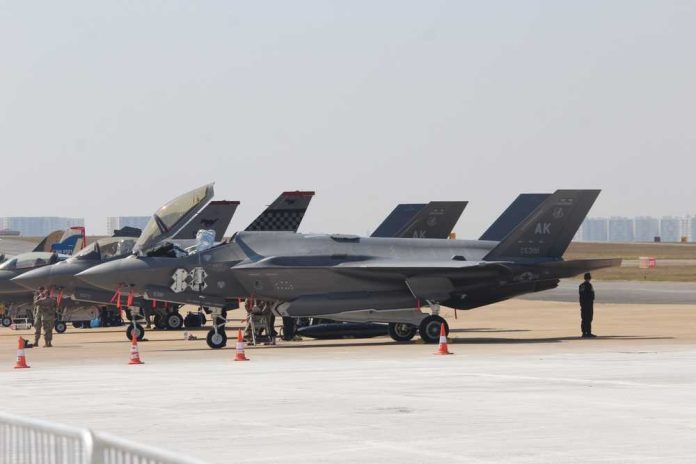
The F-35’s new APG-85 radar is arriving late, missing from some delivered jets, and now facing a far bigger question: is it only a sensor, or something more?
Quick Take
- The U.S. military has accepted at least six Marine Corps F-35s without radars because of APG-85 delays.
- Program testimony says the radar needs far more cooling, rising from about 32 kilowatts to 62 to 80 kilowatts.
- One analyst says that power jump could fit a high-power microwave attack role, but that claim is not officially confirmed.
- Official and technical descriptions still identify the APG-85 as a fire-control radar and multifunction sensor.
Why the Radar Delay Matters
The most concrete fact is the delay itself. The U.S. military has confirmed at least six F-35 Joint Strike Fighters for the Marine Corps were accepted without radars, and the APG-85’s first production lot is not expected until 2028. That gap shows how much the Block 4 upgrade depends on the radar. It also shows how stressed the F-35 upgrade chain has become, with power, cooling, and delivery timing all tied together.
That pressure is not just about schedule. Official testimony quoted in reporting says the aircraft’s current cooling limit is about 32 kilowatts, while the program’s future need is 62 to 80 kilowatts. Those numbers are large enough to fuel debate. But cooling demand alone does not prove a weapon mode. It does, however, explain why the radar is drawing so much attention from defense analysts, contractors, and critics of Pentagon procurement.
Why Some Analysts See a Weapon
Bill Sweetman and other commentators argue that a radar needing that much cooling may be able to do more than search and track targets. In that view, the APG-85’s gallium-nitride design and wider frequency range could support high-power microwave use against enemy radios, sensors, or radar systems. The logic is technical, but it remains interpretive. No official document in the material provided confirms that the APG-85 has a directed-energy attack mode.
That uncertainty is important because the claim touches a familiar pattern in military-tech debates. When a new radar draws more power and needs more cooling, some observers jump to weaponization. Sometimes that suspicion later proves wrong. In this case, the available official descriptions still describe the APG-85 as a fire-control radar or advanced multifunction sensor meant to improve awareness and defeat threats, not as a separate microwave weapon.
🇺🇸 The F-35's AN/APG-85 AESA radar may be more than just a sensor. Analysts say its GaN-based design and 62–80 kW power/cooling requirements could support High-Power Microwave (HPM) directed-energy capabilities for electronic attack.https://t.co/Qpho2wS75N pic.twitter.com/OnVHn6F6fw
— The Defense News (@TheDefenseNews) July 5, 2026
What Officials Say the APG-85 Does
Official and industry-facing descriptions point in a different direction. Radartutorial describes the AN/APG-85 as a fire-control radar built for situational awareness and fire control. Northrop Grumman describes it as an advanced multifunction sensor for the F-35’s future sensor suite. Reporting from Aviation Today says the radar is intended to deny adversaries use of the electromagnetic spectrum and improve targeting accuracy, which still fits a radar and electronic warfare role rather than a confirmed directed-energy weapon.
That split between official language and analyst suspicion leaves the public with an old problem. The Pentagon rarely explains new capabilities in plain terms, and contractors often use broad labels that hide more than they reveal. At the same time, social media can turn incomplete technical clues into certainty before the record is clear. The result is a story shaped by delay, secrecy, and competing interpretations of the same cooling numbers.
What Is Still Missing
The key missing piece is direct technical proof. The material provided does not include a public Senate transcript, a Northrop Grumman specification sheet, or an Air Force document saying the APG-85 can fire high-power microwave pulses. Without that, the directed-energy claim remains a theory built from thermal clues. That is enough to raise questions, but not enough to settle what the radar can actually do in combat.
Sources:
19fortyfive.com, instagram.com, radartutorial.eu, facebook.com, aviationtoday.com