

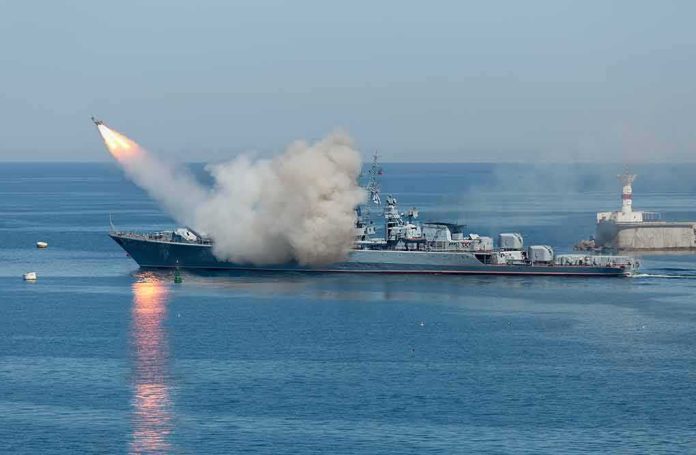
Thirteen nights of U.S. airstrikes on Iran, launched after surprise attacks on commercial ships, are turning a distant shipping dispute into a new test of American power, presidential judgment, and the risk of a wider war.
Story Snapshot
- U.S. forces have hit Iranian military targets for more than a dozen straight nights after ship attacks in the Strait of Hormuz.
- Central Command says the strikes are a “powerful response” to defend commercial shipping and keep the vital waterway open.
- Iran has fired back at U.S. assets and Gulf partners, raising fears that limited strikes could grow into a broader Middle East war.
- Experts are already split over whether Washington’s self-defense claim under international law really holds up.
What Triggered the New U.S. Strikes on Iran
U.S. Central Command says the latest wave of strikes began after Iranian forces hit commercial cargo ships moving through the Strait of Hormuz, a narrow passage that carries a huge share of the world’s oil and gas. Military officials blamed the Islamic Revolutionary Guard Corps for attacks on vessels like the GFS Galaxy and other flagged ships and said those hits broke an already fragile ceasefire. For many Americans, this sounds familiar: once again, a crisis far from home threatens energy prices, global trade, and the risk of another drawn-out conflict.
After the first ship attacks, U.S. aircraft and missiles struck Iranian missile and drone sites and coastal radar along Iran’s shoreline and nearby islands, including Qeshm, directly facing the Strait. Central Command described the initial package as a “powerful response” meant to punish Iran and to stop more strikes on civilian mariners. The message was clear: the Trump administration would use hard military power, not just sanctions or speeches, to keep global commerce moving and to show Iran there were real costs for crossing red lines.
How the Strike Campaign Expanded Night After Night
What began as a single night of retaliation quickly grew into a sustained air campaign. News outlets and Pentagon statements together show at least thirteen consecutive nights of strikes, with waves often lasting hours. U.S. forces hit air defense systems, command centers, coastal radar, missile and drone launch and storage sites, and more than sixty small boats that Central Command says Iran used to threaten shipping. Some strikes reached deeper into Iran, including around Bandar Abbas and Greater Tunb Island, showing that the operation targeted a broad network, not just one launch site.
Central Command says each round of attacks was designed to “degrade” Iran’s ability to go after commercial ships and “innocent civilian mariners” in the Strait. That framing matters. It presents the campaign not as a push for regime change or a full-scale war, but as a focused effort to protect a specific economic lifeline and U.S. forces nearby. Still, repeated strikes on command centers, logistics hubs, and surveillance networks look, in practice, like serious warfare. For citizens watching from home, it can feel like the country slides into another open-ended fight while leaders in Washington trade statements about self-defense and deterrence.
Iran’s Response and Rising Regional Risks
Iran has not stood still. Reports describe Iranian responses that include firing at U.S. military assets and infrastructure in nearby Gulf states like Bahrain, Kuwait, and Qatar, where American bases and aircraft are located. Other coverage notes fresh attacks on tankers and threats to close or disrupt the Strait, turning the waterway itself into a pressure point on the global economy. Every new hit from Tehran draws talk of more U.S. and partner strikes, creating a dangerous back-and-forth that can easily outrun any ceasefire deal or diplomatic plan.
President Trump and his team have linked earlier Iran actions to strong replies, including strikes on nuclear facilities and other key sites, while insisting they do not seek full regime change. Yet the pattern is clear: Iran pushes with missiles, drones, or attacks on ships; the United States answers with airstrikes it calls self-defense; both accuse the other of breaking ceasefires or international law. For Americans already tired of endless wars and suspicious of “deep state” decision-making, this cycle raises hard questions about who is really steering foreign policy and whose interests are being protected.
Legal Debates and What Americans Still Do Not Know
The U.S. government says these new strikes are lawful self-defense under the United Nations Charter’s Article 51 and, in some cases, collective self-defense with allies. The State Department’s top lawyer has argued that decades of Iranian aggression justify force to protect both U.S. and Israeli security. At the same time, more than one hundred international law experts and several legal analyses say Washington’s actions clearly violate the Charter’s ban on using force, because they see no proven “armed attack” or strict necessity for each strike.
Explosions were reportedly heard in southern Iran as US Central Command (CENTCOM) announced that US forces had started to carry out air strikes in Iran on Thursday morning.
Several locations in southern Iran were targeted by US forces, with explosions heard in the cities of…
— Alex 🇺🇸 (@A_L_E_X_V_E_G_A) July 30, 2026
From a citizen’s point of view, one troubling fact stands out: the public record so far leans almost entirely on U.S. military statements and brief news alerts. We do not yet see full incident reports on the ship attacks, the detailed legal memos behind each strike, or independent accounts from crews whose vessels were hit. Without that, people on both the right and the left are left to take officials at their word. Many who already distrust elites and permanent bureaucracies will worry that once again, major decisions about war, peace, and the global economy are being made far above their heads, with limited transparency and real lives on the line.
Sources:
townhall.com, centcom.mil, npr.org, aljazeera.com, cnn.com, reuters.com, apnews.com, youtube.com, en.wikipedia.org, justsecurity.org, blogs.timesofisrael.com