

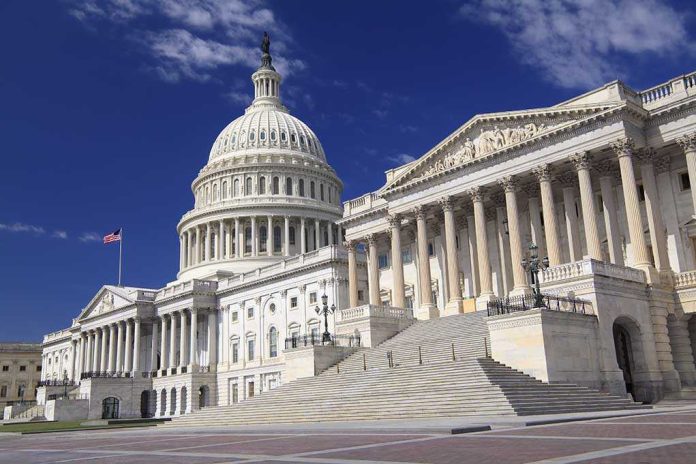
A high-profile media figure says Congress could shrink Electoral College mismatches without amending the Constitution by adding hundreds of seats to the House.
Story Snapshot
- Chuck Todd urged Congress to expand the House to about 800 seats to curb Electoral College-popular vote splits.
- Federal research confirms Congress can change House size by statute; it is fixed at 435 today.
- Scholars say a bigger House would reduce, but not end, “inversion” risks in close elections.
- Public support for expansion is weak; most adults favor keeping 435 seats or fewer.
What Todd Proposed And Why It Matters
On November 13, journalist Chuck Todd argued that Congress could “uncap” the House to roughly 800 members. He said that would make representation more population-based and lessen the chance that the Electoral College winner loses the popular vote. He also said no constitutional amendment is needed because Congress sets House size by law. His pitch touches a broad frustration: many Americans think the system rewards insiders and ignores voters in both big cities and small towns.
Congressional research backs the legal path Todd cited. The Constitution leaves House size to Congress. Federal law has capped seats at 435 for over a century. Lawmakers could pass a bill to raise that number. Doing so would change how many Electoral College votes each state gets because that count equals a state’s House seats plus its two Senate seats. That link is why House size debates often flow into presidential election debates.
What The Evidence Says About Changing Outcomes
Peer-reviewed work finds that enlarging the House lowers, but does not erase, the chance of an “inversion,” where one candidate wins the popular vote and the other wins the Electoral College. Even at very large House sizes, close races still carry about a one-in-ten inversion risk. Winner-take-all rules inside states remain a big driver of distortions, even if the House gets much larger. That means expansion may help, but it is not a silver bullet on its own.
Other modeling points the same way on partisanship. A review linked to the American Academy of Arts and Sciences reported no steady tilt toward either party from expansion. Larger Houses can shift Electoral College weights toward big states, but not in a way that locks in an advantage for Democrats or Republicans across elections. That cuts against fears that one side could “rig” the map simply by changing chamber size through a bare majority.
Practical Tradeoffs: Costs, Maps, And Trust
Expanding the House would create hundreds of new districts. Drawing those lines could spark fierce fights. Analysts warn that adding seats without strong anti-gerrymandering rules could deepen distrust. People already think political insiders game the maps to protect themselves, not voters. Advocates argue that pairing expansion with clear, fair map standards would help guard against abuse and keep the focus on better local representation.
To House Democrats, Senate Democrats, and Democratic governors and state legislatures across the country: voters gave you majorities across the board with a clear mandate for sweeping action this January, and it is time to deliver.
Follow through on Representative Hakeem…
— Elgin Charles (@ElginCharles) November 12, 2026
Public opinion is another hurdle. A 2023 survey found only about three in ten adults want a bigger House. A small majority prefers the current size, and a notable share wants fewer members. Skeptics worry about more cost, more staff, and more gridlock. Supporters counter that districts are now so large that many people cannot reach their representative or get basic help with federal problems. That day-to-day service gap feeds the sense that Washington serves the few, not the many.
How This Fits The Bigger Fight Over Power
For decades, House seats did not grow with the population. The average district now holds far more people than in the past. Critics across the spectrum say that swells lobbyist clout, mutes local voices, and warps the Electoral College by freezing House-based electors while cities and suburbs boom. Todd’s idea taps a shared concern on right and left: both feel the system is stuck, and that gatekeepers in Washington protect their power at the public’s expense.
Here is the bottom line for readers. Congress can expand the House with a simple law. Doing so would likely make districts smaller and nudge Electoral College math closer to population. Research says it would reduce, but not end, popular vote–Electoral College splits, especially in razor-thin races. Any serious push would also need guardrails on redistricting and a plan to win public trust. Without that, many will see expansion as another inside deal, not a fix.
Sources:
congress.gov, dailykos.com, paulschiffberman.substack.com, blumenauer.house.gov, delawareonline.com