
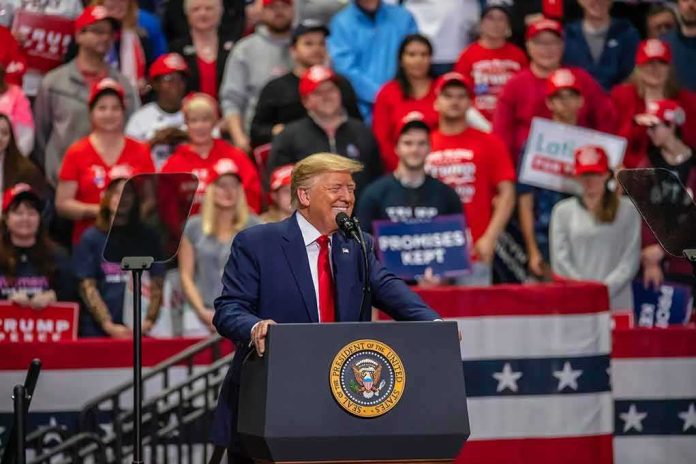
President Trump canceled his planned Iowa rally and will speak to voters through a telerally instead, signaling a late shift in campaign strategy backed by party officials.
Story Snapshot
- Trump scrapped Sunday’s in-person rally in Dubuque, Iowa, and will hold a telerally.
- Party officials say virtual events let him reach voters in many states fast.
- The Dubuque event had been set for the Five Flags Center on November 1.
- Research shows in-person rallies can deliver short, local polling bumps.
What Changed: From Dubuque Rally To Telerally
Republican officials confirmed that President Trump canceled a Sunday rally at the Five Flags Center in Dubuque, Iowa, and will replace it with a telerally aimed at boosting Republican candidates in the final campaign stretch. The party framed the move as a way to talk to more voters, more quickly, across many states at once. The schedule change came days before Election Day and followed a week of travel and media events tied to close races and turnout pushes.
Cancelling an in-person stop matters in Iowa, a state where retail politics and local energy still count. A rally is more than a speech; it is a show of presence and momentum in a specific place. Political research finds rallies signal strength and help shape press coverage and perception of enthusiasm in a region. That symbolism can matter to undecided voters and volunteers as they decide how to spend their final days before voting or helping get out the vote.
Why Campaigns Use Telerallies In The Final Days
Party aides said telerallies help scale the candidate’s message to many markets in less time than flying to each venue. That approach can be useful when races are spread out and time is short. Studies of telephone town halls and similar tools show these events can raise favorability and deliver a clear message to large audiences. They are popular because they are cheap, fast, and can be targeted to likely voters without the logistics and risk of a physical event.
Still, telerallies trade reach for the electricity of a live crowd. Past research on 2016 found Trump’s in-person rallies created short-lived bumps in support, often about a week, and boosted turnout intent among strong Republicans in those areas. That suggests canceling a local event may forgo a near-term lift in the Dubuque media market. Campaigns weigh that cost against the chance to speak to voters in many states on the same night, which can help where several races need attention at once.
What This Means For Voters Who Feel Left Behind
Voters across the spectrum see big rallies as a sign that leaders will show up and listen. Many also believe the political class spends more time on optics than on fixing daily problems like high costs, health bills, and jobs. This shift to telerallies highlights that tension. Party managers are chasing scale and efficiency, while many citizens want face-to-face accountability. The move underscores how modern campaigns try to win through media reach rather than local presence.
For conservatives focused on border security, inflation, and energy costs, and for liberals focused on inequality, health care, and civil rights, the method may feel secondary to results. But method shapes message. An in-person visit to Dubuque can rally volunteers and earn free local news coverage. A telerally can deliver a uniform script to hundreds of thousands. Both tools have value; both have limits. The open question is which better drives turnout where it counts this week.
President Trump has canceled his final planned in-person midterm rallies in Kansas (Saturday) and Iowa (Sunday), pivoting to more than 20 tele-rallies to reach voters across nearly 20 states before Election Day on Nov. 3.
RNC and White House officials say the shift maximizes his…
— Dr CHIRAG 🩺 (@Chiragrx07) October 30, 2026
The bottom line is straightforward. President Trump canceled the planned Iowa rally and will hold a telerally instead, with party officials arguing it maximizes time and reach in the final days. Evidence says rallies can give short, local boosts, while virtual events can spread messages faster to more people. In an age when many Americans doubt that leaders hear them, how campaigns choose to communicate is not just tactics. It is also a test of trust and priorities.
Sources:
nytimes.com, cbs17.com, patriotledger.com, newsfromthestates.com, tandfonline.com, openstax.org