As millions watch the August 12 total solar eclipse for awe and spectacle, NASA will quietly turn it into a flying and balloon‑borne lab to study how our Sun and atmosphere really behave.
Story Snapshot
- NASA will chase the eclipse with a high-altitude WB-57 jet and dozens of scientific balloons over Iceland and Spain.
- The jet’s nose-mounted cameras will capture rare images of the Sun’s outer atmosphere, while balloons track how Earth’s lower air responds to sudden darkness.
- Student teams in the Nationwide Eclipse Ballooning Project will run many of the balloon flights, blending real research with education.
- This mission continues a decades-long pattern of NASA using eclipses as moving laboratories, even as public messaging focuses more on spectacle than hard data.
NASA Turns a Sky Show into a Moving Science Lab
On August 12, a total solar eclipse will sweep across Greenland, Iceland, and Spain, briefly turning day into twilight for millions of people. NASA has confirmed that its funded science teams will “chase the Moon’s shadow” using a high-altitude jet and scientific balloons to study the Sun’s dynamics and how the sudden darkening affects our atmosphere. In plain terms, while most of us look up and take pictures, NASA will treat the eclipse like a rare, controlled experiment that moves across the planet.
NASA has identified the jet as the WB-57, a former bomber turned research aircraft that can fly about 50,000 feet above the ground. In the plane’s nose, engineers have installed a set of four cameras to take high-resolution images of the Sun’s corona, the faint outer atmosphere only visible during totality. Flying above most clouds and water vapor lets these cameras see visible and infrared light much more clearly than ground telescopes, which is why NASA keeps returning to aircraft whenever a major eclipse crosses land.
What the Balloons Will Watch in Iceland and Spain
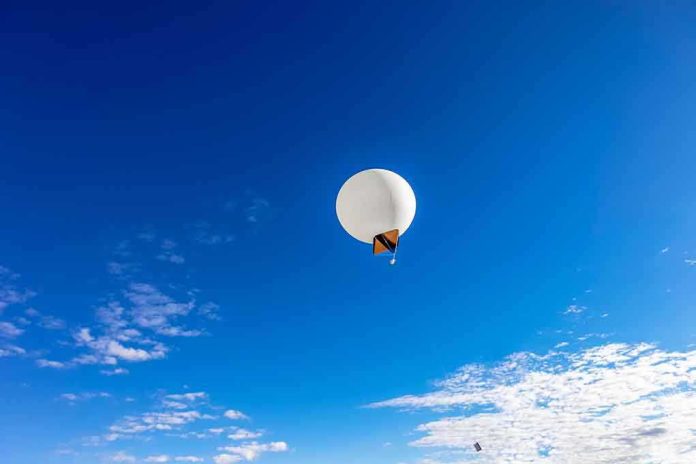
Below the jet, NASA is backing the Nationwide Eclipse Ballooning Project, led by scientist Angela Des Jardins at Montana State University. This project sends student teams from several universities to launch balloons into the upper atmosphere during eclipses. For the August event, NASA says two teams in Iceland will launch a total of 80 balloons, starting 18 hours before the eclipse and continuing until eight hours afterward. These balloons will measure how the “boundary layer,” the part of the atmosphere that touches the ground, changes as sunlight fades and then returns.
In Spain, balloon teams will fly fewer but more camera-focused payloads, including six balloons with 360-degree cameras to image the eclipse shadow from above. This gives scientists and students a bird’s-eye view of how the shadow races over land and sea, and how clouds and air respond as temperatures dip for a few minutes. Past NASA-supported balloon work during the 2017 eclipse measured weather changes and “gravity waves” in the atmosphere triggered by rapid cooling, so this is not a one-time stunt; it is part of a growing record of eclipse-driven atmospheric science.
Students in the Middle of Real Eclipse Research
NASA’s education office describes the Nationwide Eclipse Ballooning Project as a way for student teams to carry real instruments into the upper atmosphere and study temperature shifts, pressure changes, and waves in the air during eclipses. Hundreds of students have already flown balloons for NASA in past eclipses, collecting weather data and near-space video across the path of totality. The 2026 flights in Iceland and Spain continue this pattern, proving the balloon program is a recurring platform, not just a media event or classroom exercise.
Many Americans, both conservative and liberal, worry that big agencies chase publicity instead of serious work, or use student projects to look good without tackling hard problems. Here, the record shows a mix of outreach and real data: instruments are timed to launch well before and after totality, and past flights have produced measurements of atmospheric response that scientists say they “don’t know a lot about” yet. That does not mean every balloon carries cutting-edge gear, but it does show NASA is using the eclipse window to answer basic questions about how our air reacts when the Sun’s light is suddenly cut off.
Long History, Thin Public Details, and Why That Bothers People
NASA’s own technical records show this strategy has deep roots. A 1966 report describes 26 scientists aboard a jet aircraft and the Convair 990 “Galileo” flying laboratory making observations of a total solar eclipse, proving airborne eclipse science is not new. Modern WB-57 missions during earlier eclipses have used advanced visible and infrared cameras to track the corona and even hunt for tiny asteroids near the Sun. Despite this long history, today’s public announcements still describe the 2026 jet mission in broad terms and do not list the exact instruments, data products, or lead investigators.
NASA deploys jet and 86 balloons to chase August 2026 total solar eclipse https://t.co/d3INeGMpsv
— Digital Brain (@digitalbrain01) July 27, 2026
In an age when many citizens distrust “the elites” in government, that lack of detail can feed doubts, even when the basic facts are solid. Media stories often hype “jaw-dropping” jets “chasing the shadow” while skipping the hard questions about what is measured, how it is calibrated, and how results will be shared. NASA clearly states the intent to study the Sun’s dynamics and the boundary layer with jets and balloons, but it has not yet released full mission plans or post-flight results for this August campaign. For people on both the right and the left who feel shut out by distant institutions, asking NASA to show more of the math and less of the marketing is a reasonable demand.
Sources:
science.nasa.gov, space.com, scientificamerican.com, jpl.nasa.gov, nasa.gov, npr.org, astrobiology.nasa.gov, upi.com, ntrs.nasa.gov, yahoo.com