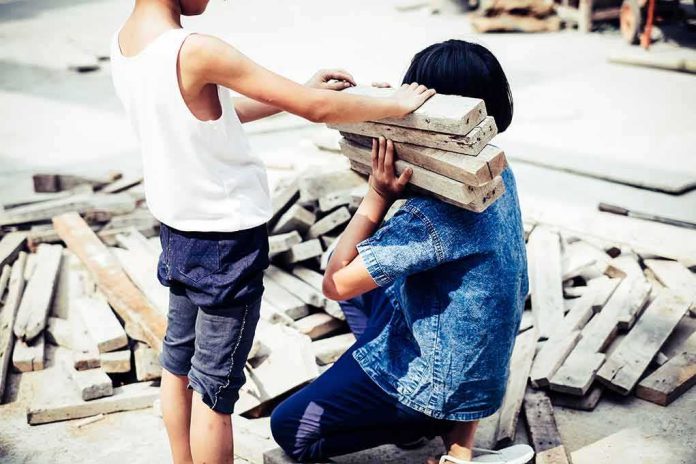
Haiti’s gangs have pushed the country to the brink, driving nearly 1.5 million people from their homes and pulling children into a cycle of fear, hunger, and violence.
Story Snapshot
- Gang violence has displaced about 1.5 million Haitians, a record level of crisis.
- Armed gangs now control most of Port-au-Prince and are spreading into new regions.
- Children are being killed, abused, and recruited by gangs as the state weakens.
- Food, shelter, and safety are collapsing while global leaders struggle to respond.
Gang Violence Drives Mass Displacement Across Haiti
United Nations migration data now show that nearly 1.5 million people in Haiti have been forced from their homes by gang violence, which is about 12 percent of the country’s population. The International Organization for Migration reports that escalating attacks and threats have pushed displacement to record levels, leaving families in makeshift shelters, schools, and crowded sites with little protection. United Nations officials say this surge is clearly linked to armed gangs, not natural disasters or normal political unrest.
Earlier reports already showed a sharp rise. In January 2025, United Nations data found about 1.04 million people living in displacement, more than triple the figure from late 2023. By mid-2025 that number had climbed to about 1.3 million, making Haiti the country with the world’s largest displacement driven by crime-related violence. New 2026 figures now reach almost 1.47 million people still displaced inside Haiti, confirming that the crisis has deepened rather than eased.
Gangs Tighten Control Over Port-au-Prince and Beyond
United Nations reporting says gangs now control around 85 to 90 percent of Port-au-Prince, Haiti’s capital city, leaving the government in charge of only small pockets of territory. Armed groups block key roads, set up checkpoints, and tax or rob travelers, cutting off food and supplies to entire neighborhoods. Violence is no longer limited to the capital. It has spread into the Artibonite and Centre regions along major routes toward the Dominican Republic, where killings and kidnappings have surged.
Human rights monitors warn that this spread of gang rule is turning once safer areas into war zones. Between October 2024 and June 2025, at least 1,018 people were killed and 620 abducted in Artibonite, Centre, and nearby communes alone, while 4,864 were killed nationwide in the same period. The United Nations describes the situation as a “multi-dimensional crisis,” with armed gangs exploiting weak police, broken courts, and failing services to tighten their hold. For ordinary Haitians, there is often no working authority to call when gangs attack or threaten their families.
Children Caught in a System of Fear, Recruitment, and Abuse
Children are at the center of this disaster. United Nations and aid groups report that more than half of Haiti’s displaced people are children, many living without steady access to school or health care. The United Nations children’s agency says sexual violence against children has jumped by around 1,000 percent from 2023 to 2024, driven by gang attacks and the breakdown of protections. In some areas, children leave school to help their families survive or to flee growing threats.
Researchers estimate that in some gangs, children and teenagers may make up over half of members, though full national data are still limited. United Nations human rights reports describe gangs using rape as a deliberate tactic to control communities and punish rivals. The same reports warn of possible atrocity crimes, noting “systematic abuses” like killings, disappearances, and forced displacement. For many young Haitians, the choice is stark: risk everything to resist gang pressure, or join and hope to avoid being targeted next.
A Deepening Humanitarian Collapse and Global Frustration
As security fails, basic needs are collapsing. United Nations agencies say about 5.7 million Haitians are going hungry, with families skipping meals and children leaving school to support their households. Many displaced people live with host families, who are themselves poor, while others crowd into emergency sites that lack clean water, toilets, and medical care. Aid plans for Haiti remain underfunded, even as more than half the country’s nearly 12 million people now need humanitarian help.
This story hits a nerve for many Americans who feel their own government ignores crises until they explode. Haiti’s catastrophe shows what happens when institutions fail, corruption spreads, and armed groups replace law and order. United Nations experts warn that Haiti’s breakdown can spill over into the wider Caribbean through migrant flows and cross-border crime. At the same time, some skeptics question global bodies like the United Nations, seeing them as part of an elite system that raises alarms but rarely fixes root problems.
Why Haiti’s Crisis Matters Beyond Its Borders
For citizens in the United States, Haiti’s collapse is not just a distant tragedy. It touches core concerns shared by many on the left and right: weak borders, rising crime, and leaders who talk about “values” while failing to protect everyday people. Haiti is just a few hundred miles from Florida. As gangs grow stronger and the state grows weaker, more desperate Haitians may try to flee by sea or land, putting pressure on U.S. immigration and security systems.
Haiti’s suffering also raises hard questions about foreign aid and intervention. Some Americans argue that the United States should not pour more money into another broken system. Others say abandoning Haiti will only let gangs and traffickers grow, making future problems bigger and more costly. The evidence from Haiti is clear on one point: when state power collapses and armed groups rule, ordinary families lose their homes, their safety, and their hope for the future. That is a warning sign for any society that lets corruption and violence go unchecked.
Sources:
gatewayhispanic.com, news.un.org, rescue.org, aa.com.tr, apnews.com, ohchr.org, acaps.org, democracynow.org, euronews.com, france24.com, miamiherald.com