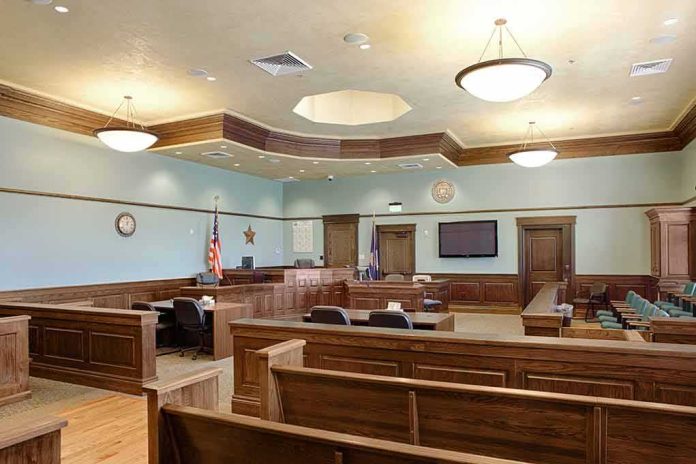
A Utah judge just punished the lead prosecutor in the Charlie Kirk murder case for talking to the media about guilt before a jury ever heard the evidence.
Story Snapshot
- A Utah prosecutor was found in civil contempt for telling media he had “ample evidence” that Tyler Robinson murdered Charlie Kirk.[2][3]
- The judge said comments about a federal ballistics report were allowed, but opinions on guilt crossed the legal line.[3][1]
- The court will expand jury selection and make the state pay defense legal fees tied to the contempt fight.[3]
- The judge refused to remove the death penalty, calling that punishment “grossly disproportionate” and an attack on proper prosecutorial discretion.[3]
Judge Says Prosecutor Crossed the Line On Guilt
Fourth District Court Judge Tony Graf in Provo ruled that Deputy Utah County Attorney Christopher Ballard violated a strict gag order in the high-profile murder case over Charlie Kirk’s killing.[2] Ballard had gone on national outlets like TMZ, Fox News, and USA Today after defense lawyers claimed a federal ballistics test could not match the fatal bullet to Tyler Robinson’s rifle.[2] Graf found that Ballard’s choice to tell reporters the state had “ample evidence” Robinson committed murder was an improper opinion on guilt under Utah’s trial publicity rules.[3][1]
Utah’s Supreme Court Rule 3.6 on trial publicity bans lawyers in active cases from making public statements they know will likely harm a fair trial, including “any opinion as to the guilt or innocence of a defendant.”[1] The rule does allow some basic facts, like the charges or information already in public records, but it draws a bright line at talking about whether the accused is guilty.[1] Graf’s ruling said Ballard “knew of the order, possessed the ability to comply, and intentionally” made the comments, meeting the clear and convincing evidence standard for civil contempt.[2]
Clarifying Evidence Was Allowed, But Boasting About “Ample Evidence” Was Not
In his written ruling, Graf divided Ballard’s media comments into two groups.[3] First, he found that Ballard’s effort to explain the Bureau of Alcohol, Tobacco, Firearms and Explosives ballistics report and what an “inconclusive” test means was a reasonable attempt to correct misleading coverage and fell within the narrow safe harbor in Rule 3.6(c).[3][3] That part was not contempt. But Graf said Ballard crossed the line when, in the same interviews, he went beyond clarifying evidence and talked about the “overall strength of the state’s evidence,” claiming prosecutors could prove Robinson’s guilt beyond a reasonable doubt and overcome his presumption of innocence.[3]
Graf ruled those extra statements had a substantial likelihood of prejudicing the case by signaling to the public and potential jurors that the state had already decided Robinson is guilty before trial.[5] Defense lawyers told local media that calling the case supported by “ample evidence” was the “functional equivalent” of publicly declaring Robinson guilty, and asked the court to step in.[4] For a conservative audience that values due process and the rule of law, this is a reminder that even in a case involving the killing of a prominent conservative voice, the government must follow its own rules and let a jury decide guilt.[1]
Contempt Sanctions: No Death Penalty Relief, But Real Costs For The State
Graf’s contempt finding was civil, not criminal, and focused on fixing the harm rather than punishing the prosecutor with jail.[2] He said he would consider expanding jury selection to help weed out any potential jurors influenced by Ballard’s comments and allowed the defense to recover attorney fees tied to litigating the contempt motion.[3] These kinds of fee sanctions and remedial steps are common in civil contempt cases over pretrial publicity because they push the government to change behavior without collapsing the underlying prosecution.[2]
A Utah judge on Friday found a prosecutor in civil contempt for violating a pretrial publicity order by publicly stating there was "ample evidence" to prove Tyler Robinson's guilt in the 2025 killing of Charlie Kirk. https://t.co/6cF2pOuAuP
— FOX 5 NY (@fox5ny) June 26, 2026
Defense lawyers tried to turn Ballard’s violation into a much bigger sanction by asking Graf to block the state from seeking the death penalty against Robinson.[3] Graf flatly rejected that request. He wrote that removing capital punishment would be “grossly disproportionate” to the misconduct and “legally unavailable” in a civil contempt setting.[3] He also warned that such a sanction would intrude on executive branch prosecutorial discretion, a separation-of-powers concern that should matter to anyone worried about judges overstepping and weakening tough-on-crime policies.[3]
Why This Fight Over Media Comments Matters For Conservatives
Graf stressed that Ballard’s comments were not made out of a “malicious desire to taint the jury pool,” but said intent does not erase the risk to a fair trial when a powerful government lawyer talks publicly about guilt.[5] Utah ethics guidance for prosecutors already warns that even well-meaning media statements can “materially prejudice” a case and tells them to keep comments tightly focused on allowed topics.[2] The Utah Supreme Court has also treated “reasonably should know” in Rule 3.6 as a negligence standard, meaning prosecutors can be disciplined even when they claim they did not mean harm.[6]
For conservatives, the stakes cut in two directions. On one hand, many want a strong, aggressive prosecution for the man accused of killing Charlie Kirk, a leading voice for constitutional rights and border security. On the other hand, we do not want government lawyers building their cases in the press instead of the courtroom, or eroding the basic presumption of innocence that protects every citizen from state overreach.[1] Graf’s ruling sends a clear message: prosecutors can push back on misleading defense spin about evidence, but they must stop short of telling the public, “trust us, he’s guilty,” before a jury speaks.
Sources:
[1] Web – Judge holds prosecutors in Charlie Kirk murder case in contempt for …
[2] Web – SCRP Rule 3-3.6 (Supreme Court Rules of Professional Practice)
[3] Web – [PDF] Utah Prosecutors Best Practices – SWAP Home Page
[4] Web – ER 3.6 Trial Publicity – State Bar of Arizona
[5] Web – Rule 3.6. Trial Publicity – Louisiana Legal Ethics
[6] Web – [PDF] Rule 3.6 Trial Publicity – The State Bar of California