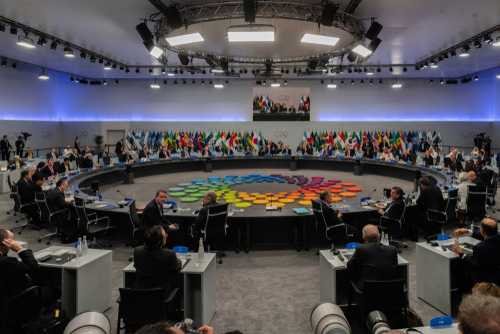
When unelected artificial intelligence bosses sit beside presidents at the G7 table, it signals just how far real power has drifted away from ordinary voters.
Story Snapshot
- Leaders of OpenAI, Anthropic, and Google DeepMind joined Trump and other G7 heads of state at a closed‑door working lunch on artificial intelligence in Évian‑les‑Bains, France.
- Talks focused on “voluntary” safety pledges, child protection online, and massive computing infrastructure, not hard limits on what companies can build or how fast they can move.
- French President Emmanuel Macron used the summit to push “tech sovereignty” for Europe, reflecting deep worries about American control over the most powerful artificial intelligence systems.
- Across left and right, the event feeds a broader fear that global elites and giant tech firms are quietly setting rules for a technology that could reshape jobs, speech, and national security.
AI CEOs at the G7: Who Was in the Room and Why It Matters
At this year’s G7 summit in Évian‑les‑Bains, France, three of the most powerful artificial intelligence chiefs sat at the same table as the leaders of the United States, United Kingdom, France, Germany, Italy, Japan, Canada, and the European Union. OpenAI’s Sam Altman, Anthropic’s Dario Amodei, and Google DeepMind’s Demis Hassabis all confirmed their attendance after the French presidency released a guest list.[3] The summit runs June 15 to 17 and is hosted by French President Emmanuel Macron.[8]
French officials built the day around a “working lunch” that placed these corporate leaders side by side with elected heads of government. Coverage describes the lunch as focused on artificial intelligence infrastructure, regulation, and online safety, including the protection of minors.[1][9] For the first time, all three frontier lab chief executives appeared together at a formal G7 gathering, turning a once government‑only summit into a shared stage for political leaders and private tech power.[6]
What They Discussed: Safety, Kids, and Who Controls the Chips
Reports describe a packed agenda: risks from the most advanced artificial intelligence systems, data center capacity, energy demands, and how to keep children safer online.[1][9] Macron’s team framed the meeting as one part of a wider push to extend earlier G7 work on “guardrails” for artificial intelligence, known as the Hiroshima process, into concrete steps that governments and companies could both sign onto.[6][10] Yet sources also suggest that many of the commitments on the table remain voluntary and non‑binding.[3][4]
For many Americans, this mix hits familiar nerves. Conservatives already worry about big technology firms shaping speech, energy use, and even national security, while liberals fear a growing gap between tech billionaires and everyone else. Here, leaders talked about online harms and child protection, which both sides care about, but did so in a format where unelected executives had equal time with presidents and prime ministers. That raises doubts about whose interests will guide any final “safety” rules.
Europe’s AI Sovereignty Push and US Resistance to Hard Rules
European leaders used the summit to air a clear concern: the dominance of American companies over the most powerful artificial intelligence models and the cloud infrastructure they run on.[7] Coverage describes the G7 as a “sovereign artificial intelligence” summit, with France in particular pushing to keep key computing power, data centers, and technical standards under at least some national or regional control rather than leaving them fully in private American hands.[8] This echoes long‑standing European unease about relying on foreign technology giants for core services.
Analysts following the meeting say the main divide is between a United States push for voluntary commitments and a European desire for firmer, enforceable rules on advanced systems and their export.[4][10] The United States approach lines up with its broader artificial intelligence action planning, which leans on cooperation with industry, international diplomacy, and export controls rather than sweeping global regulation.[11] As a result, expectations for any binding artificial intelligence treaty or detailed enforcement plan coming out of Évian remain very low.[4]
What This Signals for Ordinary Citizens on Both Left and Right
For people across the political spectrum who already believe a distant “elite” runs the show, this summit is likely to feel less like democracy and more like technocracy. The images and guest lists show chief executives whose companies are valued in the hundreds of billions of dollars sitting in small rooms with world leaders, shaping how a powerful new technology will be used at work, in schools, and even on the battlefield.[5][9] Yet citizens have almost no direct say in those talks beyond whatever pressure they can put on their own governments later.
The real power dynamic just shifted. AI CEOs from OpenAI, Anthropic, and Google joined Trump and world leaders at the G7 summit, cementing tech giants as geopolitical players. 🌐🤖
Via @giris4u #AI #BreakingNews
— Giri (@giris4u) June 17, 2026
Supporters of close government–industry cooperation argue that these companies own the most advanced systems and data centers, so leaders must bring them into the room to understand the risks and design workable rules.[2][6] Critics respond that today’s pattern looks familiar: voluntary pledges, soft language, and long communiqués instead of strong, transparent safeguards backed by law. For Americans already frustrated by high costs, job insecurity, and a sense of government capture by special interests, the G7 artificial intelligence lunch reinforces a hard question: when world leaders and corporate chiefs meet behind closed doors to “manage” the future, who is really being protected – the public, or the people at the table?
Sources:
[1] YouTube – LIVE: OpenAI’s Sam Altman, Anthropic’s Dario Amodei and other AI execs …
[2] Web – AI in spotlight at G7 as Trump, world leaders joined by tech chiefs
[3] Web – Anthropic, OpenAI, Google Executives Plan to Attend G7 Summit
[4] Web – AI executives gather at G7 as Europeans seek checks on American …
[5] Web – Sam Altman, Demis Hassabis, and Dario Amodei are heading to the …
[6] Web – Tech executives to attend G7 summit as leaders address AI, online …
[7] Web – OpenAI CEO Sam Altman and Anthropic CEO Dario Amodei …
[8] Web – Le PDG d’OpenAI, Sam Altman, et le PDG d’Anthropic, Dario Amodei …
[9] Web – G7 Summit: AI Executives Join Leaders to Address AI & Online …
[10] Web – G7 – Center for AI and Digital Policy
[11] Web – [PDF] America’s AI Action Plan – The White House