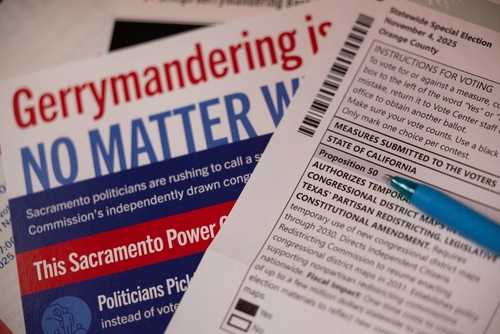
California’s new House map is turning “fair elections” into a partisan chess match, and both parties say the other side rigged the board.
Story Snapshot
- California voters approved Proposition 50, swapping independent maps for a legislature-drawn House map through 2030.
- Democrats openly designed the map to offset Republican gains from Texas redistricting and possibly add up to five seats.[3]
- Critics on both sides see Prop 50 as proof that political insiders, not citizens, now control congressional lines.[4]
- The new districts set up high-stakes 2026 House matchups that could tighten or widen the national partisan divide.[2][5][7]
How Prop 50 Changed California’s Map and Who Drew It
California voters passed Proposition 50 in 2025, allowing the state legislature to replace the independent commission’s House maps starting with the 2026 elections.[3] The Legislative Analyst’s Office explains that a “yes” vote meant California would use new, legislatively drawn congressional district maps until new commission maps follow the 2030 national census. This shift moved control from the citizen redistricting commission back to lawmakers and party leaders in Sacramento for at least three election cycles.[8]
The California State Assembly posted the official “Proposed Congressional Map,” including detailed data files and a printed atlas for the new districts.[8] That site shows the lines came from Assembly Bill 604, not from the independent commission that drew the last decade’s map.[8] Supporters argue the process was transparent because the proposed lines and data were public. Critics answer that even open data does not change the basic fact that politicians, not citizens, designed the new districts.[6][8]
Why Democrats Pushed the Change and What They Admit
The California Democratic Party describes Prop 50 as a direct response to what it calls a Republican “power grab” in Texas, where congressional lines were redrawn to gain five more seats in the national House.[3][4] Prop 50’s own campaign materials say the new California map could let Democrats gain up to five seats in Congress and would “negate the five Republican seats drawn by Texas.”[3][4] In plain terms, party leaders told voters this was about fighting fire with fire in a national redistricting war.
Supporters claim this is both an emergency fix and a temporary one, not a full return to old style gerrymandering.[3] The California Democratic Party says the new maps “expire in 2030” and that Prop 50 “reaffirms” the independent commission’s authority to draw the next round of lines after the 2030 census.[3] The Legislative Analyst’s Office also notes that current commission maps would have stayed in place until 2030 if voters had rejected Prop 50, making the statewide vote the key trigger for the change.
Accusations of Gerrymandering and What the Courts Allowed
National outlets report that California’s new map was designed to flip multiple Republican-held seats, not just to clean up odd lines or keep cities together.[4][7] Analysis from the Public Policy Institute of California notes that Prop 50 aims to establish a new congressional map for three election cycles and examines how many seats Democrats might gain under the mid-decade plan.[4] Election handicappers now expect the already large Democratic edge in California’s 52-seat delegation to grow even wider in 2026.[7] Critics say that outcome proves the lines are tilted, not neutral.
The Judicial Branch has so far allowed the maps to stand for this cycle, even as arguments over fairness continue.[3][5] Ballotpedia reports that California is one of several states with new congressional maps heading into the 2026 House elections, part of a wider national wave of mid-decade remaps.[4] A Supreme Court decision cleared the use of California’s new districts that favor Democrats, keeping them in place for the current election calendar.[3] That ruling did not bless the map as “fair”; it only allowed it to be used while deeper legal questions remain open.
What This Means for 2026 Matchups and Voter Trust
Ballotpedia notes that voters will elect representatives for all 52 House districts in November 2026, under the new district lines.[2][5] Nonpartisan election trackers show Democrats already hold a strong 43–9 edge in the California delegation, and they project that this gap will likely grow larger after the 2026 elections under the Prop 50 map.[7] Races that were once toss-ups, especially in the Central Valley and the suburbs, now lean more toward Democrats, reshaping who will face off and how hard Republicans must fight to stay in the game.[4][7]
https://twitter.com/researchUSAI/status/2064924189803561294
For many Americans on both the right and the left, the deeper worry is not which team wins a few more seats, but what this fight says about the system itself. California once sold its independent commission as proof that citizens, not insiders, could set the rules.[3] Now, even in that “reform” state, party leaders have stepped back in, justified by what the other party did in Texas and other states.[3][4] To voters who already feel shut out by elites, this looks less like fairness and more like a never-ending arms race.
Sources:
[2] YouTube – California Democrats unveil redistricting maps
[3] Web – YES on Prop 50: FAQ – California Democratic Party
[4] Web – Supreme Court allows California to use congressional districts … – …
[5] Web – How Many Seats Would Democrats Gain under California’s Mid …
[6] Web – Redistricting in California ahead of the 2026 elections – Ballotpedia
[7] Web – Proposed Congressional Map | California State Assembly
[8] Web – California Map Series – California Voter Foundation