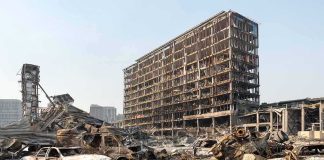


A deadly chemical tank implosion at a Washington paper mill has revived hard questions about industrial safety, transparency, and whether working Americans are being adequately protected on the job.
Story Snapshot
- Multiple workers were killed and at least 10 people injured after a chemical tank imploded at the Nippon Dynawave paper mill in Longview, Washington.
- Officials say the scene is stable and claim there is no immediate threat to the surrounding community, even as fatalities and missing workers are still being confirmed.
- The ruptured vessel was an 80,000-gallon “white liquor” tank, a highly corrosive part of the pulp process that demands strict maintenance and oversight.
- Early reassurances from company and local officials risk soft-pedaling deeper questions about process safety, regulatory enforcement, and corporate accountability.
Deadly Implosion Rocks a Quiet Mill Town
Early Tuesday morning in Longview, Washington, a massive chemical tank containing so-called white liquor imploded at the Nippon Dynawave Packaging pulp and paper mill, killing multiple workers and injuring at least ten people, including a firefighter who responded to the scene.[5] Local coverage and hospital officials said several of the wounded suffered chemical burns and other critical injuries after the rupture, while an unknown number of workers remained unaccounted for as recovery operations continued through the day.[5]
Fire department briefings described a chaotic but quickly contained industrial disaster at the long-running mill, a major employer in the southwest Washington community just north of Portland.[2] Crews arriving shortly after the blast encountered extensive structural damage around the tank and immediately treated burn victims before transporting nine patients to PeaceHealth St. John Medical Center, where at least one person was later confirmed dead.[5] Authorities also confirmed additional fatalities on-site, but withheld identities pending notification of families.[5]
Officials Emphasize “Stability” While Key Facts Stay Murky
At an afternoon press conference, Longview Fire Department Battalion Chief Mike Gorsuch and Cowlitz 2 Fire and Rescue Chief Scott Goldstein repeatedly told reporters that the incident was “stable” and in the recovery phase, stressing there was no immediate threat to the broader community.[2] Their message focused on scene control, family notifications, and coordination with mill management, even as they acknowledged the cause of the tank rupture remained unknown and some workers were still missing.[5]
This framing matches a familiar pattern in major industrial accidents: government and corporate officials move swiftly to reassure the public before investigators have answered basic questions about what failed and whether it was preventable. In this case, the joint statements from Nippon Dynawave and local agencies stressed that air monitoring had not identified a hazardous plume and that protective perimeters were holding, but they offered no data on actual exposure levels or long-term environmental impacts beyond the mill property.[1] For nearby families and workers, those gaps leave reasonable doubts about whether early reassurances are more about optics than full transparency.
High-Hazard Chemical Process Demands Real Accountability
Federal and local reports confirm the implosion involved an 80,000-gallon white liquor tank that was about 60 percent full when it failed, a critical vessel in the kraft pulp process that uses a hot, highly caustic chemical mixture to break down wood chips.[5] That combination of corrosive chemistry, high temperatures, and large-volume industrial equipment is exactly the kind of operation where rigorous inspections, integrity testing, and conservative operating procedures are supposed to prevent catastrophic failure.[5]
LONGVIEW LATEST: Multiple people killed in chemical tank rupture at Nippon Dynawave pulp and paper mill in Longview.
Stream the latest at https://t.co/qwflTALhMC
Details at: https://t.co/HzJBQizT6r pic.twitter.com/TgqvJ6tDiZ— KREM 2 NEWS (@KREM2) May 26, 2026
Officials have not identified any prior safety violations tied specifically to this tank, and early public records include no inspection logs, wall-thickness readings, or repair histories for the vessel, leaving open whether corrosion, overpressure, or operational error played the decisive role.[5] Fire and company representatives also have not released engineering analysis, photographs, or regulator findings that would show whether the failure was an unforeseeable accident or a preventable breakdown in maintenance and oversight.[5] Until those answers arrive, working families in Longview are being asked to take corporate assurances on faith.
Conservatives Press for Worker Safety Without More Bureaucracy
For Americans who value both free enterprise and personal responsibility, this tragedy underscores a tension that shows up again and again: politicians grow the regulatory state, yet basic safeguards at real-world job sites still fail in ways that cost workers their lives. Here, a major industrial employer operating in a heavily regulated sector still experienced a lethal tank implosion that killed and maimed people simply doing their jobs on a weekday morning.[5] That outcome demands answers, not more empty safety rhetoric.
Conservative scrutiny naturally turns toward whether existing rules were actually enforced, whether plant management prioritized safety over production quotas, and whether federal and state investigators will release their findings promptly instead of burying uncomfortable details in technical files.[5] Investigators can obtain maintenance records, test data, and radio logs to determine exactly what happened, but citizens should insist those materials be made public and that any proven negligence face real consequences, not just modest fines written off as a cost of doing business.[5] Limited government still requires strong accountability where life-and-death risks are concentrated.
Sources:
[1] Web – Deaths reported after tank implodes at Washington pulp and paper mill
[2] YouTube – Officials give update on deadly Longview chemical explosion
[5] Web – Deaths reported after chemical tank implodes at pulp and paper mill …