

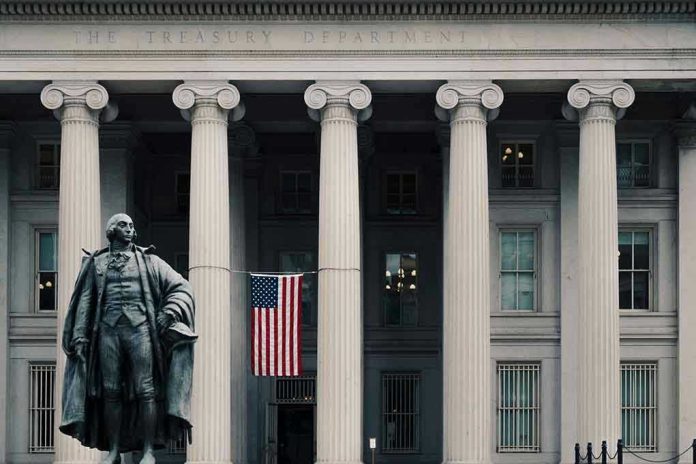
When a foreign billionaire can quietly cut a $275 million deal over alleged Iran sanctions violations, it sharpens Americans’ fear that global elites play by rules the rest of us never get to see.
Story Snapshot
- The U.S. Treasury’s sanctions office has agreed to a $275 million settlement with India’s Adani Enterprises over 32 “apparent” Iran sanctions violations tied to liquefied petroleum gas shipments.[1][4]
- The deal follows a separate United States Securities and Exchange Commission (SEC) settlement, creating what looks like a multi‑agency legal clean‑up for one of Asia’s richest men.[2][3][6][7]
- Officials describe the conduct as “apparent” violations and, based on similar cases, the settlement likely involves no admission of wrongdoing, leaving the public largely in the dark on what exactly happened.[1][4][5]
- The case highlights how complex sanctions cases are handled through insider negotiations, reinforcing concerns that powerful players can treat U.S. financial law as just another cost of doing business.[1][2][4]
What U.S. Treasury Says Adani’s Company Did
Reports on the settlement state that the United States Department of the Treasury’s Office of Foreign Assets Control, the agency that polices sanctions, reached a $275 million civil deal with Adani Enterprises Limited, an India‑based conglomerate.[1][7] Treasury said the company agreed to resolve its “potential civil liability” for 32 “apparent violations” of Iran sanctions rules.[4] Coverage describes the conduct as purchases of Iranian liquefied petroleum gas that were allegedly disguised, though the full mechanics of the scheme are not detailed in the public snippets.[1]
According to these reports, the alleged violations occurred over a roughly year‑and‑a‑half period and were serious enough to trigger Treasury scrutiny and a negotiated penalty.[4][7] Under the Iran sanctions program, the Office of Foreign Assets Control can target foreign companies that “violated, attempted to violate, conspired to violate, or caused a violation” of United States sanctions, even when the firms are headquartered overseas.[4] The recent‑actions page confirms that Iran‑related enforcement like this is a regular category of the agency’s work.[5]
How This Ties Into Adani’s Wider U.S. Legal Troubles
The sanctions case is only one piece of a larger legal tangle involving Gautam Adani, the billionaire at the center of the conglomerate.[2][3][6][7] Separate Securities and Exchange Commission filings and media reports describe a civil fraud case in which Gautam Adani and his nephew Sagar Adani agreed to pay a combined $18 million to settle claims they misled investors about anti‑bribery compliance tied to renewable energy projects.[2][3][6] Court records cited in those reports say Gautam Adani would pay $6 million personally, while his nephew would pay the larger share.[7]
Commentary around that securities case notes that the Adanis did not admit or deny wrongdoing, a standard formulation in many Wall Street settlements.[2][6] At the same time, reporters following the matter say the United States Department of Justice is poised to drop related criminal fraud charges as part of a broader resolution package, while Treasury’s Office of Foreign Assets Control closes out the Iran sanctions angle with its own civil penalty.[2][3][7] Together, those steps would effectively clear the decks for Adani’s businesses to expand again in U.S. markets, including in areas like data centers and green energy.[2]
Why Ordinary Americans Should Care About a Foreign Sanctions Deal
Many Americans, on the left and the right, see stories like this as confirmation that there are two systems of justice: one for ordinary citizens and small businesses, and another for globally connected corporations and billionaires.[1][2] In sanctions law, the Office of Foreign Assets Control routinely imposes large penalties on banks and companies, but those cases are often resolved behind closed doors through settlements that include careful “no admission” language and limited public detail.[4][5] That pattern makes it hard for citizens to know whether the law is being fairly enforced or traded away.
U.S. Treasury/OFAC announces $275M Adani Enterprises settlement over 32 apparent Iran-sanctions violations tied to LPG shipments.
The case centers on purchases from a Dubai-based trader, with red flags that cargoes originated in Iran despite being represented as Omani or Iraqi… pic.twitter.com/tziWQSojko
— kautious (@kautiousCo) May 18, 2026
This case also touches several pressure points that already frustrate Americans across party lines. Conservatives angry about globalism and weak enforcement see a foreign conglomerate allegedly using opaque shipping and financial channels to work around Iran sanctions, then writing a giant check once caught.[1][4] Liberals focused on corporate power and the widening gap between elites and everyone else see another example of a politically connected tycoon resolving fraud and sanctions issues through complex deals that no regular person could ever negotiate.[2][3][6]
What the Case Reveals About Sanctions, Transparency, and Power
The deeper problem is not just whether Adani’s firm broke the rules; it is how much of the story the public is allowed to see. The strongest documents in the record are not the settlement itself but general Iran sanctions explanations and a bare listing on the recent‑actions page, while the specifics come from fragmented news and video commentary.[1][2][4][5] Without the full settlement text, Americans cannot evaluate which facts Treasury proved, what conduct the company conceded, or how officials calculated a $275 million penalty.
That lack of transparency feeds broader distrust in Washington’s alignment with citizens’ interests. When huge cross‑border schemes are resolved through negotiated payouts, and when agencies reserve the right to label conduct “apparent violations” while avoiding courtroom tests, people reasonably wonder whether politics, diplomacy, or corporate lobbying played a quiet role.[1][4][5] In an era when many already believe a “deep state” of permanent officials and global business interests set the real rules, this settlement becomes more than a foreign sanctions story; it becomes another data point in a growing crisis of confidence in the American system.
Sources:
[1] Web – Treasury settlement allegations OFAC sanctions US SEC Adani …
[2] YouTube – Billionaire Adani Pays $18 Million to Settle US Bribery Case
[3] YouTube – US May Drop Adani Fraud Case Amid $265 Million Bribery Allegations
[4] Web – Iran Sanctions | Office of Foreign Assets Control
[5] Web – Recent Actions – Office of Foreign Assets Control
[6] Web – Adanis Consent to $18M SEC Penalty in Fraud Case
[7] Web – Adani Enterprises’ $275 Million Sanction Settlement – Devdiscourse