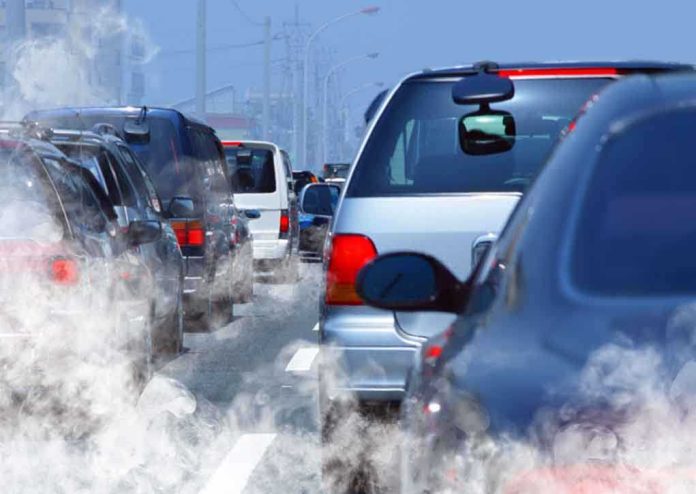
NYC’s congestion pricing toll, launched to clean Manhattan’s air, has instead worsened pollution in the working-class South Bronx, where residents already suffer from the nation’s highest childhood asthma rates.
Story Snapshot
- PM2.5 pollution increased by an average of 0.22 micrograms per cubic meter across the South Bronx after congestion pricing began January 5, 2025, with the worst spike (+1.29 µg/m³) near major truck routes
- Columbia University study monitored 19 sites over two years, finding 12-13 locations experienced air quality degradation after tolls diverted truck traffic away from Manhattan
- South Bronx residents in “Asthma Alley” face childhood asthma rates exceeding 20%, compared to the city average of 7%, in neighborhoods bordered by highways and warehouses
- MTA officials dispute any direct link between congestion pricing and localized pollution increases, citing citywide improvements and planned mitigation investments totaling $70M-plus
Government Policy Shifts Pollution to Working-Class Communities
South Bronx Unite, a local environmental justice organization, partnered with Columbia University’s Mailman School of Public Health to track air quality at 19 monitoring sites from January 2024 through December 2025. The study documented fine particulate matter levels before and after NYC implemented its $9 peak-hour congestion toll on vehicles entering Manhattan below 60th Street. Researchers found that twelve to thirteen locations recorded higher PM2.5 concentrations after the toll launched, with the Third Avenue Bridge and Major Deegan Expressway corridor showing the sharpest increase at 1.29 micrograms per cubic meter. This data directly contradicts government assurances that outer boroughs would be spared from environmental harm.
Truck Traffic Rerouted Through Vulnerable Neighborhoods
Activists and Columbia researchers attribute the pollution spike to predictable driver behavior: truckers avoiding Manhattan tolls by rerouting through the Bronx via the Major Deegan Expressway, Third Avenue Bridge, and RFK Bridge. Dr. Markus Hilpert from Columbia warned that diverting traffic would fail to improve conditions in surrounding areas like the South Bronx. Alex De Jesus, a data analyst on the project, explained that even moderate traffic increases along highway corridors translate to measurable pollution rises that hit residents hardest. These findings raise serious questions about whether government planners prioritized transit revenue over the health of low-income, predominantly Black and Latino neighborhoods already suffering from some of America’s worst air quality.
Officials Downplay Health Risks Despite Historic Asthma Crisis
The South Bronx has long been dubbed “Asthma Alley” due to its proximity to the Cross Bronx Expressway, Major Deegan corridor, ports, and warehouse districts. Childhood asthma rates in neighborhoods like Mott Haven and Hunts Point exceed twenty percent, nearly triple the citywide average of seven percent. The MTA’s 2023 environmental assessment predicted slight traffic increases of 0.5 to 1 percent in the South Bronx and committed $70 million for mitigation measures including parks, vegetation, and school air filters. Despite this acknowledgment, MTA officials now claim there is no way to tie the pollution increase directly to congestion pricing, pointing instead to overall traffic volume decreases recorded in spring 2025 and promising a full evaluation by summer 2026.
City Responds With Funding While Avoiding Accountability
Following the study’s release at a press conference near the Third Avenue Bridge in early 2026, New York City announced a $20 million investment in Bronx childhood asthma programs, green spaces, and air filtration systems. The NYC Health Department maintained that preliminary data shows citywide air quality improvements, though it acknowledged that localized Bronx data remains incomplete. This pattern—shifting pollution burdens to vulnerable communities while touting aggregate benefits—exemplifies a top-down approach that treats working families as acceptable collateral damage. The fact that government agencies dispute causation while simultaneously rushing mitigation funds to the affected area suggests officials recognize the problem but refuse to take responsibility for policy failures that harm those least able to fight back.
Critics argue this case illustrates a broader government failure: elites design policies that benefit Manhattan commuters and transit budgets while sacrificing the health of outer-borough residents who lack political clout. Whether from the left or right, Americans increasingly recognize that unelected bureaucrats and entrenched officials prioritize their own agendas over the well-being of ordinary citizens. The South Bronx situation demonstrates how even well-intentioned environmental policies can become tools of inequality when decision-makers ignore ground-level impacts in favor of models and projections. As the MTA prepares its summer 2026 review, residents continue breathing dirtier air—a tangible reminder that government promises mean little without accountability and genuine concern for all communities, not just the powerful and well-connected.
Sources:
Pollution from congestion tolls, city to study asthma rates – Bronx Times
Data: South Bronx air quality worsens during first year of congestion pricing – News12 NJ