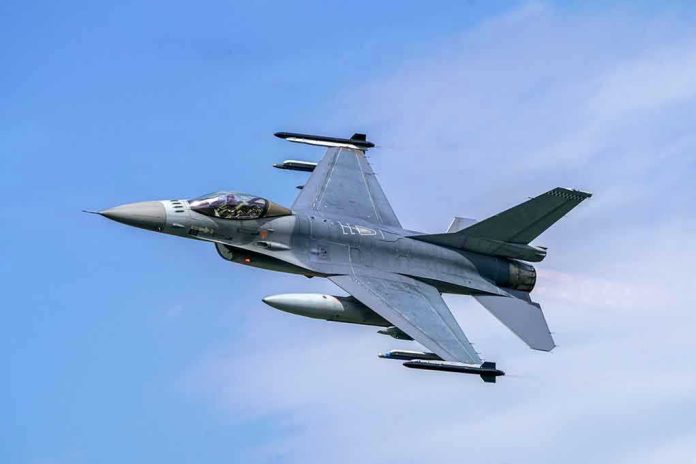
The U.S. Air Force’s $20 billion bet on the F-47 NGAD fighter represents a stark choice: deliver revolutionary airpower capable of defeating China’s growing threat, or risk American lives in a Pacific conflict where technological superiority means survival.
Story Snapshot
- Boeing’s F-47 NGAD will control up to 8 AI-driven drones per aircraft, transforming 185 jets into 1,500 combat platforms designed to counter China’s J-20 stealth fighters in the Indo-Pacific.
- President Trump signed a $20 billion contract in 2025, calling the sixth-generation fighter “the most advanced ever” with Mach 2+ speed and double the F-22’s combat range at over 1,000 nautical miles.
- The program remains on track for a 2028 first flight after years of cost debates nearly canceled it, with limited production already underway as the F-22 Raptor’s aging fleet demands replacement.
- Failure to deliver could erode U.S. air dominance against peer adversaries, leaving pilots vulnerable in contested airspace where outdated jets face advanced anti-access systems.
Boeing’s Existential Victory Reshapes Defense Landscape
Boeing secured the F-47 contract in 2025 after defeating Lockheed Martin in a high-stakes competition that industry analysts called existential for the struggling aerospace giant. The Trump administration’s $20 billion commitment provides Boeing critical revenue amid commercial aviation setbacks, shifting defense contracting power away from Lockheed’s decades-long dominance with the F-22 and F-35 programs. Production ramps up in St. Louis facilities, creating thousands of jobs while positioning Boeing as the lead contractor for America’s most ambitious fighter program since the Cold War. The win validates Boeing’s design approach emphasizing range and drone integration over Lockheed’s alternatives, reflecting Air Force priorities for Pacific theater operations where distance dictates lethality.
Revolutionary Drone Swarming Multiplies Combat Power
The F-47’s defining feature lies not in its stealth or speed alone but in its capacity to command eight Collaborative Combat Aircraft per jet, turning 185 planned fighters into 1,500 autonomous platforms. These AI-driven drones execute missions ranging from reconnaissance to strike operations, enabling the manned F-47 to function as a battlefield quarterback directing swarms against Chinese air defenses. This manned-unmanned teaming paradigm addresses the tyranny of distance in the Indo-Pacific, where contested airspace stretches thousands of miles and refueling tankers face grave risks. Air Force leaders emphasize the system’s adaptability—modular designs allow rapid upgrades as threats evolve, contrasting with the F-22’s static architecture that became obsolete within two decades of deployment.
‘Failing Could Cost Lives’: Why the F-47 NGAD Is the Air Force’s ‘Most Important’ Fighter Everhttps://t.co/nfepJ6XorT
— 19FortyFive (@19_forty_five) May 6, 2026
Doubling Range to Counter China’s Anti-Access Strategy
Air Force officials confirmed the F-47 achieves a combat radius exceeding 1,000 nautical miles, more than double the F-22’s reach and critical for penetrating China’s layered anti-access/area-denial networks protecting Taiwan and the South China Sea. General Alvin highlighted this extended range as essential for sustained operations without vulnerable aerial refueling, a capability China’s J-20 and J-35A fighters cannot match. The jet integrates advanced sensors, hypersonic weapons, and directed energy systems alongside traditional air-to-air armaments, creating a multi-domain platform designed to operate independently in environments where electromagnetic warfare disrupts communications. Industry experts note this leap addresses hard lessons from Ukraine, where shorter-range fifth-generation jets struggled against integrated air defenses and electronic countermeasures.
High Stakes in Indo-Pacific Tensions Drive Urgency
Defense analysts frame the F-47 program through the lens of potential conflict with China, where failure to maintain air superiority could cost American and allied lives in battles over Taiwan or contested maritime zones. The F-22 fleet of 187 operational jets ages rapidly with production ended in 2011, leaving gaps China’s expanding J-20 force exploits through numerical advantage and improving technology. Trump administration officials accelerated the program after 2024 cost debates nearly derailed development, with the president declaring nothing comparable exists globally. Congress balances approximately $300 million per unit costs against the strategic imperative of countering Beijing’s military buildup, with some lawmakers questioning whether 185 jets suffice against thousands of Chinese aircraft. The program’s success hinges on delivering promised capabilities by 2028 while avoiding the cost overruns and delays plaguing previous fighter programs.
‘Failing Could Cost Lives’: Why the F-47 NGAD Is the Air Force’s ‘Most Important’ Fighter Everhttps://t.co/XwkkJp7E9r
— Harry J. Kazianis (@GrecianFormula) May 6, 2026
Air and Space Forces magazine reports the F-47 is performing exceptionally well in early production phases, with Boeing meeting technical milestones that eluded competitors. The Air Force built the design for higher availability rates than the maintenance-intensive F-22, addressing operational readiness concerns that limited the earlier jet’s deployment frequency. As prototypes advance toward first flight in 2028, the program represents a fundamental shift in airpower philosophy—prioritizing network-centric warfare where human pilots orchestrate unmanned systems rather than relying solely on individual aircraft performance. Whether this gamble pays off will determine American air dominance for decades, with implications extending beyond military circles to allies watching U.S. commitment to Pacific security and adversaries calculating the risks of aggression.
Sources:
185 F-47 NGAD Fighters, Up to 8 Drones Each: That’s Not a Fleet, That’s 1,500 Combat Platforms
New U.S. Air Force F-47 NGAD Stealth Fighter Is a Paradigm Shift China Won’t Know How to Match
Bolt from the Blue: What We Know and Don’t Know About the US’s Powerful F-47 Fighter
Why Boeing’s F-47 NGAD Next-Gen Fighter Win Was Existential for the Company
Don’t You Dare Think the F-47 NGAD Is Just Another Stealth Fighter
F-47 Program On Track for 2028 Flight