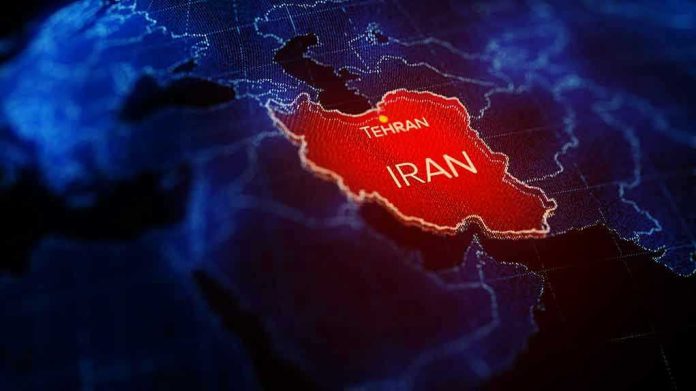
U.S. intelligence reporting that Iran’s supreme leader is isolated in a secret bunker signals a regime on edge—and a volatile threat to America and our allies.
Story Snapshot
- Multiple reports say Ali Khamenei relocated to a fortified underground site with restricted access [1][2].
- Allegations include blindfolding senior officials to conceal the location and courier-based communications [2][4].
- Iranian statements continue through intermediaries, underscoring secrecy rather than transparency [6][4].
- Conflicting location details and anonymous sourcing limit independent verification [1][2][4][6].
What U.S.-Aligned Reporting Says About Khamenei’s Whereabouts
Iran International reported that Ali Khamenei “moved into a special underground shelter in Tehran,” describing a hardened site linked by tunnels, after senior security officials assessed heightened risk [1]. Israel Hayom later echoed and expanded the claim, citing a source tied to the Islamic Revolutionary Guard Corps, and asserted that officials seeking access were blindfolded before being escorted to the hideout [2]. These accounts depict deliberate isolation at a fortified location, suggesting unusual precautions and severely gated access to the leader.
Times of Israel previously reported that Khamenei was transferred to a secure location amid tightened security while he issued a vow to avenge Hezbollah’s Hassan Nasrallah, illustrating how Tehran projects continuity even when the leader is physically shielded [6]. Together, these reports point to a pattern: remove the figure from direct risk, reduce in-person contact, and continue messaging through controlled channels. For U.S. readers, this underscores a live security posture inside an adversarial regime that still directs proxy aggression.
Restricted Access, Controlled Messaging, and What It Signals
Israel Hayom cited a named example—Ali Larijani, a senior official—among those reportedly blindfolded before meeting Khamenei, underscoring extreme operational secrecy [2]. Separate broadcast coverage summarized by Firstpost described communications handled through handwritten sealed messages carried by trusted couriers, with state media presenters reading statements attributed to Khamenei rather than airing direct appearances [4]. If accurate, these procedures reduce exposure and leaks, but they also centralize power behind gatekeepers, raising questions about who filters information in and decisions out.
This communication model can preserve command continuity while concealing the leader’s condition and exact location. Times of Israel’s account shows public threats from Khamenei continuing even as he is relocated for safety [6]. For American conservatives, the takeaway is straightforward: Iran’s hierarchy can mask vulnerabilities while sustaining hostile intent. That combination—concealment plus coercive messaging—complicates deterrence and heightens the need for clear-eyed U.S. intelligence, allied coordination, and resilient missile defense postures to protect our forces and partners.
Evidence Gaps, Conflicting Details, and How to Read the Claims
The record relies heavily on unnamed sources and mediated summaries rather than declassified documents, verifiable imagery, or on-the-record confirmation by U.S. agencies [1][2][4]. Reports conflict on precise location, with some pointing to an underground shelter in Tehran and others implying alternative sites, a discrepancy that reflects a fog-of-war information environment [1][4]. None of the supplied materials include satellite proof, intercepts, or authenticated logs that would independently fix Khamenei’s position or validate blindfold protocols [1][2][4][6].
NEW: 🇺🇸 U.S. intelligence reports that Iranian Supreme Leader Khamenei is currently isolated in a secure, undisclosed location with zero outside contact. Per CBS, "Even officials at the highest levels of the Iranian government don't know where he is and have no way to c… pic.twitter.com/SdhzAD7M1k
— Poly News and Tips (@Polymarketzone) May 24, 2026
Still, individual claims are consistent on core contours: heightened security, a secure site, and mediated communications. That alignment, while not conclusive, merits attention. For U.S. policy, the prudent stance is to treat Tehran’s leadership as operational but security-obsessed—capable of issuing orders while insulating the decision-maker. That means continued vigilance, sanctions enforcement, maritime protection, and joint targeting of Iran-backed networks, while pressing for verifiable intelligence before drawing firm conclusions from opposition-leaning or regionally aligned outlets.
Sources:
[1] Web – Khamenei hiding in underground shelter in Tehran, sources say
[2] Web – Report: Khamenei hiding in secret Tehran bunker – Israel Hayom
[4] YouTube – How Iran’s New Leader Is Taking On US & Israel
[6] Web – Rushing to secure location, Khamenei vows to avenge Nasrallah …