

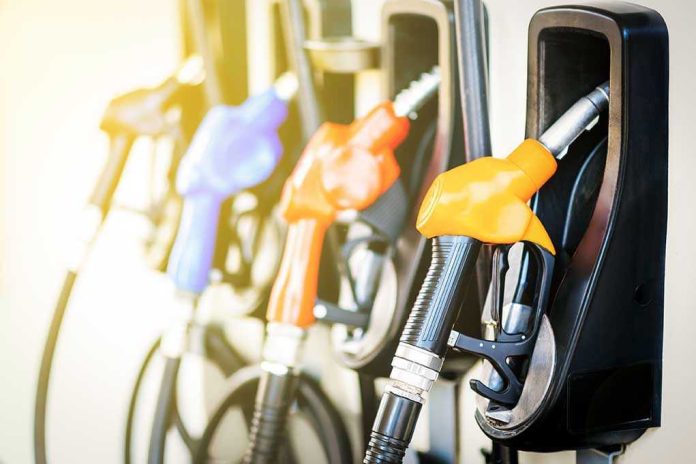
California drivers are now staring down $7-plus gas—not because of one bad day, but because the state’s energy system is built to buckle when the world gets shaky.
Quick Take
- Several California stations have crossed $7 per gallon, with at least one reported as high as $8.71 in Los Angeles.
- AAA data showed California’s statewide average around $6.01—roughly double the national average near $4.00.
- Reports tied the surge to global oil-market disruption after U.S./Israeli strikes on Iran, alongside sharply higher tanker shipping costs.
- California’s specialized fuel rules and tanker-based supply chain make it harder to bring in emergency supply from other states.
$7 Gas Becomes Reality in a State Already Paying the Most
California’s latest price spike crossed a psychological and practical line as individual stations posted prices above $7 per gallon in late March 2026. Reports cited a Shell station at 4th and Bryant Streets in San Francisco charging $7.15, while a Chevron station in downtown Los Angeles was reported at $8.71. AAA tracking put the statewide average near $6.01, far above the national average around $3.97 to $4.00.
Drivers felt the hit immediately because California’s baseline is already higher than every other state, making sudden disruptions more punishing. Regional averages highlighted how widespread the shock became, with Marin County near $6.26 and San Francisco around $6.20, while other major metros hovered near $6.00. A prior San Diego snapshot around $5.41 appeared lower, but the reporting suggested prices were moving quickly, complicating apples-to-apples comparisons across counties and dates.
Why California Takes Global Oil Shocks Harder Than Most of America
Global events mattered, but California’s structure amplified the damage. The research described U.S. and Israeli strikes on Iran as a catalyst that pushed oil above $126 per barrel and raised concerns about longer supply disruptions. Tanker shipping costs were reported to have tripled after the strikes—an outsized problem for a state that relies heavily on tanker deliveries rather than interstate pipelines. When transportation costs jump, consumers see it directly at the pump.
State policy also narrowed California’s options for quick relief. California requires a distinct cleaner-burning gasoline blend that other states typically do not stock, and that limits the ability to import large volumes on short notice. The research also pointed to refinery capacity constraints and seasonal transitions, including a switch to summer-blend fuel that can add about 15 to 17 cents per gallon. Those costs stack on top of already-high prices when markets tighten.
Newsom Blames Trump; Regulators Probe Gouging as Proof Remains Pending
Governor Gavin Newsom publicly blamed the Trump administration’s Iran-related military decisions for triggering what he called a global price shock “with no plan to protect families,” while also noting increases in states like Texas and Oklahoma. The research also reported Newsom rejecting expanded drilling as a solution and suggesting he could cut prices by about $1 per gallon “by stroke of a pen.” The legal or administrative mechanism for that claim was not detailed in the materials provided.
California’s Division of Petroleum Market Oversight opened an investigation into possible price gouging, with attention on stations charging $7 to $8 per gallon. That action may reassure frustrated drivers, but the key limitation is timing: investigations take time, and the research did not include findings showing wrongdoing. In the near term, price spikes can reflect real supply constraints, and the record provided here does not establish whether extreme station prices resulted from illegal conduct or lawful market pricing.
What the Spike Means for Families, Small Businesses, and the Wider Trust Gap
High fuel costs function like a stealth tax on working people, especially those who cannot work from home or who drive longer distances. The research warned that transportation budgets can climb 50% to 100% above national norms in California, shifting household spending away from necessities and savings. Small businesses—contractors, delivery operators, and service providers—face the same squeeze and often must raise prices or absorb losses, feeding broader inflation pressure in a high-cost state.
USC expert Michael Mahey, who has studied California gas prices since the 1970s, underscored how the state’s vulnerabilities compound each other, projecting a possible worst-case scenario reaching $8.43 per gallon and a predicted range of roughly $7.24 to $8.43. For many voters—right, left, and politically exhausted—this becomes another example of government systems that feel brittle, expensive, and unresponsive when crisis hits, even as leaders argue over blame rather than fixes.
Sources:
Gas station(s) in San Francisco $7 dollars
San Francisco Shell station is charging $7.15 a gallon, prices continue spike