A viral presidential video claims a U.S. strike killed a notorious gang boss, but the evidence so far does not match the claim.
Story Snapshot
- President Trump posted strike footage and said U.S. forces hit enemy targets.
- News outlets reported the video existed but could not verify its authenticity.
- No provided source confirms the clip shows Niño Guerrero or his death.
- The White House has used branded operation videos, raising messaging questions.
What the President Posted and What Reporters Could Confirm
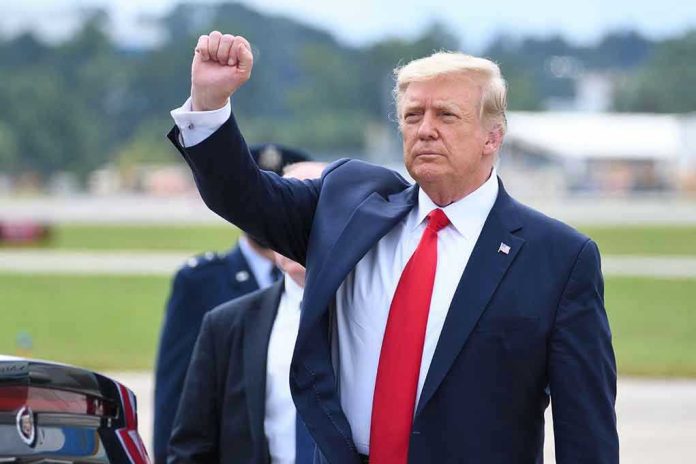
ABC News reported that President Trump shared video on social media and claimed that leaders were “terminated” in a major strike. ABC added it had not independently verified the video’s authenticity, which limits how far the claim can go without more proof [1]. The Guardian reported that Trump posted videos of strikes on Kharg Island and said U.S. forces “obliterated” targets there, placing the clips in a Middle East context rather than Venezuela [2]. Anadolu Agency also described an uncensored, uncaptioned blast video [4].
These reports establish that a presidential strike video circulated and that the president framed it as U.S. military action. They do not confirm the specific identity of anyone killed in the footage. The mismatch matters. The asserted target in online chatter is Niño Guerrero of Tren de Aragua, a Venezuela-linked crime figure. The cited coverage points to Iran, Tehran, Kharg Island, or Yemen, not to Venezuela or Guerrero. That gap leaves the core claim unproven based on the supplied record [2][4][5].
What Is Missing to Verify the Niño Guerrero Claim
The record lacks a Department of Defense statement, a combatant command report, or a battle-damage assessment that names Niño Guerrero as a casualty. There is no operational order, after-action report, or forensic confirmation tied to the video. ABC’s caveat that it could not verify the clip shows the current limit of public evidence [1]. Without geolocation, time stamps, or chain-of-custody for the media file, analysts cannot link the footage to a place, a unit, or a target with confidence.
Independent verification would require several steps. First, platform and file metadata should be preserved to fix upload time and any edits. Second, geolocation should match features in the video to known terrain and infrastructure. Third, official documents should confirm the mission, the target package, and assessed results. Fourth, law enforcement sources in the region should corroborate any reported death. None of those elements appear in the provided materials, which keeps the claim in dispute rather than confirmed.
Why This Pattern Keeps Repeating in U.S. Strike Communications
The modern playbook puts fast video posts ahead of slow evidence checks. A president can frame a strike in seconds, while journalists must verify location, timing, and casualties. That gap gives first impressions an edge, which both parties often resent for different reasons. Conservatives see media doubt as reflexive. Liberals see executive videos as spin. Both sides worry that elites control the flow of facts and leave citizens guessing about life-and-death decisions made in their name.
The White House has also released branded operation videos, like the “Operation Epic Fury” clip, which shows how official visuals can shape a narrative before documents are public [6]. That approach can rally support, but it can also blur lines between proof and promotion. When footage is uncaptioned or uncensored and lacks context, it invites mislabeling or repackaging. Reuploads, crops, and edits can strip out metadata. That makes later verification harder, and it feeds claims of a system more focused on optics than truth.
What Readers Should Watch For Next
Look for on-the-record confirmation from the Department of Defense or the relevant combatant command naming the target and the result. Watch for a battle-damage assessment that cites methods, like imagery or human reporting. Seek geolocation work from trusted analysts that ties the video to a verified site. Treat new clips with care unless outlets validate them. Absent these steps, claims that the footage shows the execution of Niño Guerrero remain unverified and should be treated as such based on the current evidence.
Sources:
[1] Web – BREAKING: President Trump Posts Unclassified Footage of US Military …
[2] Web – President Trump posted a video to social media on …
[4] YouTube – JUST IN: President Trump Posts Video Of Strikes On …
[5] Web – Trump posts video of explosions amid reported strikes on Iran
[6] YouTube – Trump posts video of US strike on Yemen, which may have …