

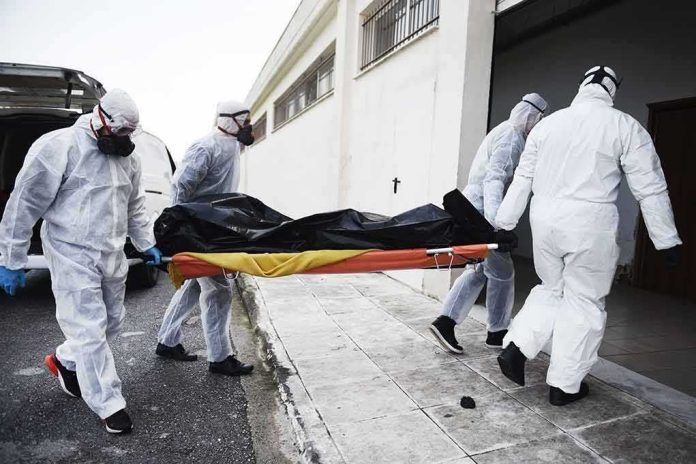
One Chicago funeral home became the center of a grim public failure after officials said they found more than 50 decomposing bodies inside it.
Quick Take
- Officials said the remains were found at South Chicago Chapel on the Southeast Side.
- State regulators suspended a funeral director’s license over unsafe storage conditions.
- Neighbors said they had complained about a foul odor for months.
- The case raises new questions about how death-care rules are enforced in Illinois.
What Officials Said They Found
Cook County Medical Examiner staff said investigators found more than 50 bodies in various states of decomposition at South Chicago Chapel. Reporters described the remains as being found in the basement, attached garage, and other non-refrigerated areas. Officials also said they were still working to identify the dead and notify families, a process that could take days.
Those details made the case more than a local nuisance story. It became a public health and oversight problem the moment regulators and forensic staff entered the building. The reported scene included bodies kept in a way that state officials said was not safe, and that pushed the story from complaint to formal investigation.
Regulators Moved After a Licensing Probe
Chicago police said they were at the funeral home to help the Illinois Department of Financial and Professional Regulation with a licensing investigation. CNN reported that state officials suspended one funeral director’s license after saying multiple bodies were kept in an unrefrigerated area under deplorable conditions, including rodent infestation, decomposition, and maggot infestation. That language points to a regulatory failure, not just a bad business day.
The broader concern is how long such conditions may have gone unnoticed or unacted on. The record provided here does not show every complaint, every inspection note, or every warning date. But it does show that the matter began as a licensing issue and ended with a major recovery of remains and a fast-moving state response.
Months of Odor Complaints Deepened the Alarm
Neighbors told reporters they had noticed a foul smell for months, and one described it as unbearable. That matters because it suggests the community did not learn about the problem only after officials arrived. It also reflects a larger pattern seen in death-care scandals: the first warning often comes from people nearby, not from routine government checks.
Families who used South Chicago Chapel are demanding answers after authorities reported the discovery of 56 bodies that were allegedly stored improperly at the funeral home. https://t.co/Zapbckqo50
— ABC 7 Chicago (@ABC7Chicago) August 8, 2026
Reporting also said the same operator had been involved in a prior crematory shutdown over mishandled remains. If that history is accurate, it will likely shape how the public reads the current case. People across the political spectrum can see the same core issue here: a licensed business handling the dead was accused of failing basic duties while families and neighbors were left in the dark.
Why This Case Is Landing Hard
The story has the power of a shock image, but its larger meaning is about trust. Families expect funeral homes to follow strict rules because the work touches grief, dignity, and public safety all at once. When officials say dozens of bodies were stored in poor conditions, the damage goes far beyond one building on East 95th Street. It raises doubts about oversight, enforcement, and whether warning signs were taken seriously enough.
There is still a limit to what the current record proves. The sources here strongly support the discovery, the license suspension, and the odor complaints. They do not yet give a full public timeline for every complaint, inspection, or internal decision. That missing paper trail is now one of the most important parts of the story, because it will show what regulators knew, when they knew it, and how they responded.
Sources:
youtube.com, facebook.com, nbcchicago.com, wgntv.com, chicagotribune.com