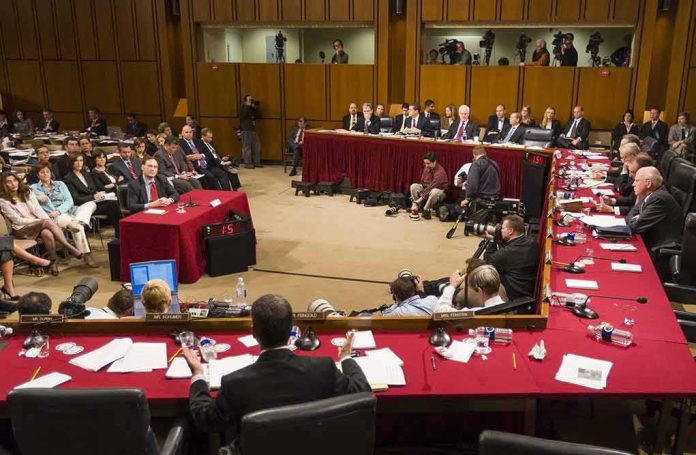
Epstein survivors broke down in tears outside a Senate hearing room after learning the Justice Department had exposed the private identities of nearly 100 victims in a file release that was supposed to protect them.
Story Snapshot
- The Department of Justice released tens of thousands of Epstein files but failed to properly hide the names of nearly 100 survivors, including 31 child victims identified in a single email.
- The DOJ pulled back roughly 9,500 documents after the privacy violations were discovered, and its own internal watchdog launched a formal audit of the release process.
- Acting Attorney General Todd Blanche admitted mistakes were made but called the release an act of “unprecedented transparency” during his Senate confirmation hearing.
- Lawmakers on both sides of the aisle have raised concerns that the DOJ redacted names of possible enablers while exposing the victims it was supposed to shield.
Survivors Exposed While Enablers Stay Hidden
The Department of Justice (DOJ) released 3.5 million pages of Epstein-related documents under the Epstein Files Transparency Act, signed by President Trump in November 2025. But the release went badly wrong for survivors. The DOJ failed to hide the names of nearly 100 victims, including an email that identified 31 child victims with only one name blocked out. The DOJ was then forced to pull back about 9,500 documents to fix the privacy violations.
At the same time survivors were being exposed, critics noted that names of people who may have helped Epstein were blacked out in many documents. The law only allowed two types of redactions: protecting survivor identities and shielding active investigations. It banned redactions to protect reputations or avoid political embarrassment. Lawmakers and advocates say the DOJ got it exactly backwards — hiding the powerful while exposing the vulnerable.
Blanche Defends DOJ at Contentious Hearing
Acting Attorney General Todd Blanche faced sharp questions at his Senate confirmation hearing over how the DOJ handled the file release. Blanche apologized to survivors whose names were exposed and said the errors affected roughly 1% of redactions. He called the overall effort a “Herculean task” and defended it as a major step toward transparency. Ten Epstein survivors attended the hearing in person, but Blanche said he could not meet with them during the proceedings.
Survivors and their advocates pushed back hard. They said the DOJ never even contacted hundreds of Epstein’s victims during its investigation. Court filings from survivors argued that investigators ignored evidence pointing to other abusers and failed to take basic steps to follow up on their accounts. The Federal Bureau of Investigation (FBI) interview records released in the files lacked follow-up details, making it hard to know whether agents ever acted on what victims told them.
Bipartisan Pressure Mounts for Real Accountability
The DOJ’s internal watchdog, the Office of Inspector General (OIG), announced a formal audit in April 2026 to review whether the department followed the law in releasing and redacting the Epstein files. Senators from both parties had asked for the review, calling some of the DOJ’s redactions unlawful. The audit will look at the processes used to decide what to release, what to hide, and how the DOJ missed its legal deadlines.
Todd Blanche
Epstein cover up made to look like a screw up?
I do not think Todd Blanche should be confirmed as Attorney General. His inept manner in the handling of the Epstein Files alone shows his inability to objectively run cases.
Todd Blanche, Trump’s former personal… pic.twitter.com/6lCkwyeXsX
— Patricia 🇺🇸 (@1109Patricia) July 16, 2026
On July 14, 2026, Representative Pramila Jayapal and Senator Cory Booker introduced the REDACT Act, a bill designed to protect survivors whose information was wrongly made public and to hold the DOJ accountable for future privacy failures. The bill was introduced alongside Epstein survivors who spoke publicly about the pain caused by the exposure. For many Americans — left and right — this story hits a nerve that goes beyond politics: the people with power stayed protected, and the people who were already hurt got hurt again.