Trump used his July Fourth message to cast the United States as the world’s beacon while warning that communism is a direct threat to the nation.
Quick Take
- Trump called the United States the “light and the glory” of the world and praised it as history’s greatest republic.
- He also described communism as a major danger and tied it to the Democratic Party.
- The speech mixed patriotic praise with sharp political attacks and broad claims that were not fully documented.
- Questions about the event’s cost and the White House’s handling of transcripts add another layer of concern.
Trump Turns July Fourth Into an Ideological Warning
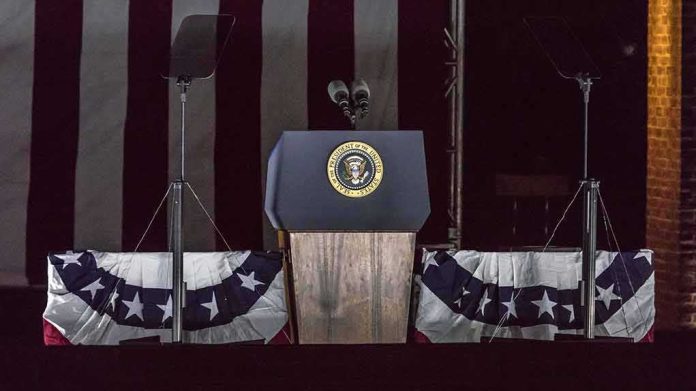
Trump used the Independence Day stage to speak less like a holiday host and more like a wartime messenger. In remarks delivered at Mount Rushmore, he called the United States the “most magnificent country in the history of the world” and “the oldest republic on Earth.” He also said communism was “the greatest threat to our country,” putting it ahead of major attacks and wars in his telling.
That framing mattered because it was not just praise for America. Trump also said people could be loyal to Karl Marx or loyal to America, but not both. He then used that line to cast the Democratic Party as aligned with communist values. The speech followed a pattern he has used before, where ideological labels are used to turn political disputes into a fight over national identity.
What Trump Claimed, and What Remains Unverified
Trump paired his political warning with a long list of economic and national-security claims. He said $19.2 trillion in investment had flowed into the country, claimed he had lifted 2.4 million people off food stamps, and said new plants and factories were appearing across the United States. The transcript provided here does not include supporting data for those numbers, so they should be treated as assertions rather than verified facts.
He also made dramatic claims about foreign policy, saying he “beat Venezuela in one day” and “knocked the hell out of Iran.” The supplied research does not include military records, diplomatic documents, or independent reporting that confirms those statements. That leaves listeners with a familiar problem in modern politics: a president speaking with certainty while the proof lags behind the rhetoric.
The Broader Fight Over Power, Money, and Public Trust
The speech landed inside a larger controversy over the July Fourth celebration itself. Reporting cited in the research says the event cost taxpayers an estimated $68 million, while the financial breakdown remained undisclosed despite questions from The New York Times. Critics also pointed to claims that the event was run by a company tied to Trump allies, which has fueled distrust on both the left and the right about who benefits from these spectacles.
Fireworks and Trump Speech Cap Independence Day Celebrations.
(TRUMP PROMISED HIS JULY 4TH SPEECH WOULD BE “REALLY LONG”- 35 MINUTES?!😂)
…Mr. Trump’s 35-minute address was followed by what the White House had billed as “the largest pyrotechnics…
https://t.co/YhBU9XtiDs— CLH (@CLH111354) July 5, 2026
That distrust is part of why Trump’s anti-communist message resonates with some voters and alarms others. Supporters hear a president defending the country against hostile ideas. Critics see a repeated effort to brand opponents as enemies without proving the charge. The research also shows that media outlets and political analysts have long described this kind of language as a red-baiting tactic, one that turns complex policy fights into simple loyalty tests.
Sources:
rev.com, instagram.com, democrats.senate.gov, en.wikipedia.org, facebook.com