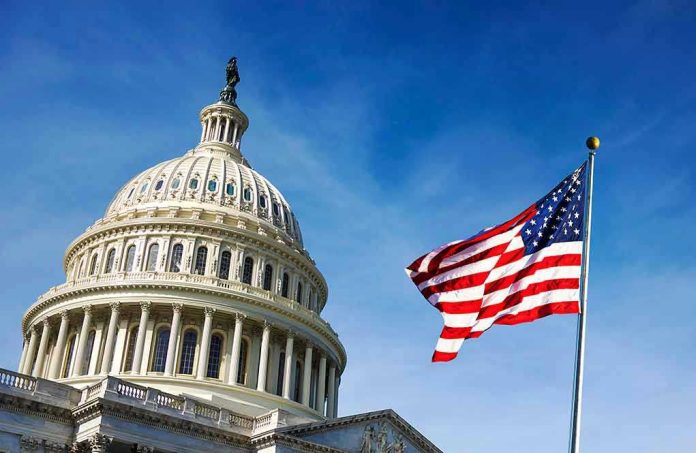
Lawmakers and courts keep invoking “under God,” yet the nation’s founding documents steer government away from endorsing any faith.
Story Highlights
- Congress added “under God” to the Pledge in 1954 amid Cold War pressures.
- Founding texts omit God and ban religious tests for office, signaling neutrality.
- The 1797 Treaty of Tripoli said the United States was not founded as Christian.
- Historians argue modern “Christian nation” claims surged in the 1930s–1950s.
Why “under God” entered the Pledge in 1954
Congress approved “under God” for the Pledge of Allegiance in 1954, after church groups and political leaders tied public faith language to unity against Soviet communism. President Dwight Eisenhower backed the move, and he signed Public Law 397. Supporters framed it as a statement about rights coming from a higher authority, not the state. Advocates today often cite this moment as proof of national identity rooted in God, though it reflected Cold War fears as much as faith.
Some activists point to public opinion to defend that framing. Advocacy groups claim strong majorities still support “In God We Trust” on money and “under God” in the Pledge. Those counts come from movement sources and are contested in academic spaces. Even so, they show that many Americans, across parties and regions, still want civil rituals to nod to a Creator. That popular support persists even as legal standards push the government toward religious neutrality.
What the Founders actually wrote into law
The United States Constitution does not mention God or Christianity. It blocks any religious test for public office in Article Six. The First Amendment bans laws that establish a religion or limit free exercise. Those choices signaled a government limited in religious matters and open to all faiths and to none. That framework has guided court rulings for decades and shapes what schools, agencies, and courts can do with religious language today.
The Treaty of Tripoli adds another early marker. The Senate approved it in 1797, and President John Adams signed it. Article Eleven stated the United States government was not founded on the Christian religion. Defenders of church-state separation cite it as clear proof that federal institutions were never meant to be sectarian. Supporters of public faith language often answer that it addressed foreign policy and peace, not domestic worship. The text remains a stark data point either way.
How historians explain the modern “Christian nation” push
Scholars trace a surge in “Christian America” advocacy to the 1930s through the 1950s. They link business leaders, clergy, and politicians who promoted public religion to counter the New Deal and later godless communism. This coalition helped normalize mottos, prayers, and national rites that referenced God. Historian Kevin Kruse argues this was a modern political project, not a Founding era plan. His thesis challenges claims that the nation’s official identity was always explicitly Christian.
That argument does not erase faith’s strong social role. Early American life had many Protestant norms in schools, charities, and local laws. Presidents issued calls for prayer. Revivals crossed colonies and later states. Yet federal design kept the national government from endorsing a single creed. That tension endures today. People on the right and the left often agree elites game the system while dodging real problems. This debate fits that worry: symbols rise, while core rules stay murky and uneven.
What the courts and today’s politics mean for citizens
Supreme Court rulings since the mid‑1900s have leaned toward state neutrality on religion. Public schools cannot sponsor prayers. Agencies must avoid favoring one faith. At the same time, personal religious speech is protected, and passive references, like mottos, sometimes pass legal tests. This mixed map confuses families and fuels anger. Many feel leaders use God-talk to score points, then ignore high costs, weak schools, and rising divides that make the American Dream harder to reach.
There was a time when our children stood at attention, and with pride, put their hand on their heart, and in one UNITED voice, recited the PLEDGE OF ALLEGIANCE.
There was a time when STRENGTH and HONOR meant something.
There was a time when standing for our FLAG meant something.… pic.twitter.com/MnLaU7Ocyg— Hadessah1776!🍊🍊🍊🍊🍊 (@HKracken) July 1, 2026
In 2026, with Republicans in charge of Congress and the White House, the rhetoric will stay loud. Some laws and policies may spotlight faith again. Legal guardrails will still matter. The key question is not just what leaders say in ceremonies, but what they do in budgets and oversight. Voters across the spectrum want honest government that treats everyone fairly. Clear rules on faith and state, applied the same to all, can lower the heat and refocus power on serving the people.
Sources:
jewishjournal.com, history.princeton.edu, masters.edu, lehrmaninstitute.org