A Biden-appointed judge’s hypothetical about Donald Trump “bulldozing the Statue of Liberty” has been weaponized by corporate media to claim the president wants unchecked power over America’s monuments.
Story Snapshot
- A Department of Justice (DOJ) attorney, pressed by liberal judges, agreed to an extreme Statue of Liberty hypothetical during a hearing on Trump’s White House ballroom project.[1][3]
- Media outlets are spinning the exchange as proof Trump could demolish national monuments with no court review, while the actual case is about standing, remedies, and separation of powers.[1][3]
- The lawsuit was brought by an elite historic-preservation group trying to halt a security-focused East Wing project that the administration says protects the White House complex.[3]
- Critics are using the Statue of Liberty soundbite to paint Trump’s DOJ as power-mad, even though federal law and Congress still heavily regulate national monuments.[1][3]
How A Ballroom Dispute Turned Into A Statue Of Liberty Firestorm
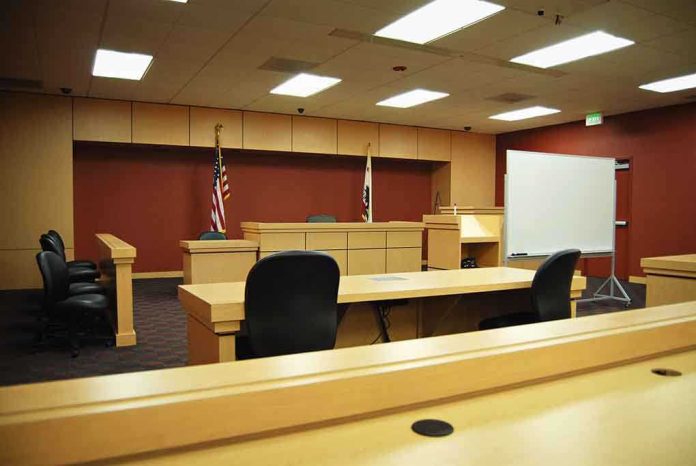
During oral arguments before the United States Court of Appeals in Washington, a Department of Justice lawyer defended President Trump’s plan to continue work on a new White House ballroom and related East Wing changes without additional congressional approval.[1][3] The National Trust for Historic Preservation, a powerful Washington nonprofit, sued to stop the project, arguing the construction violated preservation laws and overstepped executive authority.[1][3] A lower court judge agreed in part, putting the expansion on hold while the case proceeds.[1]
As the appeals panel pressed the government on whether courts could still intervene after construction advanced, Judge Patricia Millett raised a dramatic hypothetical about the Statue of Liberty.[1][3] She asked if, under the administration’s theory, the government could rapidly bulldoze the monument so that people with deep cultural ties would have no chance to seek an injunction.[1][3] Principal Deputy Assistant Attorney General Yaakov Roth responded, “I think that’s right, yes,” applying the same standing and remedy theory to the hypothetical.[1][3]
What The DOJ Actually Argued — And What It Did Not
According to contemporaneous reporting, DOJ’s core claim was not that Trump can do “anything he wants,” but that certain rapid executive actions on federal property might leave some groups without legal standing to stop them in time.[1][3] The government argued that once demolition or construction is far along, courts lack practical tools to unwind the work, and any remedy should come from Congress, not judges issuing late-stage injunctions.[1][3] That is a controversial separation-of-powers position, but it is still a legal argument, not a blank-check decree.
Media critics seized on Roth’s answer to Millett’s Statue of Liberty question as proof the administration believes it can literally destroy the monument without consequence.[1][2] Outlets emphasized the phrase “right to demolish the Statue of Liberty” and cast the courtroom exchange as a declaration of unchecked presidential power over every national monument.[1][2] By contrast, legal coverage notes that the example was an extreme hypothetical testing the limits of the government’s standing theory, not an announced plan or specific order to target the statue.[1][3] The appeals judges themselves pushed back, with one member saying the statute at issue could not authorize outright demolition.[1]
Judicial Skepticism, Real Legal Limits, And Executive Power
Reporting on the hearing shows that at least one judge on the panel openly questioned the notion that the statute supporting Trump’s White House project could ever justify demolishing a major structure.[1][3] Judge Bradley Garcia reportedly told the government, “This cannot be a source of authority for demolishing and replacing part of the construction,” directly challenging the breadth of the executive-power reading.[1] That exchange underscores that the courts are treating the controversy as reviewable and are not simply rubber-stamping administration claims.
Outside the courtroom, commentators have folded the Statue of Liberty line into a broader narrative about an aggressive Department of Justice seeking to maximize presidential control over monuments and federal property.[1][3] Past internal opinions have argued presidents can reduce or even revoke national monument designations under the Antiquities Act, expanding executive discretion beyond what many legal scholars long assumed.[3] At the same time, federal preservation statutes, the National Historic Preservation Act, and ordinary appropriations law still constrain what any administration can do to iconic sites, especially where Congress has clearly spoken.[1][3] The uproar therefore illustrates genuine concern about executive overreach, but it also reveals how vivid hypotheticals can distort complex structural-law disputes.
Why Conservatives Should Care About The Spin
For constitutional conservatives, the episode raises two parallel concerns: first, the risk of a Department of Justice that reaches for expansive theories when it suits the administration’s agenda; second, the willingness of legacy media to turn a technical standing argument into a viral claim that Trump wants to “bulldoze the Statue of Liberty.”[1][2][3] The same outlets that downplayed real abuses of power under prior left-wing administrations are now framing every separation-of-powers fight as an apocalypse, especially when national symbols are involved.[1][2]
In the specific context of today's (June 5, 2026) D.C. Circuit Court of Appeals hearing on the National Trust for Historic Preservation's lawsuit against the Trump White House ballroom project, the DOJ lawyer's statements were a narrow legal argument about standing and… https://t.co/4E4A0RaGYS
— Y Not (@Schelmy) June 6, 2026
At the same time, the controversy is a reminder that conservatives should demand consistency from every Justice Department, including one serving a Republican president. If courts cannot review rushed federal actions on monuments or historic sites, then a future progressive White House could invoke the same doctrines to tear down memorials, erase national heritage, and reward radical activists with no meaningful judicial check. Careful scrutiny of standing, remedies, and executive authority today protects not just Trump’s projects, but the constitutional balance tomorrow.[1][3]
Sources:
[1] Web – DOJ: No role for courts if Trump demolishes Statue of Liberty…
[2] Web – DOJ argues Trump could ‘bulldoze’ Statue of Liberty during White …
[3] YouTube – How The Supreme Court’s Decision Could Affect The DOJ’s …