

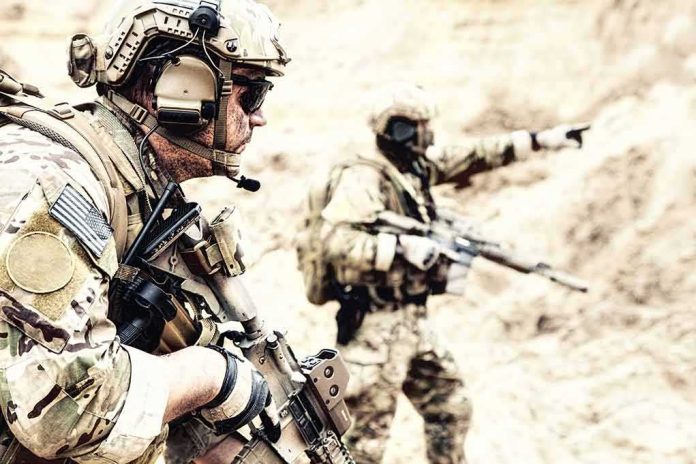
Washington is weighing U.S. military training for Syria’s army even as watchdogs tie those same forces to brutal attacks on minorities.
Story Snapshot
- U.S. discussions reportedly focus first on training Syrians in mine removal, not combat.
- Officials frame training as a way to shape Syria’s postwar security forces.
- Rights reports link Syrian security institutions to unlawful killings of Alawis and Druze.
- U.S. law bars training units credibly tied to gross rights abuses, raising vetting hurdles.
What Is Reported About The U.S. Plan
Reuters-based reports say the United States is considering its first training mission with Syria’s army since the Assad era ended. The initial focus would be mine clearance, not combat, and could involve coordination with several partner nations. The Times of Israel echoed that the talks involve a limited demining role at the outset. No formal U.S. document is public. There is no announced Pentagon order, State Department memo, or congressional notice tied to this proposal.
President Trump has said Syria should confront Hezbollah and suggested Syria could do better than Israel. Supporters see training as one way to build that capacity over time. The policy question is whether a technical mission like demining becomes a bridge to wider security cooperation. Critics warn that small missions can expand, pulling America deeper into a conflict without a clear end point. That risk, known as mission creep, is a familiar pattern in U.S. policy.
Why This Sparks Bipartisan Concern
United States law known as the “Leahy Laws” blocks training for any foreign unit when there is credible information of gross human rights abuses. The Congressional Research Service explains that both the State Department and the Department of Defense must vet units and individuals before assistance. If the proposal advances, U.S. agencies would need to screen Syrian trainees and their chains of command. Any unit linked to past atrocities would have to be excluded from help under the law.
Human rights reporting raises hard red flags. The United States Commission on International Religious Freedom’s 2026 report says Syrian transitional authorities failed to prevent or address mass killings and that security forces and the Interior and Defense ministries played a substantial role in unlawful killings of Alawis and Druze. An Associated Press summary of a United Nations-backed probe found widespread and systematic violence against Alawite civilians in Syria’s coastal region, including links to units folded into the new army.
What The Administration Says It Hopes To Gain
Supporters of the training idea argue that mine clearance saves lives and opens roads, farms, and towns. They say a training channel gives Washington leverage over how Syria’s forces act after the war, including border security and countering armed groups. They also point to President Trump’s push to shorten Israel’s costly fight with Hezbollah by shifting more pressure to regional actors. A narrow, skills-based mission could be a first step toward that approach if strict vetting holds.
That case runs into practical gaps. The public record does not show that Syria can or will fight Hezbollah at scale. The reporting describes discussions about demining, not a combat plan or a Syrian pledge to take on Hezbollah. There is no public framework detailing rules, funding, command oversight, or benchmarks. Without that, the policy reads as an early idea, not a settled program with guardrails and accountability built in.
Accountability And Guardrails That Would Be Required
To meet United States law, agencies would need to publish clear vetting steps, unit-by-unit eligibility, and a process to suspend aid if new evidence emerges. The State Department also documents a practice of withholding aid when credible information surfaces, and of tracking remediation if a government takes real steps to hold abusers to account. Any Syria plan would need those protections in writing before training starts.
Congress and the public will look for measurable results, not slogans. De-mining outputs, civilian casualty trends, and disciplinary actions after training are testable. So are hard exclusions of implicated units. Rights groups and minority communities will also judge whether cases from 2025–2026 move forward in courts. Without visible justice, training risks looking like a reward for impunity rather than a tool to protect civilians.
Bottom Line For Readers
The United States appears to be exploring a small, practical mission that could save lives and give Washington a seat at the table. The same plan also runs straight into documented massacres, weak accountability, and a legal wall that forbids aiding tainted units. Both conservatives and liberals who doubt Washington’s discipline see the danger: a quiet start, unclear end state, and partners with bloody records. Transparency, strict vetting, and public benchmarks would decide whether this helps or harms.
Sources:
zerohedge.com, efile.fara.gov, eur-lex.europa.eu, kurdistan24.net, uscirf.gov, state.gov, justsecurity.org