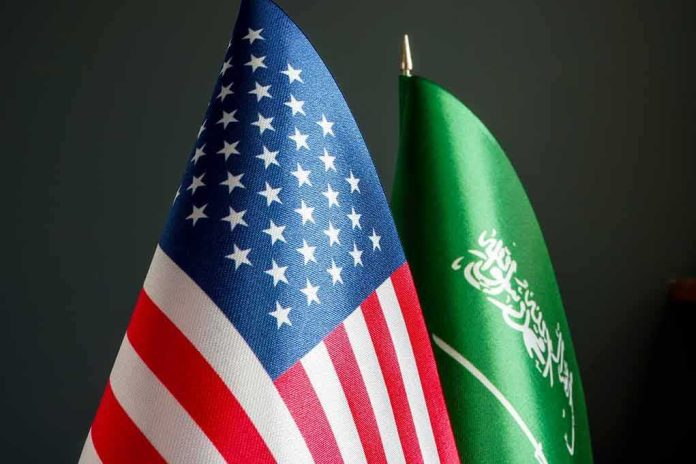
Washington’s new nuclear deal with Saudi Arabia gives a key U.S. ally a path to enrich uranium, raising big questions about who really benefits and how much risk America is willing to accept.
Story Snapshot
- The U.S.–Saudi pact creates a decades-long, multi‑billion‑dollar civilian nuclear partnership anchored by American companies.
- The agreement opens a conditional path for uranium enrichment on Saudi soil using U.S. technology and oversight.
- Supporters say U.S. control and inspections will protect against weapons use; critics see weaker guardrails than past deals.
- The deal could reshape Middle East power politics and deepen public distrust of “elite” deal‑making behind closed doors.
A Landmark Deal That Blends Business, Power, and Nuclear Risk
U.S. officials say the new nuclear cooperation agreement with Saudi Arabia will lock in a “decades‑long, multi‑billion‑dollar” partnership in civilian nuclear energy, with American firms as Riyadh’s preferred partners. The Energy Department describes the pact as a peaceful nuclear cooperation framework that gives U.S. companies a front‑row seat in building Saudi reactors and related infrastructure. For many Americans, this looks less like careful policy and more like another giant government‑brokered deal that favors big corporations over ordinary citizens.
Saudi leaders frame the deal as a way to diversify their energy mix, develop local industry, and move beyond oil. The agreement covers reactor technology, research, training, and investment, laying the foundation for a domestic nuclear sector in the kingdom. Backers say U.S. involvement will bring stricter safety rules than a Russian or Chinese deal and keep American influence strong in a region that feels more unstable every year. Still, many Americans on both the right and left worry that Washington keeps chasing foreign projects while problems at home grow worse.
The Enrichment Question: How Far Does Saudi Nuclear Power Go?
The most sensitive piece of the deal is uranium enrichment, the step that can produce fuel for power plants but also, at higher levels, material for nuclear weapons. Media reports and expert commentary say the arrangement could allow a U.S‑built enrichment facility in Saudi Arabia after a joint study, giving the kingdom a pathway to enrich fuel on its own soil. Supporters argue U.S. suppliers and oversight will limit how far enrichment can go and make it harder to cheat. Critics respond that once enrichment exists, the technical line between “peaceful” and “military” can be crossed faster than politicians admit.
Past agreements with other partners, like the United Arab Emirates, followed a “gold standard” model where the country agreed not to enrich uranium or reprocess spent fuel at all. By contrast, reporting on the Saudi framework says Washington is willing to relax some of those strict guardrails, trading tight limits for commercial access and strategic influence. Arms‑control advocates warn that these looser terms could encourage other regional players, including Iran and Turkey, to demand the same rights and launch a slow nuclear arms race. That fear resonates with Americans who already feel global rules bend for the rich and powerful while harsh standards fall on weaker states.
Nonproliferation Promises vs. Deep State Suspicion
The White House and Energy Department insist the pact will follow “strong nonproliferation standards,” saying U.S. participation and international inspections will keep Saudi activities peaceful. A separate bilateral safeguards agreement, announced alongside the main deal, is supposed to define how facilities are monitored and how violations would be handled. Officials argue that if Saudi Arabia turned toward weapons use, the United States could cut off cooperation and pressure others to do the same. They present the deal as a way to bind Saudi nuclear plans inside a U.S.‑led rules system instead of leaving them to Russia or China.
Yet major questions remain because the full text of the agreement and its safeguards annexes are not public. That secrecy lets critics claim Washington is “removing guardrails” that used to apply, and it feeds the broader belief that key choices are made by a small circle of elites far from public view. Members of Congress, including some Republicans, have already voiced concern that the deal could weaken U.S. nonproliferation policy and set a dangerous precedent in the Middle East. For Americans who distrust both parties’ leadership, this looks like another example of leaders cutting quiet deals overseas while citizens see only the risks if things go wrong.
Regional Fallout: Israel, Iran, and a Shifting Balance of Power
The U.S.–Saudi nuclear pact lands in a region already tense over Iran’s nuclear work and stalled peace efforts. Analysts say the United States is trying to link nuclear cooperation, security promises, and a path toward a Palestinian state to encourage Saudi Arabia to normalize ties with Israel. That means nuclear technology is now tied directly to high‑stakes diplomacy, where every side fears being outmaneuvered. Israeli and regional voices warn that Saudi enrichment, even under U.S. watch, could push Iran to respond in kind and erode what remains of earlier nonproliferation deals.
🚨🇺🇸 US: “We won’t let Iran make nukes!”
🇮🇷 Iran: “Our program is only for civilian energy & medical use. We never wanted nukes.”
🇺🇸 US: Signs nuclear deal with Saudi Arabia for “civilian” use…
🇮🇷 Iran: Same right for Saudi = fine.
Same right for Iran = threat. pic.twitter.com/GUBF0Xc6gm— News 24X7 (@AlexReportsUS) July 27, 2026
For Americans across the political spectrum, the bigger worry is pattern, not just policy details. Washington once went to the brink of war to stop Iran’s enrichment, yet now is blessing a path for Saudi Arabia under softer rules. That double standard makes it easy to see the deal as driven by oil wealth, arms sales, and elite ties rather than by clear principles. Many citizens already feel the federal government serves global corporations and foreign partners first, while middle‑class families face rising costs, weak wages, and fading trust. This nuclear deal, whatever its technical merits, plugs straight into that frustration and into growing doubts about whether anyone in power is still guarding the long‑term safety of the American people.
Sources:
youtube.com, time.com, wsj.com, armscontrol.org, washingtonpost.com, ans.org, cfr.org, reuters.com, energypolicy.columbia.edu, thebreakthrough.org