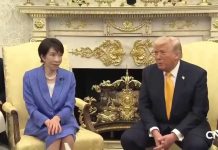

Trump’s unprecedented economic blackmail over Greenland has exposed Europe’s dangerous willingness to appease rather than defend sovereignty, with German Chancellor Merz prioritizing “dialogue” over the decisive retaliation needed to stop this assault on Western allies.
Story Highlights
- Trump threatens 10% tariffs on eight European nations to force Greenland acquisition by February 1
- German Chancellor Merz calls for “dialogue” instead of immediate retaliation against economic coercion
- European markets plummet as investors react to unprecedented territorial extortion tactics
- EU holds €93 billion retaliation package in reserve while prioritizing appeasement strategy
Trump’s Greenland Gambit Exposes European Weakness
President Trump delivered a direct ultimatum to eight European nations Saturday, threatening 10% tariffs effective February 1 unless they facilitate America’s acquisition of Greenland. The targeted countries—Denmark, Sweden, Norway, France, Germany, Netherlands, Finland, and the UK—face these additional levies on top of existing 15% tariffs already crushing their export-dependent economies. This represents the boldest assertion of American economic dominance since Trump’s return to office, using tariff leverage to achieve territorial objectives that traditional diplomacy has failed to secure.
European markets immediately recognized the severity of Trump’s threat, with major indices collapsing Monday morning. Germany’s DAX dropped 1.02%, France’s CAC 40 slipped 1.28%, and Italy’s FTSE MIB slid 1.43%, while the broader STOXX 600 fell 0.87%. These declines reflect investor understanding that Europe’s export-dependent economies cannot withstand prolonged tariff warfare, particularly Germany which remains “still reeling from the impact of last year’s so-called reciprocal tariffs.” The market’s swift reaction demonstrates the credible threat Trump’s economic pressure represents to European prosperity.
Merz Chooses Dialogue Over Deterrence
German Chancellor Friedrich Merz responded Monday with calls for de-escalation, stating “We want to avoid any escalation in this dispute if at all possible” and “We simply want to try to resolve this problem together.” While acknowledging Europe’s capacity for retaliation, Merz emphasized diplomatic solutions over immediate countermeasures. His approach reflects the EU’s Sunday agreement prioritizing dialogue despite possessing a €93 billion retaliation package ready for deployment. This measured response may encourage further American pressure by signaling European reluctance to defend their economic interests decisively.
The European Parliament adopted a more confrontational stance, with President Manfred Weber declaring trade deal approval “not possible at this stage” given Trump’s Greenland threats. EU lawmakers called to suspend the existing EU-US trade agreement, representing significant pushback against American economic coercion. However, this parliamentary resistance remains symbolic without executive action from European leaders who continue prioritizing negotiation over retaliation. The disconnect between legislative anger and executive appeasement reveals internal European divisions that Trump can exploit.
Strategic Implications of Arctic Competition
Trump’s Greenland demand reflects broader American strategic interests in Arctic resources and geopolitical positioning against Chinese and Russian expansion. Greenland’s semi-autonomous status under Danish sovereignty provides significant mineral wealth and strategic military positioning that enhances American Arctic dominance. The February 1 deadline creates immediate pressure on European leaders to choose between territorial sovereignty and economic stability, forcing decisions that will define transatlantic relationships for decades. Europe’s willingness to negotiate over territorial integrity sets dangerous precedents for future American territorial ambitions.
The EU’s never-before-used anti-coercion instrument, adopted in 2023 specifically for situations like this, remains unused as European leaders prioritize diplomacy over deterrence. Merz’s planned meeting with Trump at Davos represents Europe’s preferred path forward, seeking negotiated solutions rather than demonstrating resolve through economic retaliation. This approach may prove catastrophic if Trump interprets European restraint as weakness, encouraging additional territorial demands or economic coercion campaigns against traditional American allies who refuse to defend their fundamental interests.
Sources:
Europe wants to ‘avoid escalation’ with US over Greenland, says Merz