

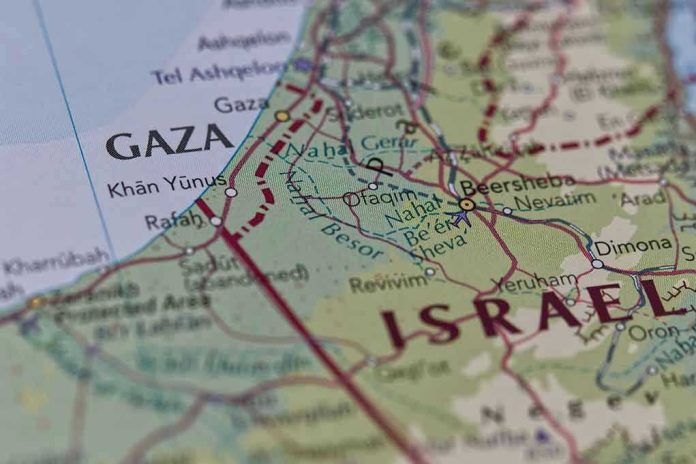
A new U.S. policy reshapes Gaza’s future, igniting skepticism and cautious hope among Palestinians.
Story Overview
- President Trump’s 20-point plan aims to resolve the Gaza conflict.
- The newly formed Board of Peace faces skepticism from Gazans.
- Hamas agrees to some terms but remains defiant on disarmament.
- International community cautiously optimistic about peace efforts.
Trump’s Ambitious Peace Plan for Gaza
President Donald Trump has launched a comprehensive 20-point peace plan aimed at ending the ongoing conflict in Gaza. Announced in September 2025, this plan involves the creation of a Board of Peace, designed to oversee transitional governance, demilitarization, and the reconstruction of Gaza. The initiative is part of a larger effort to stabilize the region and ensure lasting peace, with significant international backing, including a UN Security Council endorsement.
The Board of Peace, central to Trump’s strategy, includes a committee of Palestinian technocrats to manage day-to-day governance in Gaza. Appointed key figures like Aryeh Lightstone and Nickolay Mladenov are tasked with advising on strategy and operations. However, the plan faces resistance from Hamas, which, while agreeing to some terms, refuses to fully disarm, casting uncertainty on the peace process.
Challenges and Skepticism from the Ground
Despite international support, the plan is met with skepticism from many Gazans. Concerns arise over its ability to address the realities on the ground, given the region’s division and ongoing violence. Critics argue that the plan might be more performative than practical, as it struggles to reconcile with local dynamics and Hamas’s persistent influence. The plan’s success hinges on the delicate balance of power and cooperation among key stakeholders.
The political dynamics in Israel further complicate the situation. Prime Minister Benjamin Netanyahu endorses the plan but faces pressure from domestic extremists wary of concessions to Palestinians. The U.S. and Israel’s strategic interests align, yet the path to peace remains fraught with challenges, particularly as Hamas retains significant power.
Path Forward: Hope and Uncertainty
The Board of Peace’s formation marks a significant step in implementing Trump’s vision for Gaza. The international community, including mediators from Egypt, Qatar, and Turkey, plays a crucial role in facilitating dialogue and ensuring the plan’s execution. Despite the hurdles, there is cautious optimism that this initiative could pave the way for sustained reconstruction and stability in Gaza.
As the Board of Peace moves forward, its ability to effectively govern and stabilize Gaza will be closely watched. Success in this endeavor could redefine the region’s future, offering a template for peace and cooperation in other conflict zones. However, the true test will be in overcoming entrenched distrust and achieving tangible progress on the ground.