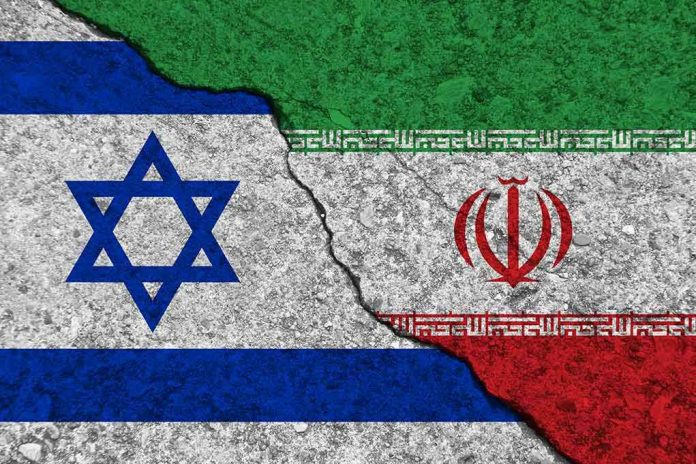
Iran’s drive to surround Israel with missiles and proxy militias has erupted into open war, forcing Trump’s America to choose between deterrence and another endless Middle East quagmire.
Story Snapshot
- Iran’s nuclear and missile buildup, plus its “Axis of Resistance,” has made it Israel’s most dangerous state-level enemy.
- The June 2025 Twelve‑Day War saw direct Israel–Iran combat and U.S. strikes on hardened Iranian nuclear sites.
- Iranian proxies from Lebanon to Yemen continue threatening Israel, U.S. troops, and global shipping lanes.
- Mass unrest inside Iran in 2026 collides with Israeli planning for new strikes, raising risk of wider conflict.
How Iran Became Israel’s Chief State-Level Threat
Since the 1979 Islamic Revolution, Iran’s regime has defined itself by hostility to Israel, slowly building a network of armed proxies and a nuclear infrastructure that now make it Jerusalem’s top state-level threat. From Hezbollah rockets in Lebanon to Hamas and Palestinian Islamic Jihad in Gaza, to Iraqi militias and Yemen’s Houthis, Tehran has spent decades ring‑fencing Israel with groups armed, trained, or inspired by the Islamic Revolutionary Guard Corps. That patient strategy now underpins every major escalation in the region.
Iran’s nuclear facilities at Natanz, Fordow, Arak, and Isfahan gave the regime leverage over the West while alarming Israeli planners who view a nuclear‑armed Tehran as an existential danger, not a distant possibility. Long before open war, Israel and Iran fought a “shadow war” of cyberattacks, assassinations, and covert strikes. Israel targeted nuclear scientists and weapons depots, while Iran shipped rockets and precision‑guided munitions to its proxies, probing for weak spots in Israel’s layered missile defenses and Washington’s willingness to respond.
From Proxy Confrontation to Open Iran–Israel War
Years of Gaza conflicts and Hezbollah rocket flare‑ups laid the groundwork for direct clashes. After a brutal Gaza war from 2023 onward, Hezbollah opened a northern front, Houthis attacked Red Sea shipping, and Iraqi and Syrian militias harassed U.S. forces, all under Iran’s “Axis of Resistance” banner. The game changed on April 1, 2024, when Israel struck Iran’s consulate in Damascus, killing senior IRGC officers and triggering Iran’s first overt missile‑drone barrage directly against Israeli territory.
Through mid and late 2024, tit‑for‑tat escalations intensified. Israel reportedly assassinated Hamas political leader Ismail Haniyeh in Tehran and later Hezbollah chief Hassan Nasrallah and senior IRGC commander Abbas Nilforoushan in Lebanon, signaling that no Iranian proxy commander was beyond reach. Iran answered with missile strikes on Israel that October, while Israeli attacks allegedly degraded parts of Tehran’s advanced S‑300 air defenses, opening theoretical corridors for deeper raids into Iranian airspace and its hardened nuclear infrastructure.
The Twelve‑Day War and Trump’s Calculus
On June 13, 2025, Israel launched a sweeping air and missile campaign on Iranian nuclear and military targets, initiating the Twelve‑Day Iran–Israel War. Iran responded by firing ballistic missiles at Israeli cities and strategic infrastructure, forcing Israeli civilians back into bomb shelters and testing missile defenses. For American conservatives who remember the Obama‑Biden era’s deference to Tehran, the barrage underscored why “engagement first” diplomacy had failed to restrain a regime willing to risk regional war.
By June 21, the United States directly entered the conflict, with Trump‑era forces striking Iranian nuclear facilities at Natanz, Isfahan, and Fordow using bombers and cruise missiles. Washington and Jerusalem later said these operations severely damaged Iran’s nuclear and missile capabilities, though outside analysts questioned whether the blow was permanent. For many on the right, the message still mattered: instead of pallets of cash and weak red lines, American power was used to back an ally and punish a regime that had targeted U.S. troops and partners for years.
Aftermath: Proxies, Protests, and the Next Flashpoint
When the guns fell mostly silent after twelve days, there was no formal peace—just a fragile halt in large‑scale fire. Iran’s nuclear program was battered but not erased, and its network of proxies from Hezbollah remnants to Houthis and Iraqi militias remained active, if disrupted. Tehran leaned harder on these non‑state partners to reassert influence, even as Israeli and U.S. planners studied how to keep pressure on Iran’s dispersed missile sites without being dragged into a sustained occupation or another open‑ended nation‑building fiasco.
Inside Iran, economic crisis and war damage helped ignite massive protests by early January 2026, spreading across major cities including Tehran. Demonstrators angry over inflation, repression, and the regime’s foreign adventurism challenged clerical authority, while Iran’s leaders worried that renewed confrontation with Israel could deepen instability. At the same time, Israel’s security cabinet authorized “Operation Iron Strike,” preparing additional options against Iranian targets. That combination of domestic unrest, proxy activity, and war planning keeps the region on a knife’s edge.
What This Means for America Under Trump
For Americans who value strong borders, fiscal sanity, and peace through strength, the Iran–Israel showdown is a stark reminder that weakness invites aggression. Past U.S. policies that freed up Iranian cash while downplaying missile tests and proxy attacks did not buy stability; they helped finance the very network now threatening Israel, U.S. forces, and global trade routes. Today’s Trump administration faces a tougher but clearer choice: deter Tehran decisively, or watch a hostile regime test America’s resolve far from our own secure energy independence.
Going forward, Iran’s likely move is to harden, disperse, and partially rebuild its nuclear and missile programs, while doubling down on proxies that can bleed Israel and harass U.S. assets without always triggering direct retaliation. That strategy is designed to outlast Western election cycles and exploit any return to appeasement‑minded globalism. For constitutional conservatives, the stakes are simple: stand firmly with Israel’s right to self‑defense, maintain American strength without reckless occupations, and refuse to bankroll or normalize a regime that openly seeks the destruction of a key ally.
Sources:
A timeline of the Iran–Israel war
The road to the Israel–Iran war
Confrontation between the United States and Iran
New Year’s 2026 Unrest in Iran in the Context of Israel and the Middle East