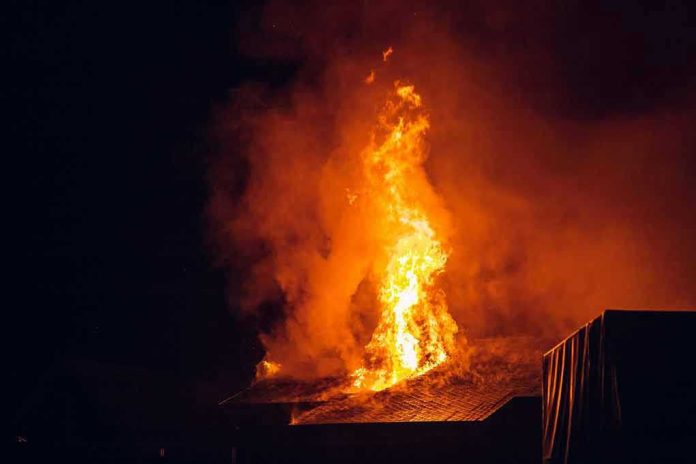
Turkmenistan’s “Gate to Hell” – a Soviet-era blunder wasting precious natural gas for over 50 years – is finally dimming, reminding us how centralized government overreach leads to decades of inefficiency and lost resources.
Story Highlights
- Soviet drilling in 1971 collapsed the ground into a massive crater, ignited to burn off gas but raging uncontrolled for half a century.
- Turkmen authorities report a threefold reduction in flames by 2025 through new methane-capture wells, addressing economic waste and emissions.
- The site draws global tourists despite the nation’s closed borders, clashing with state efforts to extinguish it for health and revenue reasons.
- Symbol of authoritarian mismanagement: limited records and independent verification highlight risks of opaque state control over resources.
Soviet Drilling Disaster Ignites Perpetual Inferno
Soviet engineers drilled in Turkmenistan’s Karakum Desert near Darvaza village around 1971. The rig punctured a subsurface natural-gas cavern, causing the ground to collapse and form a crater roughly 70 meters wide and 20 meters deep. To prevent poisonous methane release, they ignited the escaping gas, expecting it to burn off in days or weeks. The reservoir proved vastly larger, fueling flames for over 50 years and creating a glowing spectacle visible for miles at night.
Government Efforts to Tame the Flames
President Gurbanguly Berdimuhamedow ordered measures in 2010 to limit the crater’s impact on nearby gas fields. In January 2022, he directed officials to extinguish it, citing health hazards to residents, environmental damage from emissions, and economic losses from burned marketable gas. A commission formed to explore solutions. By 2025, Turkmengaz drilled wells around the site to capture methane, depressurizing the reservoir and reducing fire size and intensity nearly threefold.
Turkmengaz director Irina Luryeva announced this progress at an Ashgabat hydrocarbon conference. Officials stated the crater is finally starting to burn out, though it remains active with fewer, smaller flames. Independent verification stays scarce due to Turkmenistan’s tight information controls.
Stakeholders Clash Over Economic and Environmental Priorities
State-owned Turkmengaz manages gas fields and leads technical interventions to recover lost resources. Local Darvaza residents, numbering about 350, face emission health risks but gain from tourism guiding and trade. Adventure tourists flock despite visa restrictions, drawn to the “Door to Hell” – locally named for its fiery pit, officially “Shining of Karakum.” Scientists study its geology and extremophile microbes, as in George Kourounis’s 2013 descent.
The authoritarian government dominates decisions, prioritizing gas monetization and emission cuts over tourism. This mirrors conservative concerns with inefficient state resource handling, where centralized control wastes potential revenue while locals bear costs. Tourism operators push to preserve the spectacle, conflicting with official economic goals.
Impacts of Dimming Flames on Economy and Environment
Short-term, methane capture recovers wasted gas for export or use, boosting energy sector gains and improving local air quality by curbing combustion products like CO2 and NOx. Tourism may dip if the dramatic glow fades, shifting focus from inferno to geological site. Long-term, full extinction eliminates a chronic emitter, aligning with global methane reduction while ending a symbol of Soviet wastefulness.
Local communities could see health benefits but risk tourism income loss. For energy-rich Turkmenistan, success demonstrates resource competence, though opaque reporting limits trust. This case underscores value in efficient energy stewardship over prolonged government inaction.
Sources:
https://en.wikipedia.org/wiki/Darvaza_gas_crater
https://www.discoverwildlife.com/environment/darvaza-gas-crater-turkmenistan
https://www.livescience.com/turkmenistan-gates-of-hell-finally-closed
https://www.atlasobscura.com/places/the-gates-of-hell-turkmenistan