

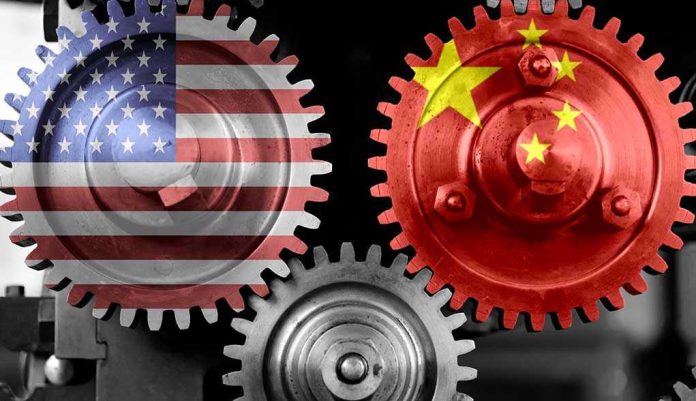
A new policy threatens American technological dominance, as China continues to secure advanced semiconductors despite U.S. restrictions.
Story Overview
- China finds ways around U.S. export controls to obtain cutting-edge technology.
- Trump administration modifies some restrictions, impacting U.S.-China tech rivalry.
- China implements state-supported strategies to advance its semiconductor industry.
- U.S. firms face economic consequences due to restricted access to Chinese markets.
China’s Continued Access to U.S. Technology
Despite rigorous U.S. export controls aimed at limiting China’s access to advanced technology, China persists in obtaining critical semiconductors. The country employs strategies such as exploiting loopholes, using third-country intermediaries, and leveraging robust state-backed industrial policies. As a result, China continues to strengthen its semiconductor capabilities, raising concerns among U.S. policymakers about the effectiveness of these restrictions.
The Trump administration, responding to both domestic and international pressures, has adjusted some of the export restrictions initially set by the previous administration. These adjustments include easing certain restrictions on AI chip exports, which were thought to disadvantage allies and domestic firms reliant on the Chinese market. This recalibration highlights the ongoing complexity of the U.S.-China tech rivalry.
China’s Strategic Adaptations
China has ramped up its efforts to achieve technological self-reliance, investing heavily in domestic semiconductor research and development. The government’s substantial subsidies and support for local industries have enabled Chinese firms to develop alternative solutions and reduce dependency on foreign technology. For instance, Chinese companies are turning to open-source architectures like RISC-V, which bypass traditional proprietary systems, to advance their technological capabilities.
Despite these advancements, China’s semiconductor industry still lags behind in cutting-edge technology, such as advanced EUV lithography. However, the continued progress in domestic production and design capabilities demonstrates China’s resilience in the face of international pressure and its commitment to overcoming technological barriers imposed by the U.S.
Impact on U.S. Industries and Global Tech Landscape
The restrictions on technology transfers to China have led to significant economic implications for U.S. and allied firms. Companies like Nvidia and Intel, which have previously generated substantial revenue from the Chinese market, now face reduced sales and potential setbacks in research and development due to limited market access. Additionally, global supply chains experience disruptions as firms seek alternative production routes and markets.
The technological bifurcation between the U.S. and China continues to grow, with each country developing parallel ecosystems. While U.S. controls aim to maintain a technological edge, China’s strategic adaptations suggest that the gap may narrow over time. This ongoing rivalry not only affects economic and technological landscapes but also has broader implications for global security and geopolitical dynamics.
Sources:
New U.S. Restrictions on Transfers to China for Semiconductor and Advanced Computing Uses
Chinese Semiconductor Industrial Policy: Past and Present
Billion Dollar Chip Wars Between the U.S. and China
The US-China Chip War in Dates
Limits of Chip Export Controls: Meeting the China Challenge
The Evolution of China’s Semiconductor Industry Under U.S. Export Controls